April 6, 2016 by Theo Jung

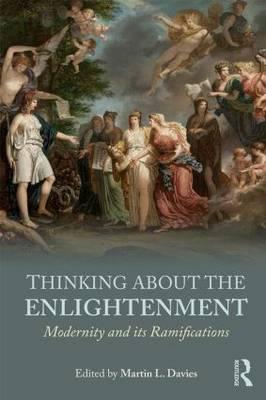
The volume Thinking about the Enlightenment: Modernity and its Ramifications, edited by Martin L. Davies of Leicester University has now been published by Routledge.
My chapter,
Multiple Counter-Enlightenments: The Genealogy of a Polemics from the Eighteenth Century to the Present
the penultimate in a very diverse series of perspectives on the various dimensions of the relationship between Enlightenment and the present, takes up the issue of counter-enlightenment(s). It asks how various criticisms of ‘the’ Enlightenment gradually came to be viewed as constituting a singular tradition of thought, constitutive of Western reflection upon or own place in history.
[Edit: The text is now available online here.]
Volume Introduction
Thinking about the Enlightenment looks beyond the current parameters of studying the Enlightenment, to the issues that can be understood by reflecting on the period in a broader context. Each of the thirteen original chapters, by an international and interdisciplinary team of contributors, illustrates the problematic legacy of the Enlightenment and the continued ramifications of its thinking to consider whether modernity can see its roots in the intellectual revolution of the seventeenth and eighteenth centuries.
Drawing from history, philosophy, literature and anthropology, this book enables students and academics alike to take a fresh look at the Enlightenment and its legacy.
Posted in Publications | Tagged Counter-Enlightenment, Eighteenth Century, Enlightenment, Martin L. Davies, Publication, Routledge | 1 Comment »
April 3, 2016 by Theo Jung
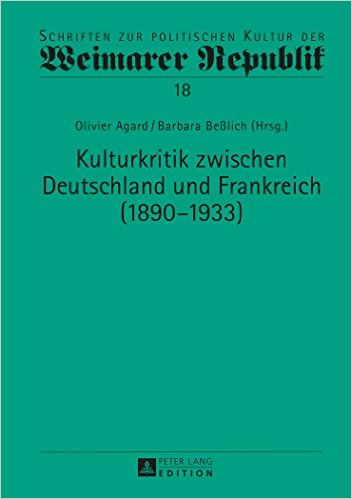
The proceedings of a conference I attended two years ago in Heidelberg have been published as volume 18 in the series Schriften zur politischen Kultur der Weimarer Republik by Peter Lang.

My own contribution, titled
Eine “Klage, die so alt ist, als die Geschichte”? Dimensionen des Wandels im Diskurs der modernen Kulturkritik
(A “Complaint as old as History itself”? Dimensions of Change in the Discourse of Modern Cultural Criticism)
develops an analytical model to describe four dimensions of change in the modern discourse of cultural criticism since the late eighteenth century.
[EDIT: the text is now available online here.]
Click here for the volume’s contents, a short introductory text, part of the introduction and the publisher’s page.
Posted in Publications | Tagged Article, Cultural Criticism, Heidelberg, History, Temporalization | 1 Comment »
March 27, 2016 by Theo Jung
On April 6 to 7, I will participate in a conference organized by the History of Parliament research group in cooperation with Prof. Christopher Reid of Queen Mary University London.
The conference program may be found here.
My own paper, titled
“A Rhetoric of Silence: Silent Members in the July Monarchy Chamber of Deputies (1830-1848)”,
will be concerned with the rhetorical role of the silent members in the parliamentary debates of the July Monarchy. As I will argue, these silent members were anything but passive. Rather, they developed a complex rhetoric of their own, playing a significant role in the development of debates.

Posted in Conference | Tagged Conference, France, July Monarchy, London, Nineteenth Century, Parliament, Politics, Rhetoric, Silence | Leave a Comment »
January 3, 2016 by Theo Jung
In January of 2014, a group of colleagues from the Freiburg history department and I founded the ‘Reading Workshop History and Theory’ (Lektürewerkstatt Geschichte und Theorie). Its aim is to bring together scholars and students from all disciplines of the humanities with an interest in the theoretical basis of their respective fields.
Starting point was the observation that although the necessity to coordinate theoretical reflection and empirical research is often stressed, in practice the links between the two aspects are often neglected. The reading workshop confronts this weakness by providing an informal forum for rigorous discussion of the theoretical foundations of research in the humanities.
Two years onward, we have been discussing a wide variety of themes, such as:
- Postcolonialism
- Walter Benjamin
- Niklas Luhmann
- Spatial turn
- Carl Schmitt
- Actor-Network-Theory
- Paul Ricœur
- Max Weber
- Michel Foucault
- … and many others
Since this is a self-organized group and not an official teaching course, we are flexible with regard to themes, dates as well as to the form of discussion.
Anyone in the Freiburg area – from the first semester student up to the PhD and beyond – interested in joining is cordially invited to send an email to: geschichteundtheorie@gmail.com.
Our poster:

Posted in Teaching | Tagged Discussion, Freiburg, History, Humanities, Theory, Workshop | Leave a Comment »
October 12, 2015 by Theo Jung
The conference proceedings of a workshop I participated in two years ago have now been published under the title:
Denis Diderot und die Macht / Denis Diderot et le pouvoir
My own contribution considers Diderot’s discussion of power, sexuality and colonial rule in the Supplément au voyage de Bougainville and is titled
Stimmen der Natur. Diderot, Tahiti und der homme naturel
Voices of Nature. Diderot, Tahiti and the homme naturel
Summary (in German):
Im Supplément au voyage de Bougainville setzt sich Diderot am Beispiel Tahitis mit Fragen der Macht, der Sexualität und der Kolonialherrschaft auseinander. Der Text gilt als Paradebeispiel für die exotistische Verklärung eines fremden Naturvolkes als Kontrastbild zur Verkommenheit abendländischer Zivilisation. Und tatsächlich gibt es Stimmen im Text, die einer solchen Idealisierung und einem ‚Zurück zur Natur’ das Wort reden. Aber es gibt auch andere. Erst die Auflösung der Stimmenvielfalt des Textes zugunsten der Identifikation einer eindeutigen Grundaussage lässt bestimmte Äußerungen im Text als Elemente einer systematischen ‚Naturtheorie‘ Diderots erscheinen. Jedoch muss eine solche Lesart nicht nur eine konstitutive Ebene des Textes – seine multiperspektivische Form – außer Acht lassen, sie verstrickt sich auch auf inhaltlicher Ebene in Widersprüche. In diesem Beitrag wird versucht, die verschiedenen Positionen im Text in ihrem Zusammenhang zu betrachten. Aus diesem Blickwinkel zeigt sich, dass Diderot sich keineswegs als autoritatives Sprachrohr der Natur aufführt. Im Gegenteil. Indem er die Vielfalt der Stimmen, die sich auf die ‚natürliche’ Ordnung als Legitimitätsbasis ihrer jeweiligen Autorität beziehen, miteinander kontrastiert, zeigt er performativ, was es heißt, sich auf die Veränderlichkeit der Natur einzulassen, ohne den Anspruch zu erheben, sie ein für alle Mal festlegen zu können.
I’m very grateful to the volume’s editor, PD Dr. Isabelle Deflers and the team at the Frankreichzentrum (Center for French Studies) of Freiburg University for making this publication possible.
Edit: A digital file of the article has now been made available here.

Posted in Publications | Tagged Diderot, Eighteenth Century, Exotism, France, Nature, Power, Sexuality, Tahiti | 1 Comment »
September 27, 2015 by Theo Jung
Summer break is coming to an end and soon the winter term will start again. As usual, I will be offering an intensive ‘Seminar’ course as well as a smaller ‘Übung’ or reading course.
The Fourth Estate: Press and Politics in Germany and France (1789-1914)
Whereas the constitutive role of the press in any well-functioning democracy stands beyond doubt today, at the same time its power in modern ‘mediocracies’ is often the target of criticism. The origins of this tension lie in the 19th century – when the press developed an unprecedented importance to political processes. In this seminar, these developments are traced from a comparative viewpoint, focusing on the French and German cases.
The Power of Language: Introduction to Historical Semantics
Since the emergence of the so-called ‘linguistic turn’ in the 1970s a variety of new theoretical and methodological approaches in the field of historiography have stressed the role of language not only as an indicator, but also as a factor in historical processes. This reading course offers an introduction to the different theoretical research models developped in this context as well as to their empirical results.
Posted in Teaching | Tagged France, Germany, Historical Semantics, Historiography, Nineteenth Century, Press, Teaching | Leave a Comment »
September 14, 2015 by Theo Jung
Next week, 24 and 25 September, I’ll be participating in a workshop held in Marburg, titled:
Aristokratismus. Historische und literarische Semantik von ‘Adel’ zwischen Kulturkritik der Jahrhundertwende und Nationalsozialismus (1890-1945).
Aristocratism. Historical and Literary Semantics of ‘Aristocracy’ between Cultural Criticism of the Turn of the Century and National Socialism (1890-1945)
The workshop is part of a DFG-funded research project on the same theme and is organized by Prof. Dr. Eckart Conze, PD Dr. Jochen Strobel, Daniel Thiel und Jan de Vries.
My paper pursues a diachronic comparison of German discourses of cultural criticism around 1800 and around 1900, focussing on the differences in the use of semantics of aristocracy in these contexts. Thus, the paper offers an empirical case study using a model distinguishing between four dimensions of change in the history of cultural criticism I formulated last year on a conference in Heidelberg (soon to be published in its proceedings).
The Call for Papers for the Marburg workshop may be found here.
Posted in Conference, Presentation | Tagged Aristocracy, Conference, Eighteenth Century, Germany, Historical Semantics, History, Marburg, Nineteenth Century, Presentation, Workshop | 1 Comment »
August 28, 2015 by Theo Jung
Next week, I will be presenting a paper at an academic workshop organized by Juri Auderset, Andreas Behr, Philipp Müller and Aline Steinbrecher at the University of Fribourg (CH). The workshop’s topic is “Zeiterfahrung. Untersuchungen über Beschleunigung und Entschleunigung von Geschichte” (Temporal Experience: Studies on Acceleration and Deceleration in History). It’s ultimate goal is to prepare a special issue of the journal Traverse: Zeitschrift für Geschichte in 2016.
The topic of my paper is the variety of discourses of acceleration in nineteenth century germany. Considering the influential views of accelleration formulated by Hartmut Rosa and Reinhart Koselleck in terms of attempts at a general temporal theory of modernization, the paper points to the method of Historical Semantics as a way to more fruitfully consider the plurality of experiences and discourses of temporality in this period. Instead of searching for a single, specific temporality of the modern era, the paper argues for a differentiated view of the pluriform ways in which contemporaries experienced the temporal nature of their own present.
See here for the call for fapers and here for the workshop’s program.
Posted in Conference, Presentation | Tagged Acceleration, Conference, Discourse, Fribourg, Germany, Historical Semantics, Nineteenth Century, Temporalization, Time, Traverse, Workshop | Leave a Comment »
May 22, 2015 by Theo Jung
On 9 and 10 July, I will be participating in a workshop in Berlin, organized by the DFG research network Auditory Knowledge in Transition. The workshop’s title is “Auditory Knowledge in Politics: The Sound of Power and the Power of Sounds”.
A keynote lecture by professor Monika Dommann of Zürich University with the title “Record, Rewind, Rewrite? Eine akustische Geschichtsschreibung der Presidential Tapes” will be held on Thursday July 9th, at 6 PM at the Seminarzentrum Silberlaube Otto-von-Simson-Straße 26 (Raum L 116). All are welcome.
I myself will comment upon a paper presented by my friend Daniel Morat of the Free University of Berlin.

Posted in Conference | Tagged Auditory Knowledge, Berlin, DFG, History, Politics, Sound, Workshop | Leave a Comment »
May 14, 2015 by Theo Jung
Last week (May 7-8), I participated in an international conference titled “Parlamentarismuskritik und Antiparlamentarismus in Europa” [Criticism of Parliamentarism and Anti-Parliamentarism], organized by the German Kommission für Geschichte des Parlamentarismus and EuParl.net, a European research network on the history of parliaments.

Besides a keynote speech by Dr. Norbert Lammert, speaker of the German Bundestag, I had the opportunity to discuss the varieties and modes of criticism of parliament and parliamentarism with a number of renowned experts in the field. My own presentation focussed on the question to what extent antiparliamentary sentiments and discourses current in the German Empire found their way into the ‘lion’s den’, the Reichstag itself. Combining qualitative and quantitative methods of analysis, I attempted to shed some new light on a few famous cases of antiparliamentary discourse in the imperial parliament as well as on their wider relevance for its political culture and modes of communication.
The conference’s program may be found here. A publication of the proceedings is planned.

Posted in Presentation | Tagged Antiparliamentarism, Berlin, Conference, EuParl.net, KGParl, Parliament, Politics, Presentation | Leave a Comment »
« Newer Posts - Older Posts »