Feeds:
Posts
Comments

Posts Tagged ‘History’

In the new year, I will be presenting my research in various contexts.

On January 16, I will present my current research project (Habilitation) in the research colloquium of Prof. Dr. Paul Nolte at the Freie Universität Berlin. The title of my presentation will be:

Politisches Schweigen: Sprachspiele an den Grenzen politischer Kommunikation, ca. 1815–1920.
(Political Silence: Language Games on the Edges of Political Communication, ca. 1815-1920).

One week later, on the 24th and 25th of January, I will participate in a workshop titled Kulturkritik zwischen Frankreich und Deutschland (1860-1933): Schreibweisen zwischen Wissenschaft und Dichtung organized by Prof. Dr. Barbara Beßlich, PD Dr. Olivier Agard and Prof. Dr. Gérard Raulet at Heidelberg University. My presentation (to be held on Friday, January 24 at 10:15) will be titled:

Eine ‘Klage, die so alt ist, als die Geschichte’? Kulturkritik um 1800 und 1900 im diachronen Vergleich.
(A ‘Complaint, as Old as History Itself’? Kulturkritik Around 1800 and 1900 Compared).

Finally, I will participate in a conference titled Die Geschichtlichkeit kollektiver Vorstellungen: Historische Semantik und Soziologie, to be held in Lüneburg from 13 to 15 February, organized by the section Sociology of Culture of the German Society for Sociology. My paper (to be held on Saturday at 11:45) is titled:

Beschleunigung: theoretische und empirische Perspektiven auf eine Kategorie der Moderne.
(Acceleration: Theoretical and Empirical Perspectives on a Category of Modernity).

Read Full Post »

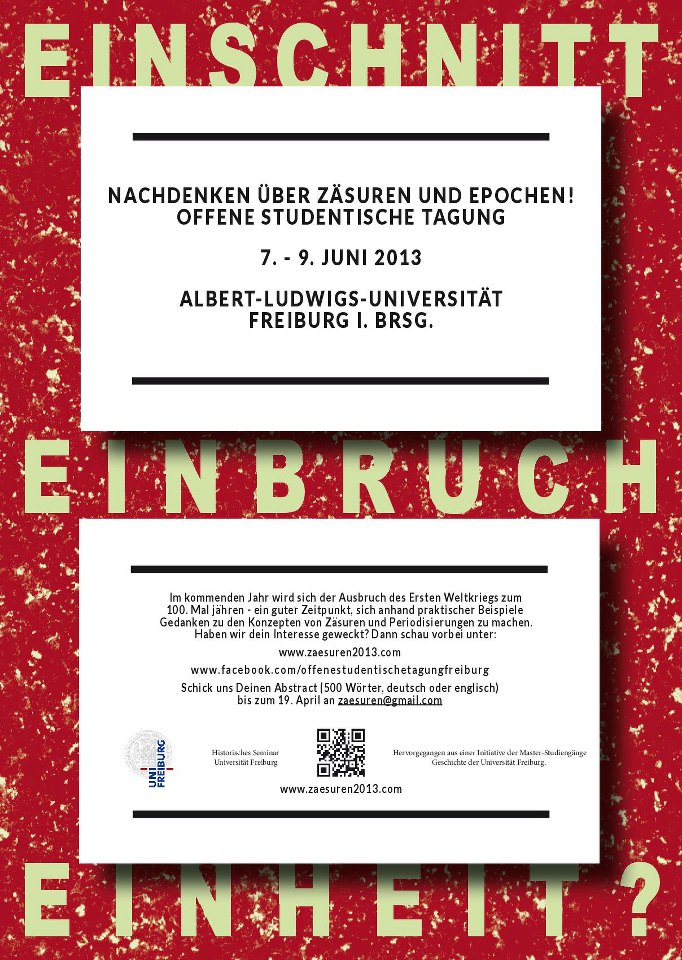
On the 8th of June, I will be presenting an ‘introductory lecture’ on problems of periodization within the framework of the student-organized conference

“Einschnitt – Einbruch – Einheit? Nachdenken über Zäsuren und Epochen”
(“Incision – Incursion – Unity? Thinking about Caesuras and Epochs”)

held at Freiburg University.

Taking the history of periodization as well as its current ‘state of the art’ within the humanities as my point of departure, I will try to give an overview over the major questions and controversies currently under discussion in this field.

For more information on this conference, please refer to the official website or the facebook page.

zaes

Read Full Post »

On May 15th to 17th of next year, I will be attending a conference titled “Declines and Falls: Perspectives in European History and Historiography” organized at the Central European University in Budapest.

My presentation – which draws upon my dissertation research – will address the complex interrelations between the concepts of progress and decadence in the long eighteenth century. Often, these two concepts are understood as mutually exclusive counter-concepts, epitomizing a forward-looking ‘Enlightenment theory of progress’ on the one hand and the backward and ultimately futile ‘complaints’ of conservatives and reactionaries on the other.

A closer look at the semantic structure of debates about the development of civilization in the eighteenth and early nineteenth centuries reveals, however, that to contemporaries, these concepts were not usually counter-concepts at all. Rather, they were regularly understood as linked, or even interdependent. To understand this paradox, my paper addresses the various ways in which ‘the culture/civilization as a whole’ was conceptualized in these discourses.

Joining the analysis of the semantic structure of contemporary narratives of cultural decline with their pragmatic interpretation as speech acts in public interaction, I identify three different types of interpretation of the ‘whole’ in which ostensibly monistic claims about civilization in toto were linked to a differentiated understanding of its plural nature. In this way, the common view of narratives of progress and decadence as mutually exclusive discourses – at worst resulting in a general narrative of modern intellectual history as an eternal struggle between Enlightenment and Counter-Enlightenment – may make way for a more detailed understanding of the complexities of the debates about the character and development of civilization that have been so very important to public discourses of self-reflection in the modern age.

Update: a conference report has been published on the CEU website.

Read Full Post »

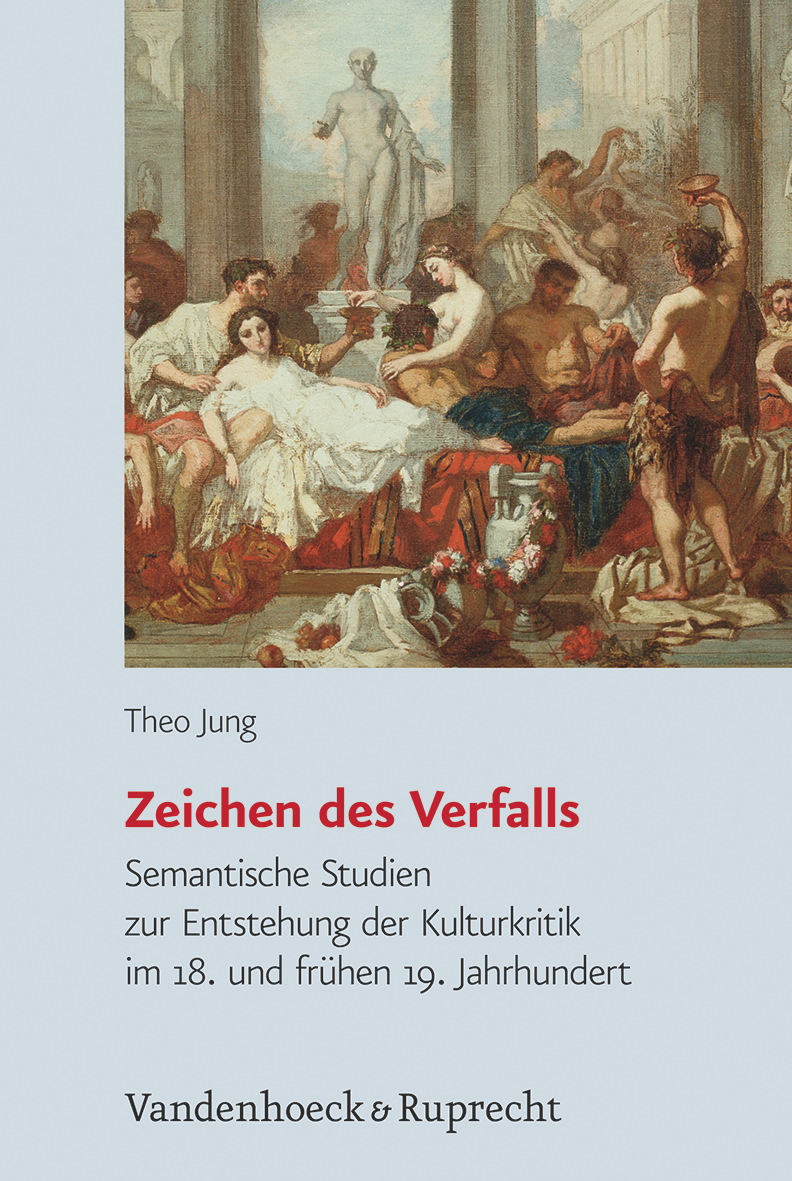
My dissertation has been published as volume 18 of the series ‘Historische Semantik‘ by Vandenhoeck and Ruprecht.

For more information, click here. For ordering from within Germany, click here.

Read Full Post »

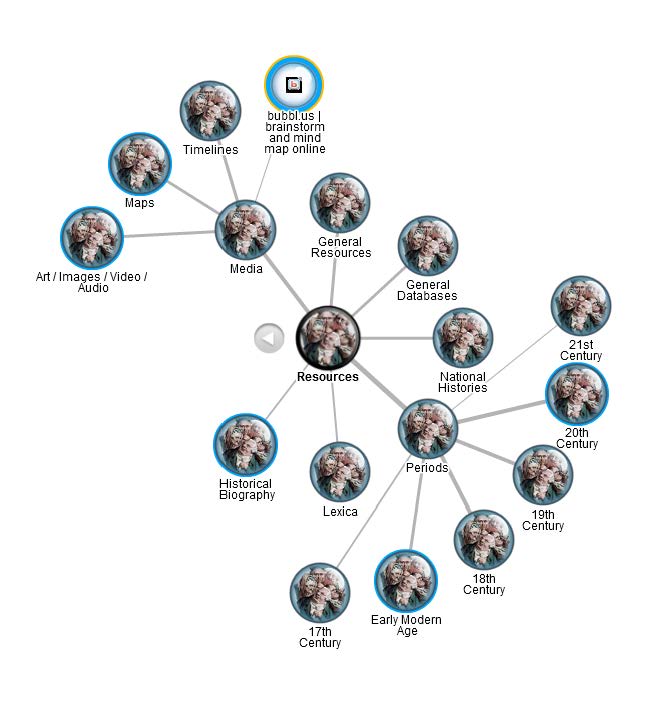
Pearltree

Using the pearltrees web environment, I’ve started a systematic collection of links to websites of historical interest. Primarily, I aim to use these links as a teaching tool, providing useful background information to my various courses. Beyond this, I hope to provide students (and other people interested in various historical topics) with an accessible gateway into the digital side of historical research. The collection is dynamic and built to – using the input of colleagues and students – grow and ‘branch out’ over time.

It may be found here

Read Full Post »

This winter semester, I will again be teaching two courses.

The Salon: a Form of Enlightened Sociability
The social life of the Ancien Régime has never lost its fascination. In many books and movies, a world is evoked in which beautifully dressed gentlemen and ladies cultivate a witty and light-footed conversation. The central and most famous form of this type of elitist sociability was, without a doubt, the salon. In this setting, an exquisite circle of guests of all sorts met under the gentle guidance of an elegant hostess. Drawing upon French and ‘German’ cases from the 18th and 19th centuries, this seminar studies the social, cultural and gender dimensions of this social form in their historical development. Its focus will lie on several questions which have been the subject of heated historiographical debate. Were these salons hatcheries of Enlightenment thought, of emerging civil society or of women’s emancipation, or did they rather represent a late – and ultimately dying – branch of aristocratic (court) culture? In the conversations that built the central element of any salon, what was the relationship between serious discussion and lighthearted amusement? Were the salons able to adjust to the new political environment after the French Revolution, or did the rise of bourgeois society spell their end?

Enlightenment and Revolution: Reading Course on French Sources
The French Revolution is often thought of as the birthplace of European modernity. Contemporaries were already very aware of its significance and debated about its various causes. Central among these was a diffuse set of phenomena that would gradually come to be subsumed under the title of ‘Enlightenment’. In this context, a controversial debate about the relationship between ‘Enlightenment’ and ‘Revolution’ emerged that has not quieted down since. Reading French primary sources (pamphlets, theatre, speeches, lexicon articles, etc.), this course will trace the political dimension of the Enlightenment as it was understood before, during and after the French Revolution.

Read Full Post »
As of April first, I will be moving to the University of Freiburg to start a new job as a Hochschulassistent (‘assistant professor’). I will be working under Professor Jörn Leonhard and ‘Privatdozentin’ (Private Lecturer) Svenja Goltermann at the Lehrstuhl für die Geschichte des Romanischen Westeuropa (chair for the History of the Romanesque Western Europe).

Besides teaching and other academic activities, I will start work on a new project on the ‘history of silence‘ in the long nineteenth century.

Read Full Post »

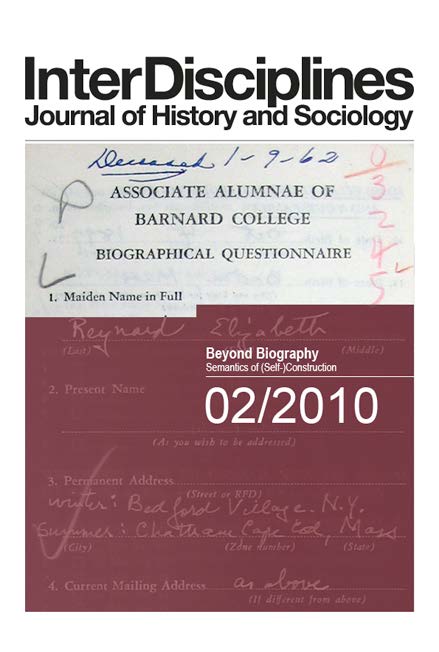
An article I wrote about the construction of the authorial identity in the eighteenth century was published in the issue »Beyond Biography« of the Journal InterDisciplines. It originates from a workshop on the »Semantics of (Self)Construction. (Auto-)Biography in Sociology and History in the 19th and 20th centuries«, held in Bielefeld (Germany) in January 2010.

Jung, Theo, „The writing self. Rousseau and the author’s identity“ InterDisciplines 1, Nr. 2 (2010) 91–121.

Abstract

In 1749, while on the road to Vincennes to visit his friend Diderot in prison, Rousseau had an inspirational experience that prove to be a deciding moment in his life story. In his many autobiographical writings, he would time and again interpret this event as the seminal point of his identity as a writer. Taking the conflicting contemporary interpretations of the Vincennes episode as a starting point, this article asks in what way modern, post-subjectivist theories of the self can enrich our understanding of historical events, while at the same time providing answers to wider questions concerning the ways in which historically changing and contextually specific forms of what it means to be a self are constructed, intepreted, articulated and ›put into practice‹. To this end, Rousseau’s ›illumination‹ and its subsequent interpretations are interpreted in the light of contemporary controversies over the identity of the writer that developed against the background of fundamental changes in the social and economic structure of the literary field.

To the article.

Read Full Post »

Next semester, I will have te opportunity to teach a seminar on the concept of Enlightenment to students of the University of Bielefeld. This is a translation of the text published in the syllabus.

Dimensions of Enlightenment: Self-Understanding, Descriptions, Historiography

The most famous characterization of the essence of Enlightenment stems from the philosopher Immanuel Kant. He defined the concept as the “departure of man from his self-inflicted minority” and tied this to the motto “Sapere aude!”: “Have the courage, to use your own understanding!”

The question ‘What is Enlightenment?’ is not only at the centre of the historical study of Enlightenment. The age that we now know under that name asked herself the same question. Furthermore, it has up until the present played a major part in debates about the self-understanding of modern culture.

The aim of this seminar is to consider the concept of Enlightenment in all its many dimensions. Accordingly, the question mentioned is examined from three perspectives:

1. What is Enlightenment in Historiography?

With reference to the example of Enlightenment historiography general questions are posed about problems of historical periodization (when was Enlightenment?), terminology (what does Enlightenment mean?) theory and method (how does one study Enlightenment?). Several ways in which this field has been studied will be compared with regard to their particular understanding of the subject.

2. What was Enlightenment in the Enlightenment?

In the course of the Eighteenth Century a group of authors emerged that closely tied their self-understanding to the historical mission of ”enlightening’ the world. On the other hand, others viewed this group as ridiculous posers in the best case, a world-wide conspiracy against throne and altar in the worst. What Enlightenment meant was highly controversial. It was negotiated in a long discursive process. On the basis of selected sources, such debates will be analyzed. The focus will be both on strategies of (linguistic and visual) self-presentation as well as on the hostile depictions by enemies of the Enlightenment.

3. What is Enlightenment now?

Most strongly in France and in the Anglo-Saxon countries, but also in Germany, Enlightenment plays a significant role in debates about the cultural self-understanding of modernity. The question is posed, if we live in enlightened times – or at least in an ‘Age of Enlightenment’ today. Is Enlightenment obsolete? Has she in the course of the Twentieth Century, as Horkheimer and Adorno thought, proven to be dialectical? Or does she still shape the present? What does this mean in the confrontation with non-Western, ‘unenlightened’ cultures?

Read Full Post »

I’ve been invited to speak at the conference Perspektiven der Aufklärung (Enlightenment Perspectives) to be held in Bern on September 16th and 17th of this year. The event is organized by Dietmar Wetzel and Aleksander Zieliński, both from the University of Bern. Other participants include Sabine Maasen (Basel), Evelyn Gröbl-Steinbach (Linz), Claudia Honegger (Bern), Urs Stäheli (Hamburg) and Hartmut Rosa (Jena).

Most of these are sociologists, so that I’ll  have the opportunity to discuss a few of my more wide ranging hypotheses with a group of people specifically trained to grapple with general questions and models. Since many historians are – to say the least – less inclined to leave their sources behind to address more theoretical and abstract questions, I am confident this will be a very useful experience.

The program can be found here, and the call for papers (with a description of the themes under discussion) here.

My topic will be one that I have spoken about before, in Wolfenbüttel last year: the concept of Counter-Enlightenment. More specifically, I will address three questions.

  • In what way and to what purpose was the concept of Counter-Enlightenment (anti-philosophie) used in the Age of Enlightenment?
  • What role did the concept play in historiographical traditions about the Enlightenment?
  • And finally: What are the strengths and weaknesses of the concept of Counter-Enlightenment as an analytical tool to understand the Enlightenment both as a historical phenomenon and as a general characteristic of modernity?

My specific goal is to address the links between the concept of Counter-Enlightenment as an analytical tool and as a historical concept used in historical contexts.

In my opinion it is too easy to just declare a clean break between the source language and the analytical framework, between the tools of the historian and his object. Whereas this can certainly be a viable goal, it will never be fully attainable. The reason for this lies in the fact that the language we use as historians to write about, but also to understand our source material as well as the world at large, is itself historically determined. The very same linguistic structures that are the subject of historical semantics still shape the semantical horizon within which this study is carried out. Therefore, self-reflection has to be an integral part of any study within the field of discourse analysis. This is all the more true in the case of the study of Enlightenment, the period in which our modern consciousness took shape.

Later this year, I will address these same questions in a seminar at the University of Bielefeld.

Read Full Post »

« Newer Posts