Feeds:
Posts
Comments

Posts Tagged ‘Eighteenth Century’

A short article I wrote about luxury debates at the end of the eighteenth century has been published in the Zeitschrift für Kulturphilosophie.

Luxus und Sozialordnung. Kulturelle Selbstbestimmung und die Grenzen des Konsums am Ende des 18. Jahrhunderts, in: Zeitschrift für Kulturphilosophie 7, Nr. 1 (2013), S. 199-203.

In essence, the article  provides a commentary on and contextualization of a text published in 1776 by Lorenz Hübner (1751-1807) titled Abhandlung von dem Luxus, oder schädlichem Prachte, which is also reprinted in the Zeitschrift. Hübners text – originally a speech in honor of the bavarian elector Maximilian III. Joseph – provides an interesting insight into the history and development of eighteenth century luxury debates. books

Read Full Post »

On May 15th to 17th of next year, I will be attending a conference titled “Declines and Falls: Perspectives in European History and Historiography” organized at the Central European University in Budapest.

My presentation – which draws upon my dissertation research – will address the complex interrelations between the concepts of progress and decadence in the long eighteenth century. Often, these two concepts are understood as mutually exclusive counter-concepts, epitomizing a forward-looking ‘Enlightenment theory of progress’ on the one hand and the backward and ultimately futile ‘complaints’ of conservatives and reactionaries on the other.

A closer look at the semantic structure of debates about the development of civilization in the eighteenth and early nineteenth centuries reveals, however, that to contemporaries, these concepts were not usually counter-concepts at all. Rather, they were regularly understood as linked, or even interdependent. To understand this paradox, my paper addresses the various ways in which ‘the culture/civilization as a whole’ was conceptualized in these discourses.

Joining the analysis of the semantic structure of contemporary narratives of cultural decline with their pragmatic interpretation as speech acts in public interaction, I identify three different types of interpretation of the ‘whole’ in which ostensibly monistic claims about civilization in toto were linked to a differentiated understanding of its plural nature. In this way, the common view of narratives of progress and decadence as mutually exclusive discourses – at worst resulting in a general narrative of modern intellectual history as an eternal struggle between Enlightenment and Counter-Enlightenment – may make way for a more detailed understanding of the complexities of the debates about the character and development of civilization that have been so very important to public discourses of self-reflection in the modern age.

Update: a conference report has been published on the CEU website.

Read Full Post »

This summer semester I will be teaching one master seminar and an exercise course on the reading of French sources. As usual, I have assembled a ‘pearltree’ for each of these courses with weblinks to the specific themes.

A History of Time – Changing Cultures of Temporality (ca. 1750-1850)
(Pearltree – websites on this topic)

and

Politeness – Sources on the History of Manners in France (ca. 1700-1850)
(Pearltree – websites on this topic)

Read Full Post »

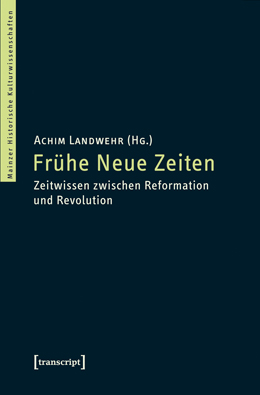
An article I wrote about the concept of the ‘spirit of the age’ in the long Eighteenth Century has been published in the volume Frühe Neue Zeiten, edited by Prof. Dr. Achim Landwehr.

Zeitgeist im langen 18. Jahrhundert. Dimensionen eines umstrittenen Begriffs, in: Achim Landwehr (Hg.): Frühe Neue Zeiten. Zeitwissen zwischen Reformation und Revolution (= Mainzer Historische Kulturwissenschaften 11), Bielefeld: transcript 2012, S. 319–355.

In my article, I trace the meanings and usages of the concept of zeitgeist in its various forms (esprit du siècle, Geist der Zeit, spirit of the age, etc.) across a number of contexts in France, England and the German lands. The concept is shown to be at the center of the temporalization of discourses about contemporary culture and its historical development during the Eighteenth Century. A special focus of the article lies on the complicated relation between the unstressed usages of the concept on the one hand and the explicit, metalinguistic discussion about it on the other. Because of its controversial and elusive nature, the concept of the spirit of the age was at the center of heated debates about its cognitive and metaphysical legitimacy and its pragmatic usefulness. How did such debates influence its use in other contexts?

To read the Achim Landwehr’s introduction to the volume, click here.

Read Full Post »

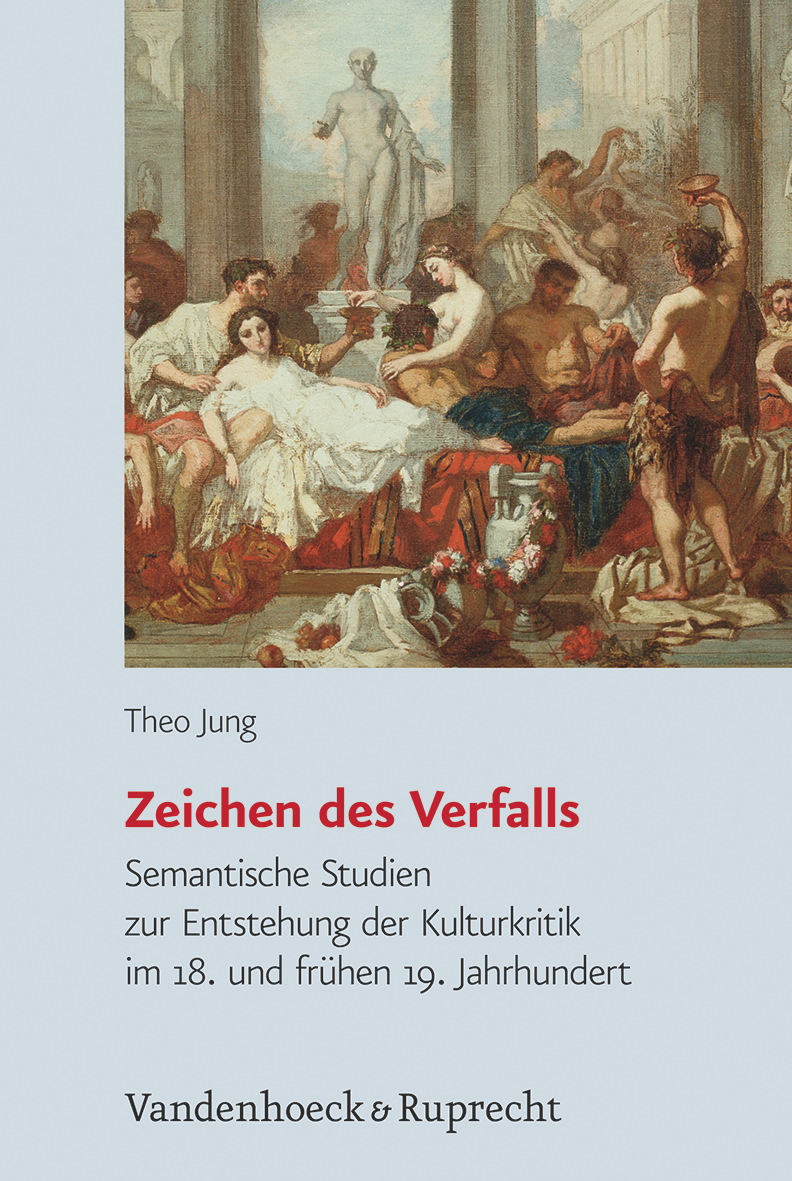
My dissertation has been published as volume 18 of the series ‘Historische Semantik‘ by Vandenhoeck and Ruprecht.

For more information, click here. For ordering from within Germany, click here.

Read Full Post »

Last week, I presented a paper at the conference ‘The Changing Experience of Time in the Long Nineteenth Century: Local, Regional, (Trans)National and Global Perspectives‘, held at the Centre for Transnational History of the University of St. Andrews (Scotland). My presentation was concerned with different models of historical analysis of the changing experiences and practices of time, especially with the so-called model of ‘temporalization’ which has been primarily championed by the German historian Reinhart Koselleck. Its title was:

Modern Times: Temporalization as a Concept of Historical Analysis

Also, I’m happy to announce that next month, I’m presenting other research at a conference ‘Populäre Geschichte und medialer Wandel zwischen Fortschrittsoptimismus und Kulturpessimismus‘, organized by the DFG-research group ‘Historische Lebenswelten in populären Wissenskulturen der Gegenwart‘ (DFG-FOR 875). This time, my topic will be a narrative of cultural interpretation that was quite influential at the end of the 18th century, which interpreted history as a slow evolution from a ‘poetic’ to a ‘prosaic’ mode of existence. The title of my presentation will be:

Vom poetischen Ursprung zur prosaischen Gegenwart: ein kulturanalytisches Geschichtsnarrativ im späten 18. Jahrhundert
(From poetic origin to prosaic present: a historical narrative of cultural analysis at the end of the 18th century)

Read Full Post »

This winter semester, I will again be teaching two courses.

The Salon: a Form of Enlightened Sociability
The social life of the Ancien Régime has never lost its fascination. In many books and movies, a world is evoked in which beautifully dressed gentlemen and ladies cultivate a witty and light-footed conversation. The central and most famous form of this type of elitist sociability was, without a doubt, the salon. In this setting, an exquisite circle of guests of all sorts met under the gentle guidance of an elegant hostess. Drawing upon French and ‘German’ cases from the 18th and 19th centuries, this seminar studies the social, cultural and gender dimensions of this social form in their historical development. Its focus will lie on several questions which have been the subject of heated historiographical debate. Were these salons hatcheries of Enlightenment thought, of emerging civil society or of women’s emancipation, or did they rather represent a late – and ultimately dying – branch of aristocratic (court) culture? In the conversations that built the central element of any salon, what was the relationship between serious discussion and lighthearted amusement? Were the salons able to adjust to the new political environment after the French Revolution, or did the rise of bourgeois society spell their end?

Enlightenment and Revolution: Reading Course on French Sources
The French Revolution is often thought of as the birthplace of European modernity. Contemporaries were already very aware of its significance and debated about its various causes. Central among these was a diffuse set of phenomena that would gradually come to be subsumed under the title of ‘Enlightenment’. In this context, a controversial debate about the relationship between ‘Enlightenment’ and ‘Revolution’ emerged that has not quieted down since. Reading French primary sources (pamphlets, theatre, speeches, lexicon articles, etc.), this course will trace the political dimension of the Enlightenment as it was understood before, during and after the French Revolution.

Read Full Post »

Starting in Freiburg in the summer semester of 2011, I will be teaching two courses.

The Intellectual: Genesis of a Modern Social Type
The Dreyfus Affair is often viewed as the birth of the modern intellectual.  In fact, however, the origins of this important ‘persona’ are much older and reach into the Enlightenment period. Taking a series of case studies from France, England and the German lands as a starting point, this BA-Seminar from a comparative perspective traces the emergence and development of this figure during the eighteenth and nineteenth centuries. Besides questions of social structure, finance, forms of communication and use of media, its focus will be on the problematic relation of the intellectual (and his locus naturalis, the public realm) with the political.

Zeitgeist: History and Impact of a Controversial Concept
The concept of ‘zeitgeist’ or ‘spirit of the age’ has all but disappeared from our vocabulary. If used at all it is usually employed in an ironic mode. Yet at one time, this was remarkably different. For a long time, zeitgeist was the central concept within Western discourses of historical reflexion. It expressed the reflexion upon the present as a changing form of life and thus built the center of a historical consciousness that emerged at the onset of the modern era. This reading course (Übung) will trace the history of this modern concept from its beginnings in the seventeenth up to his heyday in the first half of the nineteenth century. On the basis of source material (pamphlets, journal articles, poetry, theatre) from the German, French and English language areas several questions will be posed, i. e.: what meanings did the concept convey and how did these change over time? In what contexts and to what purposes was it used? How was it instrumentalized for political aims? Against which social background did it arise and how did it influence this in turn? Thus, on the basis of this example, general question are put forward about the history of concepts and its method.

More information about these courses may be found here.

Read Full Post »

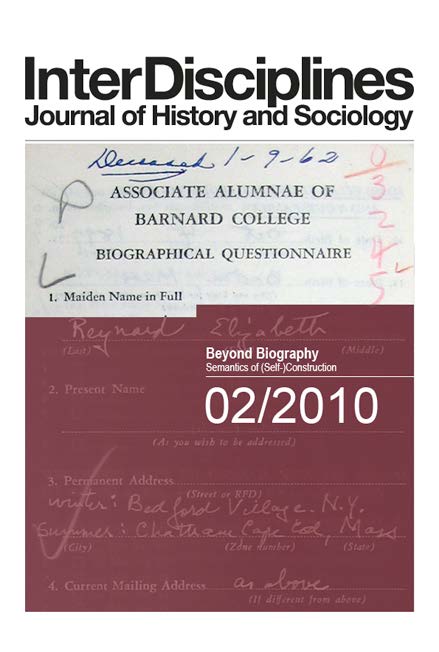
An article I wrote about the construction of the authorial identity in the eighteenth century was published in the issue »Beyond Biography« of the Journal InterDisciplines. It originates from a workshop on the »Semantics of (Self)Construction. (Auto-)Biography in Sociology and History in the 19th and 20th centuries«, held in Bielefeld (Germany) in January 2010.

Jung, Theo, „The writing self. Rousseau and the author’s identity“ InterDisciplines 1, Nr. 2 (2010) 91–121.

Abstract

In 1749, while on the road to Vincennes to visit his friend Diderot in prison, Rousseau had an inspirational experience that prove to be a deciding moment in his life story. In his many autobiographical writings, he would time and again interpret this event as the seminal point of his identity as a writer. Taking the conflicting contemporary interpretations of the Vincennes episode as a starting point, this article asks in what way modern, post-subjectivist theories of the self can enrich our understanding of historical events, while at the same time providing answers to wider questions concerning the ways in which historically changing and contextually specific forms of what it means to be a self are constructed, intepreted, articulated and ›put into practice‹. To this end, Rousseau’s ›illumination‹ and its subsequent interpretations are interpreted in the light of contemporary controversies over the identity of the writer that developed against the background of fundamental changes in the social and economic structure of the literary field.

To the article.

Read Full Post »

Next semester, I will have te opportunity to teach a seminar on the concept of Enlightenment to students of the University of Bielefeld. This is a translation of the text published in the syllabus.

Dimensions of Enlightenment: Self-Understanding, Descriptions, Historiography

The most famous characterization of the essence of Enlightenment stems from the philosopher Immanuel Kant. He defined the concept as the “departure of man from his self-inflicted minority” and tied this to the motto “Sapere aude!”: “Have the courage, to use your own understanding!”

The question ‘What is Enlightenment?’ is not only at the centre of the historical study of Enlightenment. The age that we now know under that name asked herself the same question. Furthermore, it has up until the present played a major part in debates about the self-understanding of modern culture.

The aim of this seminar is to consider the concept of Enlightenment in all its many dimensions. Accordingly, the question mentioned is examined from three perspectives:

1. What is Enlightenment in Historiography?

With reference to the example of Enlightenment historiography general questions are posed about problems of historical periodization (when was Enlightenment?), terminology (what does Enlightenment mean?) theory and method (how does one study Enlightenment?). Several ways in which this field has been studied will be compared with regard to their particular understanding of the subject.

2. What was Enlightenment in the Enlightenment?

In the course of the Eighteenth Century a group of authors emerged that closely tied their self-understanding to the historical mission of ”enlightening’ the world. On the other hand, others viewed this group as ridiculous posers in the best case, a world-wide conspiracy against throne and altar in the worst. What Enlightenment meant was highly controversial. It was negotiated in a long discursive process. On the basis of selected sources, such debates will be analyzed. The focus will be both on strategies of (linguistic and visual) self-presentation as well as on the hostile depictions by enemies of the Enlightenment.

3. What is Enlightenment now?

Most strongly in France and in the Anglo-Saxon countries, but also in Germany, Enlightenment plays a significant role in debates about the cultural self-understanding of modernity. The question is posed, if we live in enlightened times – or at least in an ‘Age of Enlightenment’ today. Is Enlightenment obsolete? Has she in the course of the Twentieth Century, as Horkheimer and Adorno thought, proven to be dialectical? Or does she still shape the present? What does this mean in the confrontation with non-Western, ‘unenlightened’ cultures?

Read Full Post »

« Newer Posts - Older Posts »