Feeds:
Posts
Comments

Posts Tagged ‘Eighteenth Century’

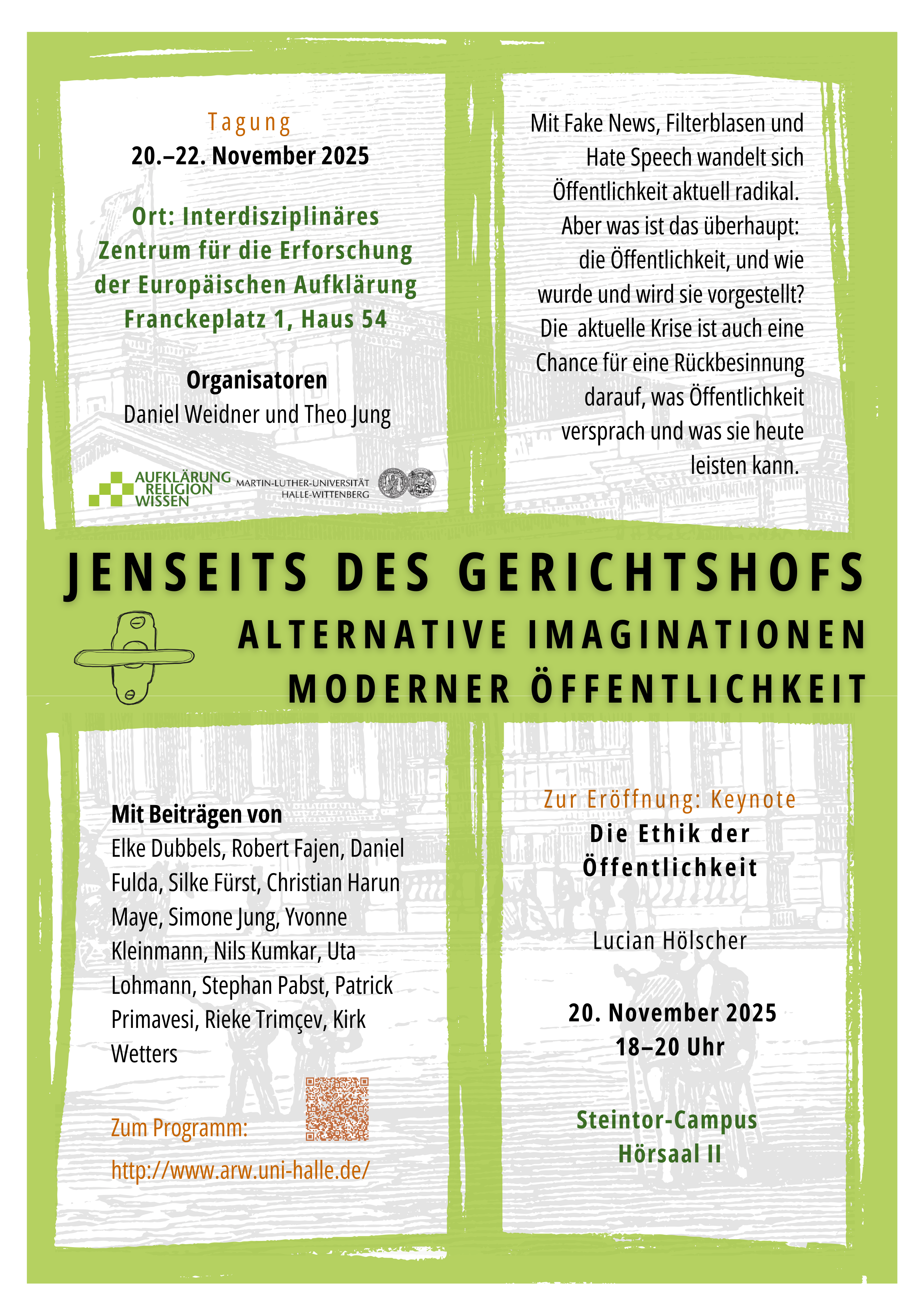
On 20 to 22 November, the yearly symposium of the Martin-Luther-University’s Research Focus “Enlightenment – Religion – Knowledge” will take place under the title

Jenseits des Gerichtshofs: Alternative Imaginationen moderner Öffentlichkeit

(Beyond the Court: Alternative Imaginations of the Modern Publich Sphere)

The symposium has been organized by my colleague Daniel Weidner and myself and will include contributions by

Lucian Hölscher (Bochum), Nils Kumkar (Bremen), Simone Jung (Lüneburg/Halle), Yvonne Kleinmann (Halle), Robert Fajen (Halle), Patrick Primavesi (Leipzig), Uta Lohmann (Hamburg), Christian Harun Maye (Basel), Elke Dubbels (Bonn), Kirk Wetters (Yale), Rieke Trimçev (Halle), Daniel Fulda (Halle), Silke Fürst (Zürich) and Stephan Pabst (Halle).

For further information on the venues and program, see here.


Abstract

In recent years, there has been renewed talk of a crisis of the public sphere. Filter bubbles and fake news, unrestrained insults and cancel culture are discussed as symptoms of decay, disintegration, or dysfunction of the publis phere – although, of course, these debates themselves take place within the public sphere itself. But what, in fact, is this “public sphere”? How de we imagine it, how do we describe it, and what conclusions do we draw from this?

The current diagnosis of crisis offers an opportunity for a critical genealogy, since the sense of crisis may itself stem, not least, from the fact that certain established imaginations of the public sphere have become fractured and questionable. Such a moment invites renewed reflection on what the public sphere was, is, and could be – and may point to traces laid down since the formative period of modern publics that have as yet not been fully pursued.

Read Full Post »

The Research Focus Group ‘Enlightenment – Religion – Knowledge‘ based at the Martin-Luther-University Halle-Wittenberg is offering a 1-year postdoctoral fellowship under the title “Kritik im Widerstreit” (criticism in contest), beginning on October 1, 2025.

The research focus group is dedicated to the historical Enlightenment and its continued legacy up to the present. This includes, not least, the concept of “criticism,” which was first emphatically formulated during the Enlightenment and is currently again the subject of intense debate—particularly with regard to its political implications.

Where does criticism stand today, what is it still capable of, and how must we rethink it? What forms of practice are associated with it, what does it mean in different fields—politics, art, the public sphere—how is it shifting under new media conditions, and what political significance does it have in each case?

Today, criticism itself is under criticism: it is said to be elitist, exhausted, and outdated, to defend particular interests, and to serve self-promotion more than its apparent cause. Particularly disturbing is the fact that critical arguments seem to be easily appropriated by their opponents: Today, prohibitions on thinking are proclaimed in the name of “freedom”; exclusions in the name of “equality”; and questionable dogmas in the name of “criticism”. What remains of criticism if one does not want to abandon it entirely but has given up belief in a “critique of critical criticism” (Marx)?

The scholarship is intended to serve as a means of investigating and discussing political figurations of criticism between appropriation and dismissal together with other scholars involved in research focus group. Applicants should propose an academic project (aimed at publishing an academic article) and, within this framework, organize and host an academic event; accompanying formats such as readings, panel discussions, exhibitions, guided tours, etc. are also conceivable and can be financed with ARW funds.

Deadline for applications is 27 June, 2025.

More information on the fellowship and application procedure can be found here.

Read Full Post »

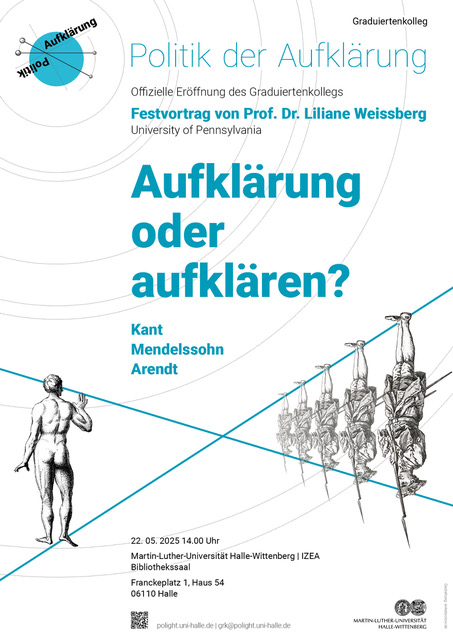
The new DFG Research Training Group “Politics of the Enlightenment”, which has started its work at the University of Halle-Wittenberg with eight doctoral and one post-doctoral researchers this month, will be officially inaugurated on May 22.

Besides various presentations by the Training Group’s members, the university’s rector, Prof. Dr. Claudia Becker, will give an official address. The ceremony is concluded with a key note speech by Prof. Dr. Liliane Weisberg, the Training Group’s first fellow and a distinguished expert in the field of Enlightenment studies.

The ceremony will be held at the library of the Interdisciplinary Centre for European Enlightenment Studies. All are welcome to join us for this festive occasion.

Read Full Post »

We have received notice that a new interdisciplinary Research Training Group, which I had applied for with a group of colleagues of the universities of Halle-Wittenberg, Leipzig and Erfurt, will be funded by the DFG (German Research Foundation). This means that from 2025 on, PhD students, visiting scholars and other researchers will be developing a wealth of new projects on the global “Politics of Enlightenment” since the eighteenth century.

Calls for application for PhD and Post-Doc positions will follow soon.

The Politics of Enlightenment

The Research Training Group (RTG) examines the politics of the Enlightenment from the 18th to the 21st century. Its approach is twofold: firstly, it analyzes the political claims and interpretations that have been fostered by the Enlightenment or in its name, and, secondly, the political discussions and measures which determines our understanding of Enlightenment that is constantly reinterpreted according to political interests and concepts. The project thus combines the study of the historical Enlightenment—here it relates in particular to recent research which has emphasized the complexity and diversity of Enlightenment movements— with the study of its impact, appropriation, and reinterpretation up to the present day.

Apparently, ‘Enlightenment’ is once again moving to the center of political debates on, for example, the crisis of the public sphere and the disappearance of truth. The historical expansion goes along with a spatial one, as the reassessment of the Enlightenment is no longer a European phenomenon but must be considered in a global context. This spatial widening is paid tribute to by the transnational conception of the RTG and by the inclusion of a postdoctoral position that focusses on issues of Enlightenment beyond Europe. Methodologically, these historically and geographically broad perspectives on the politics of the Enlightenment allow for the fruitful integration of different approaches such as the history of ideas and concepts, social and cultural history, political science and philosophy as well as literature and cultural studies, which is reflected in the team of applicants.

The joint work is oriented towards four thematic axes, which are both central to eighteenth century politics and to current references to Enlightenment: ‘civilization’; ‘public sphere’; ‘secularity’; ‘plurality’. The doctoral students will find a lively interdisciplinary working environment, that provides them with ideal conditions for completing their work. Thanks to its location at the Interdisciplinary Centre for the Study of the European Enlightenment (IZEA) at Martin-Luther-University Halle-Wittenberg (MLU), the Research Training Group will be firmly anchored in Enlightenment research. In addition, the range of applicants’ institutional affiliations link the future doctoral students with two faculties at MLU, the Research Centre Gotha at the University of Erfurt as well as the Institute of Philosophy at the University of Leipzig.

Read Full Post »

For the journal French Studies, I reviewed the volume “Éloquences révolutionnaires et traditions rhétoriques (XVIIIe et XIXe siècles)” edited by Patrick Brasart, Hélène Parent and Stéphane Pujol.

The review can be found online here.

Read Full Post »

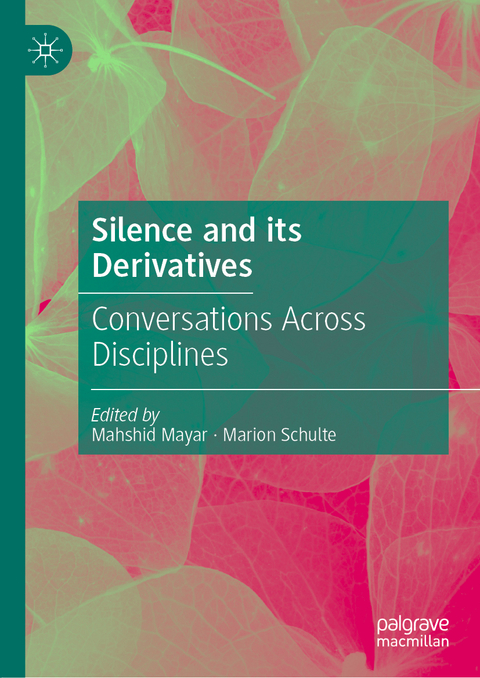
For an interdisciplinary volume on silence edited by Mahshid Mayar (Cologne) and Marion Schulte (Bielefeld), I wrote a chapter on the way Europeans have historically framed the question of ‘talkative’ and ‘taciturn’ nations.

Even today, we often think of authoritarian and dictatorial regimes in terms of ‘silence’, while parliamentary and democratic politics are linked to the category of ‘voice’. Retracing the historical emergence of such conceptualizations during the late eighteenth and early nineteenth centuries, my chapter aims at a reconsideration of these familiar, but reductive binaries.

Exploring French, German, and British discourses on the question why some nations are more talkative than others brings to light a fundamental shift in the understanding of communication around the turn of the nineteenth century, when explanations in terms of national character were gradually superseded by a point of view linking taciturnity and talkativeness to specific political regimes.

This gradual reorientation from a spatio-cultural to a temporal framing coincided with a distinct politicization of the question of communication (and its absence) which still resonates today. Placing our current understanding of the significance of voice and silence into a wider historical perspective thus contributes to a reconsideration of the meanings of communication in the modern world.

  • Talkative and Taciturn Nations. Ethnographic and Political Perspectives in European Discourses on Communicative Cultures (c. 1750–1850), in: Mahshid Mayar und Marion Schulte (eds): Silence and its Derivatives. Conversations Across Disciplines. London 2022, 87–108.

The chapter can be downloaded here. The whole volume is to be found here.

Many thanks to the editors for their meticulous organization of the publishing process.

Read Full Post »

Depoliticization before Neoliberalism: Contesting the Limits of the Political in Modern Europe

All too often, depoliticization is reduced to a very recent phenomenon, an effect of ‘Neoliberalism’. In a workshop to be held in Nijmegen on April 1-2, 2022, organized by Adriejan van Veen (Nijmegen) and myself, we aim to place the concept in a wider historical perspective. On the basis of a broad spectrum of European cases from the late eighteenth century until today, depoliticization no longer appears as a monolithic and autonomous process, but rather as a complex bundle of practices and discourses contesting the boundaries of the political sphere.

For further information on the themes and questions we will be addressing, please refer to our call for papers here.

[Edit April 28, 2022: Oliver Weber wrote a detailed report on our workshop for the Frankfurter Allgemeine Zeitung titled “Entpolitisierung. Hinter unserem Deich sind wir keineswegs sicher”. It is available online here.]

Guests are more than welcome to attend, either off- or online (via zoom). Please contact the organizers for registration and further details.

Venue: Vergader- en Conferentiecentrum Soeterbeeck Elleboogstraat 2 5352 LP Deursen-Dennenburg

Workshop Program

Friday April 1

Introduction (9:30 – 9:55) Theo Jung and Adriejan van Veen

Keynote (9:55 – 10:40) Ido de Haan

Panel 1: Timeless Realms: Art and Religion beyond Politics (10:45 – 12:30)
● Tamar Kojman: Constructing an Apolitical Realm after the 1848/9 German Revolutions
● Jan-Markus Vömel: Unpolitical Islam? Stategies of De-Politicization Surrounding Islam in Turkey
● Klara Kemp-Welch: Antipolitics and Art in Late-Socialist East-Central Europe

Lunch (12:30 – 14:00)

Panel 2: Perspectives on Political Abstention (14:00 – 15:45)
● Oriol Luján: Articulating Political Unease in 19th Century Europe: Abstention and Blank Vote as Forms of (De)Politicization
● Adriejan van Veen: Passive Citizenship? Civil Society and Political Abstention in the Netherlands, 1780–1840
● Zoé Kergomard: Depoliticizing “Apathy”? Institutional Reactions to Non-Voting in France under De Gaulle (1958–1969)

Coffee (15:45 – 16:15)

Panel 3: Discourses of Competence and Functionalism (16:15 – 18:00)
● Ruben Ros: Technocratic Anti-Politics in Dutch Interwar Political Culture (1917–1939)
● Koen van Zon: Depoliticisation through Participation? Consultation and Consensus Formation in European Community Policy-Making, 1960s–1980s
● Wim de Jong: Politicizing the Police? The Problem of Depoliticization in the Public History of Democratic Municipal Policing in the Netherlands, 1945–2019


Saturday April 2

Panel 4: Protecting the System from Politics (9:00 – 10:45)
● Mart Rutjes: Depoliticizing the Will of the People: Limiting the Franchise for Political Opponents in the Netherlands 1780–1800
● Stefan Scholl: Doubly Politicized? Semantical Struggles around the Relation between Economics and Politics in the Weimar Republic and National Socialism
● Anna Catharina Hofmann: An Administered Society? Planning and (De-) Politicization in the Late Franco Dictatorship, 1964–1973

Coffee (10:45 – 11:05)

Panel 5: Ruling by Ideas and Dreaming of Rational Government (11:05 – 12:50)
● Matthijs Lok: Moderation and Depoliticization after the Revolution: the Case of the Idéologues
● Eva Visser: Planning the Technate. The Apolitical Politics of the 1930s’ Technocratic Movement
● Jussi Kurunmaki and Jani Marjanen: Ideology, Politicization and Depoliticization in Parliamentary Rhetoric

Lunch (12:50 – 14:00)

Final discussion (14:00 – 15:00)

Read Full Post »
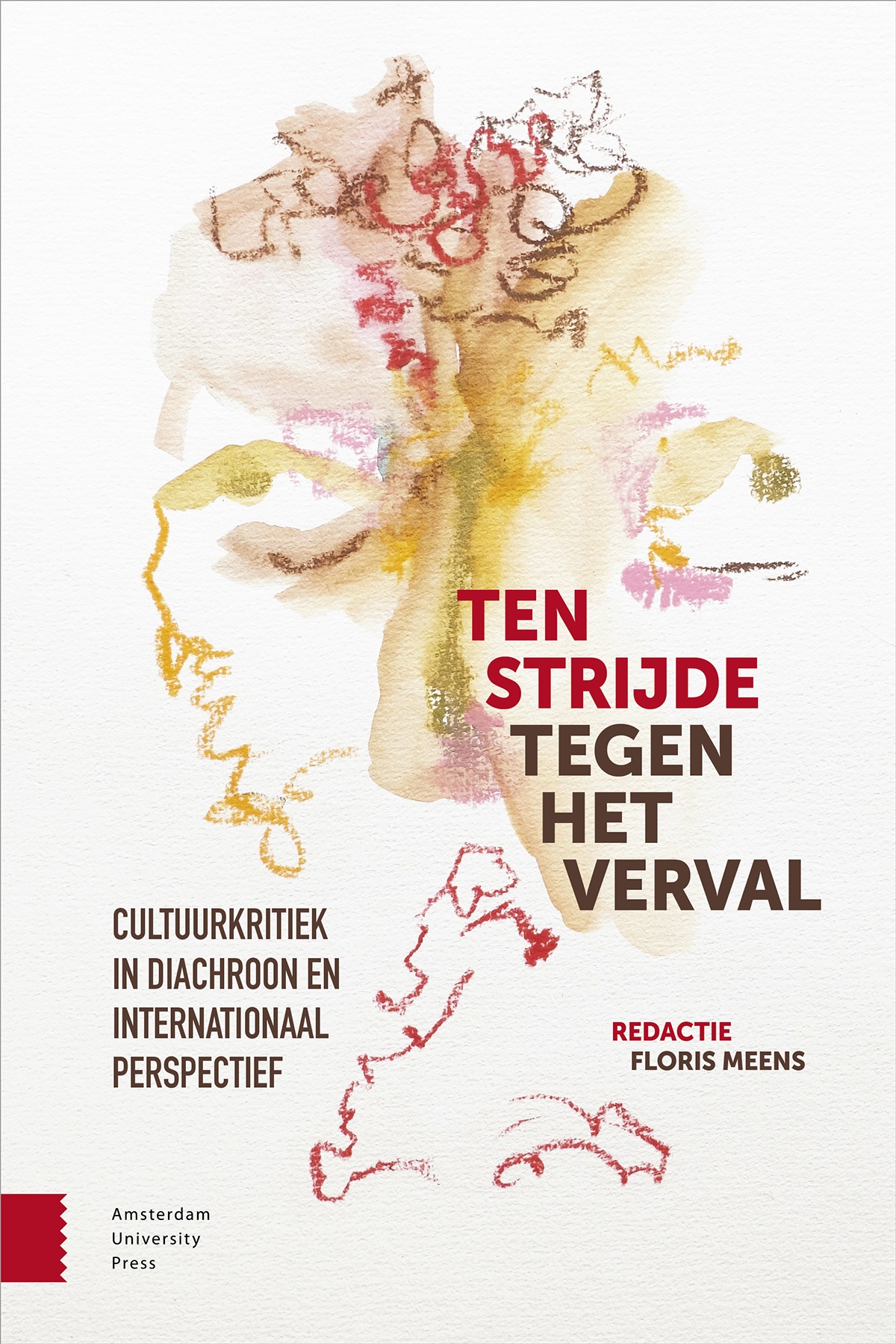
After a long gestation period, I’ve finally published my very first article in my native tongue, Dutch. Many thanks for Floris Meens for his thorough editing. After 15 years abroad, I needed some help getting my grammar back up to par.

My contribution

Een tweestrijd om de tijd? Cultuurkritiek en beschavingsapologie in dialoog

(A Conflict over the Times? Cultural Critique and the Apology of Civilization in Dialogue)

considers the interaction between the discourses of decadence and progress. Building on French debates of the late eighteenth century as a case study, I argue for a new, dialogical understanding of discursive change. Focusing on the question of how positions crystallize and develop in interaction with each other opens new perspectives on polemics as a dynamics of discursive development.

The essay is published in the volume Ten strijde tegen het verval. Cultuurkritiek in diachroon en internationaal perspectief, which is available from Amsterdam University Press.

Read Full Post »

On October 5, between 2:15 and 4 pm, I am participating in a panel titled

Deutungskämpfe um die Gegenwart: Zeitgenossenschaft und Zeitdiagnostik um 1800 in der Kontroverse [Controversies over the Present: Debates about Contemporaneity and Temporal Diagnosis around 1800]

at the German Historikertag. The panel is structured as follows:

  • Sebastian Schütte / Susan Richter: Einleitung
  • Theo Jung (Freiburg): Augenblick und Durchblick: Zeitgeistdiagnosen und ihre Kritik um 1800
  • Susan Richter (Kiel): Von der Seife und dem Besteck des Zeitgenossen. Formen und Analyseinstrumente der Zeitdiagnostik im Deutungskampf
  • Sebastian Schütte (Heidelberg): Von Nachtwandlern und Traumfängern im utopischen Dämmerschein. Geschichtsdeutung und Zeitkritik im (vor)revolutionären Paris
  • Uwe Justus Wenzel (Zürich): Auf der Höhe der Zeit und in ihren Niederungen. Einige Probleme philosophischer Zeitgenossenschaft
  • Helge Jordheim (Oslo): Kommentar

[EDIT: a review of the panel written by Kai Gräf has now been published on H-Soz-u-Kult and can be read here.]

Read Full Post »

Next semester, I’m offering two courses at Freiburg University (one online, one in person).

The Age of Revolutions: Transatlantic Political Upheaval (1776-1848)

This in-person seminar considers current debates on the entanglements between the era’s political revolutions and asks if it makes sense to speak of a ‘Revolutionary Era’.

Laughing Matters: Spotlights on the Cultural History of Humor since the Early Modern Age

This online reading course presents an introduction to the history of humor. Focusing on the political significance of joking and laughing as a mode of interaction, it asks how historians can integrate this aspect of social life into broader narratives on the character of specific constellations and eras.

I’m looking forward to returning to the class room. As usual, I’ve started collecting online resources on these topics on the Pearltrees website. These collections can be found here:

Read Full Post »

Older Posts »