Feeds:
Posts
Comments

Posts Tagged ‘Conference’

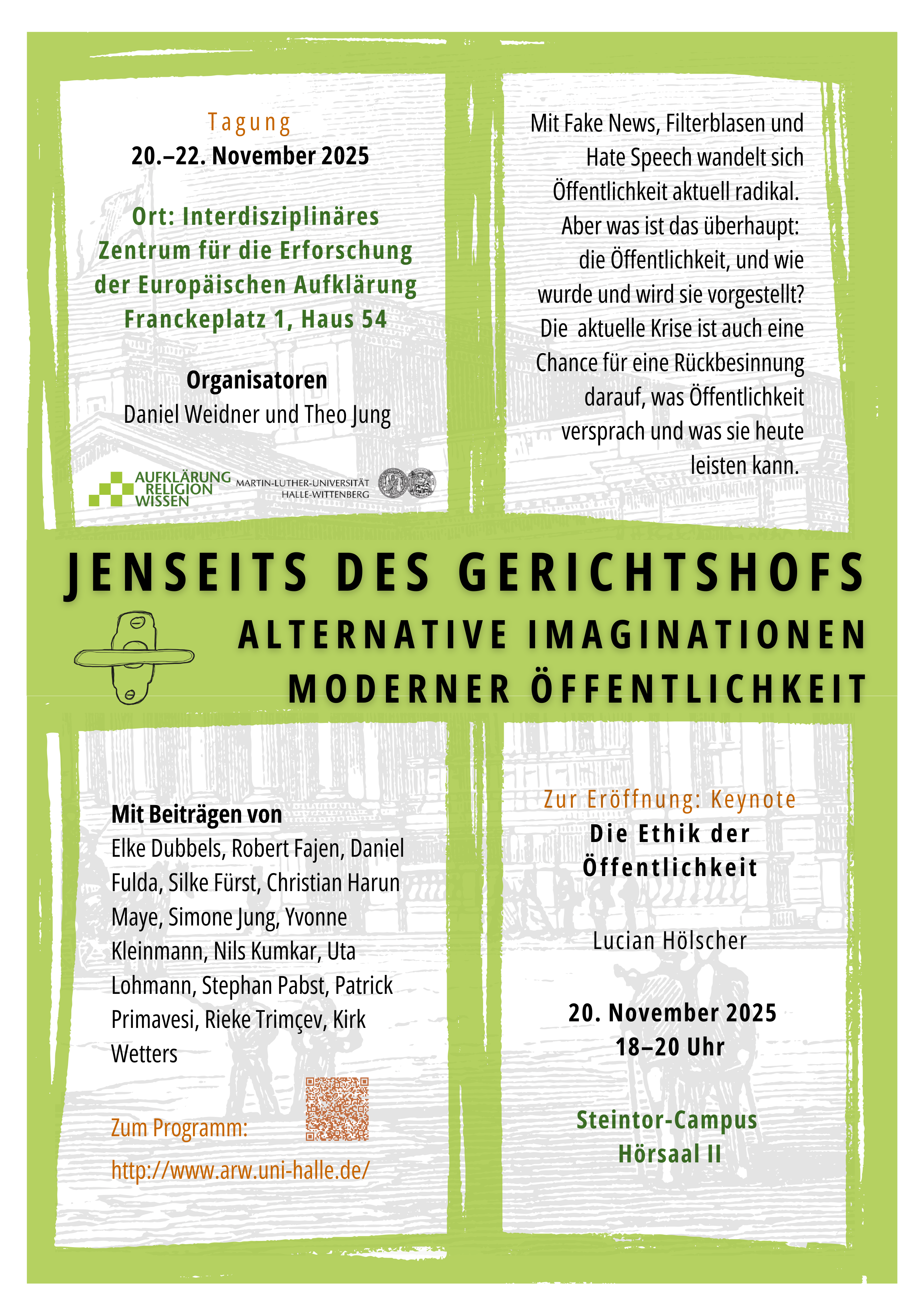
On 20 to 22 November, the yearly symposium of the Martin-Luther-University’s Research Focus “Enlightenment – Religion – Knowledge” will take place under the title

Jenseits des Gerichtshofs: Alternative Imaginationen moderner Öffentlichkeit

(Beyond the Court: Alternative Imaginations of the Modern Publich Sphere)

The symposium has been organized by my colleague Daniel Weidner and myself and will include contributions by

Lucian Hölscher (Bochum), Nils Kumkar (Bremen), Simone Jung (Lüneburg/Halle), Yvonne Kleinmann (Halle), Robert Fajen (Halle), Patrick Primavesi (Leipzig), Uta Lohmann (Hamburg), Christian Harun Maye (Basel), Elke Dubbels (Bonn), Kirk Wetters (Yale), Rieke Trimçev (Halle), Daniel Fulda (Halle), Silke Fürst (Zürich) and Stephan Pabst (Halle).

For further information on the venues and program, see here.


Abstract

In recent years, there has been renewed talk of a crisis of the public sphere. Filter bubbles and fake news, unrestrained insults and cancel culture are discussed as symptoms of decay, disintegration, or dysfunction of the publis phere – although, of course, these debates themselves take place within the public sphere itself. But what, in fact, is this “public sphere”? How de we imagine it, how do we describe it, and what conclusions do we draw from this?

The current diagnosis of crisis offers an opportunity for a critical genealogy, since the sense of crisis may itself stem, not least, from the fact that certain established imaginations of the public sphere have become fractured and questionable. Such a moment invites renewed reflection on what the public sphere was, is, and could be – and may point to traces laid down since the formative period of modern publics that have as yet not been fully pursued.

Read Full Post »

Next week, I’ll be speaking at the German History Society’s Annual Conference in Loughborough. I’m part of a panel on “Democracy in German Lands, 1780-1870”, organized by Prof. Mark Philp. My own talk is titled

Prussian Democracy? Territorial Variations in a Complex State (1815-1870)

I will address the variability of the concept of democracy in the Prussian context, focusing on some lesser-known patterns of use, especially the issues of democratic bureaucracy and local democracy.

Shortly after, I’ll attend the 55th German History Society’s biannual conference (Historikertag) in Bonn. In the context of a panel on the meanings of the concept of “dynamics” in historical scholarship (“Die Macht der Dynamik. Theoretische Zugänge zu einem historischen Schlüsselbegriff“), my contribution is titled

Dynamik und Statik (Dynamics and Statics)

In it, I will question the common way in which these concepts are framed in terms of a dichotomy or opposition, instead asking how historical scholarship copes with situations that are dynamic and static at the same time (but in different ways).

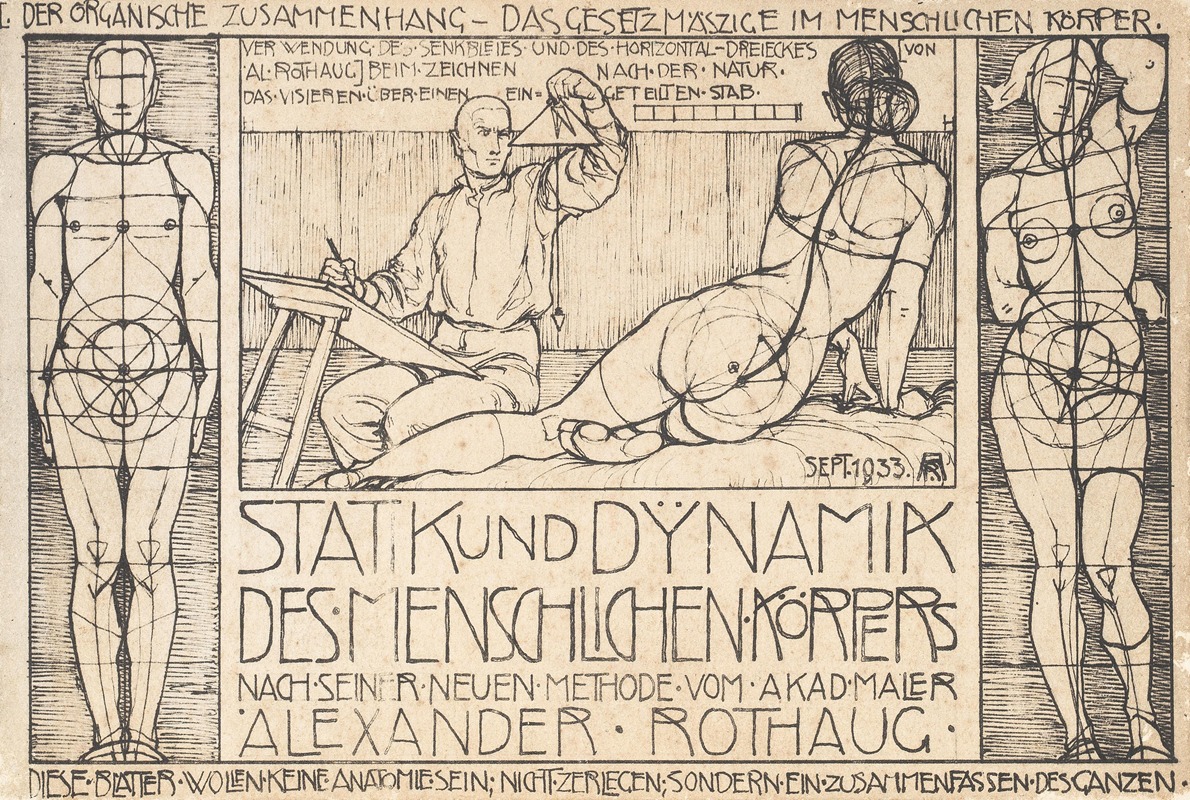
Alexander Rothaug - Statik und Dynamik des menschlichen Körpers Pl.01
Alexander Rothaug: Statik und Dynamik des menschlichen Körpers (1933).

Read Full Post »

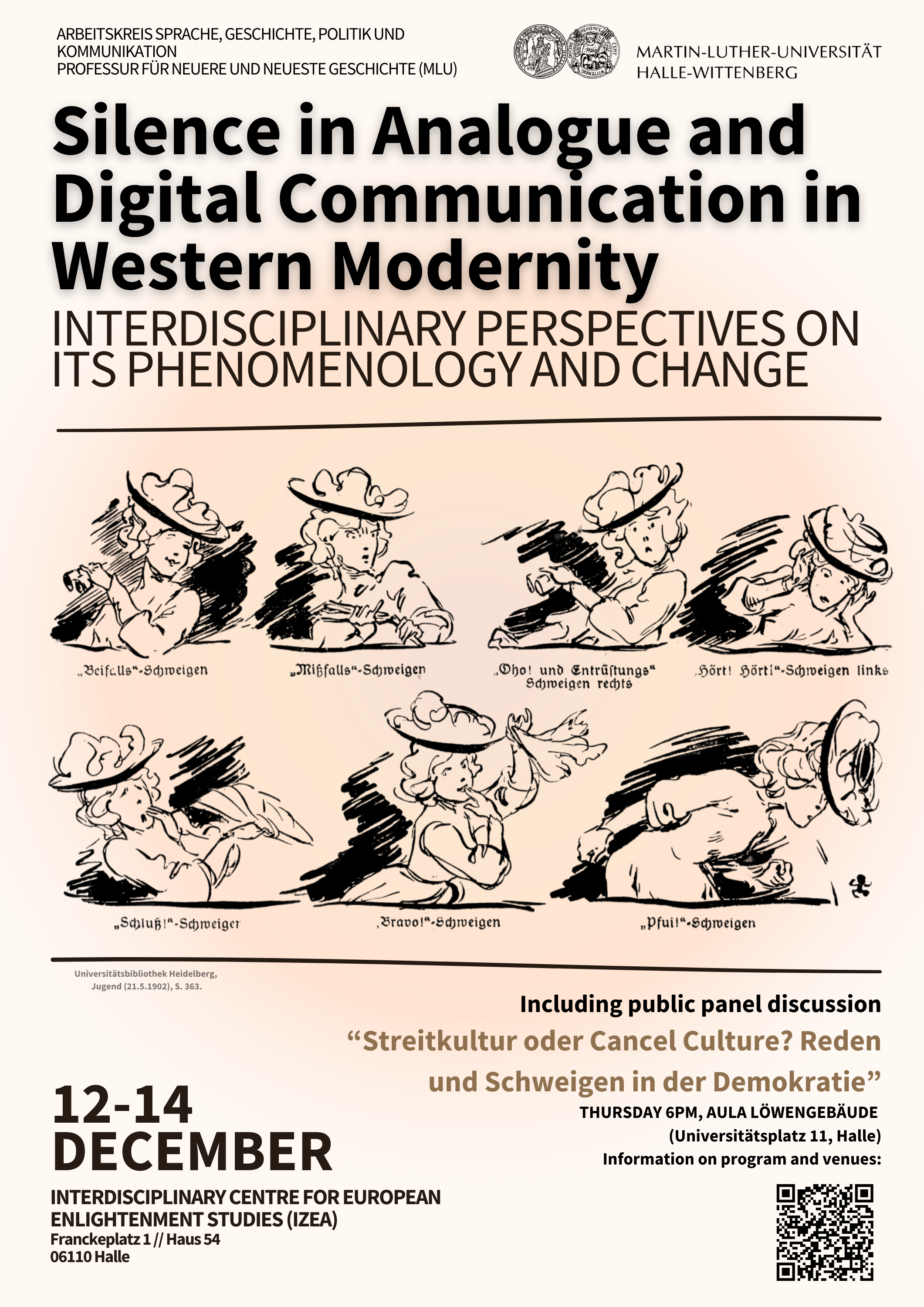
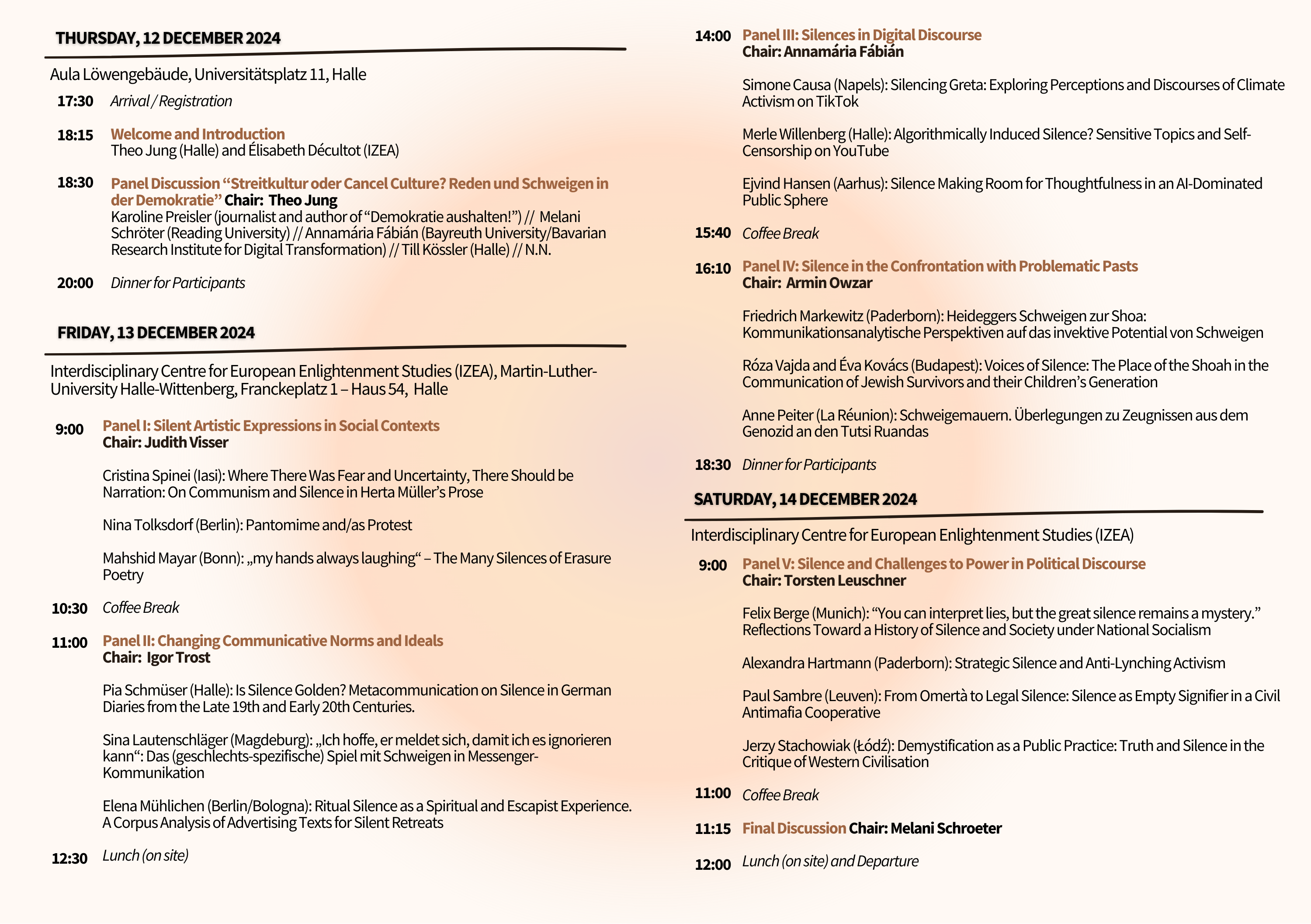
As announced earlier this year, from 12 to 14 December the University of Halle-Wittenberg will host the interdisciplinary conference Silence in Analogue and Digital Communication in Western Modernity. Interdisciplinary Perspectives on Its Variety and Change.

This event is organized by the Arbeitskreis Sprache, Geschichte, Politik und Kommunikation in cooperation with Martin-Luther-University’s Chair of Modern and Contemporary History.

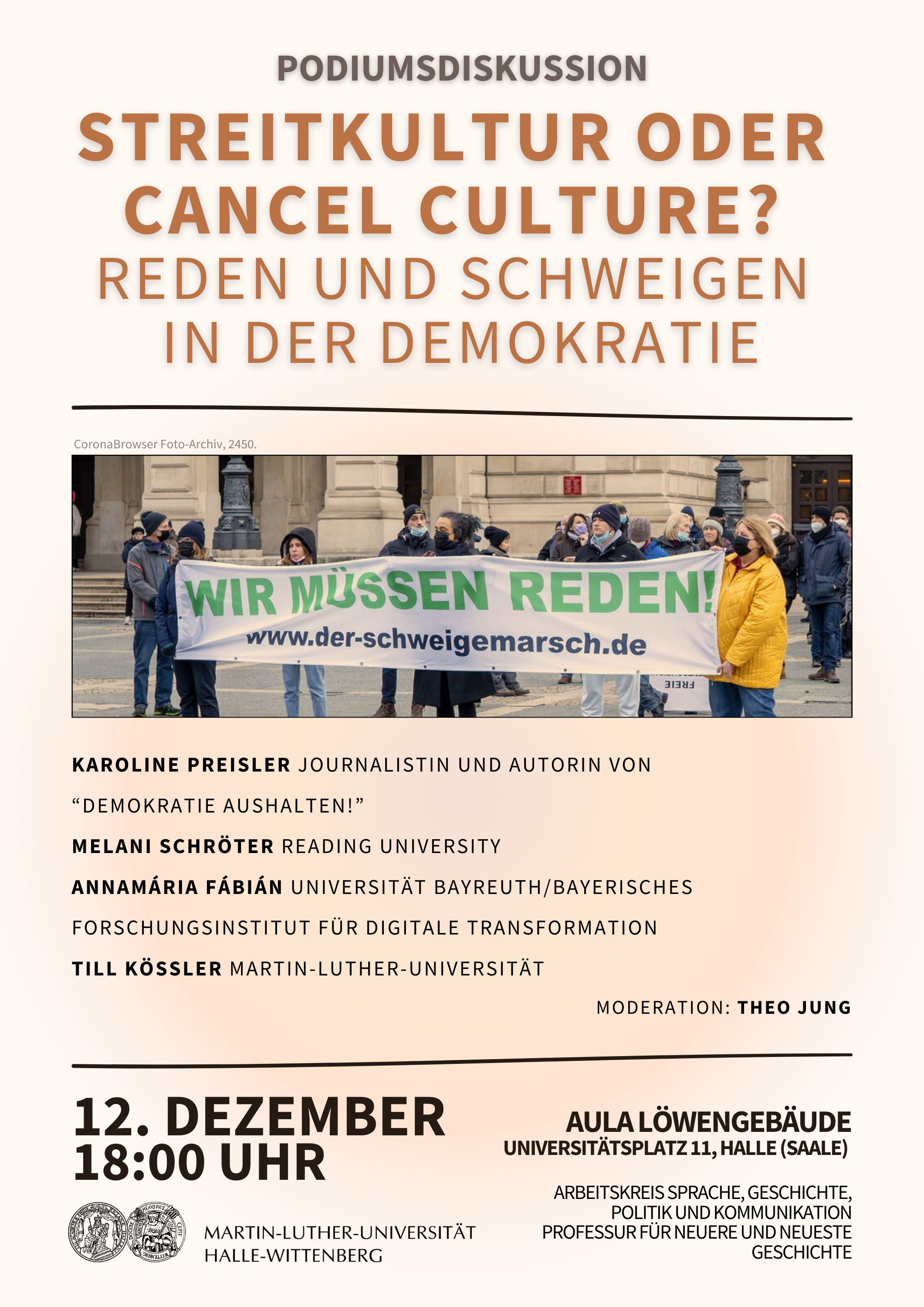
The conference begins with a panel discussion (in German) involving experts from journalism and various academic disciplines, who will tackle the many tensions between speech and silence apparent in current democratic regimes. This event is open to the public and entry is free. It takes place in the university’s main building (Löwengebäude, Universitätsplatz 11).

Many thanks in advance to Karoline Preisler, Melani Schröter, Annamária Fábián, and Till Kössler for their willingness to join in this discussion.

On Friday and Saturday, we continue with a dense program of presentations from the fields of history, literature, media studies, linguistics, memory studies and philosophy. Again, anyone is very welcome to attend one or more of the panels. Please note the different venue for Friday and Saturday: the Interdisciplinary Centre for European Enlightenment Studies, Franckeplatz 1 – Haus 54.

The organizing committee includes: Torsten Leuschner (Ghent), Judith Visser (Bochum), Annamária Fábián (Bayreuth), Armin Owzar (Paris), Melani Schroeter (Reading), Igor Trost (Passau), and myself.

Many thanks in advance to all those participating in the conference, to my co-organizers, as well as to my colleagues at the Chair of Modern History, who have made this possible.

To dowload the program, click here.

Read Full Post »

In April, I will be speaking in Dresden, at the conference “Das Königreich Sachsen 1848/49 – Dynamiken und Ambivalenzen der Revolution” (April 24-26, 2024), organized by Prof. Dr. Susanne Schötz, Prof. Dr. Andreas Rutz and Werner Rellecke.

The program can be downloaded here.

All are welcome and attendance is free.

Conference abstract in German:

Sehr geehrte Damen und Herren,
 
vom 24. bis 26. April 2024 veranstalten die Professur für Wirtschafts- und Sozialgeschichte der TU Dresden, die Sächsische Landeszentrale für politische Bildung und das Institut für Sächsische Geschichte und Volkskunde eine internationale Tagung in Dresden, die sich den revolutionären Ereignissen von 1848/49 im Königreich Sachsen widmet. Niemals zuvor haben sich hier so viele Menschen für Freiheit, Recht und Einheit begeistert wie während der Revolution von 1848/49. Männer und Frauen verliehen ihrem Wunsch nach bürgerlichen Rechten, größerer sozialer Gerechtigkeit und einem vom Volk gewählten sächsischen wie nationalen Parlament auf vielfältige Weise Ausdruck. Sachsen war in dieser Zeit der am dichtesten besiedelte und industriekapitalistisch am weitesten entwickelte deutsche Mittelstaat. Hier hatte sich eine starke Demokratiebewegung entfaltet, zahlreiche Arbeitervereine entstanden und Frauenrechte wurden zum Thema. Doch wie anderswo behielten auch in Sachsen die konservativen Kräfte die Oberhand. Die Tagung spürt den Verflechtungen, Dynamiken und Ambivalenzen des Geschehens aus unterschiedlichen Perspektiven nach. Sie interessiert sich für revolutionäre Karrieren und staatliches Handeln ebenso wie für transnationale und transatlantische Aspekte sowie Formen des Erinnerns und der Revolutionsbewältigung.
 
Die Tagung findet in Präsenz in der Sächsischen Landeszentrale für politische Bildung, Schützenhofstraße 36, 01129 Dresden statt. Das vollständige Tagungsprogramm und den Link zur Anmeldung finden Sie hier: www.isgv.de/tagung1848
Die Anmeldung ist ab jetzt freigeschaltet und noch bis zum 16. April 2024 möglich.
 
Wir freuen uns auf Ihren Besuch!
 
Im Namen des Tagungsteams
 
Prof. Dr. Susanne Schötz

Read Full Post »

On October 5, between 2:15 and 4 pm, I am participating in a panel titled

Deutungskämpfe um die Gegenwart: Zeitgenossenschaft und Zeitdiagnostik um 1800 in der Kontroverse [Controversies over the Present: Debates about Contemporaneity and Temporal Diagnosis around 1800]

at the German Historikertag. The panel is structured as follows:

  • Sebastian Schütte / Susan Richter: Einleitung
  • Theo Jung (Freiburg): Augenblick und Durchblick: Zeitgeistdiagnosen und ihre Kritik um 1800
  • Susan Richter (Kiel): Von der Seife und dem Besteck des Zeitgenossen. Formen und Analyseinstrumente der Zeitdiagnostik im Deutungskampf
  • Sebastian Schütte (Heidelberg): Von Nachtwandlern und Traumfängern im utopischen Dämmerschein. Geschichtsdeutung und Zeitkritik im (vor)revolutionären Paris
  • Uwe Justus Wenzel (Zürich): Auf der Höhe der Zeit und in ihren Niederungen. Einige Probleme philosophischer Zeitgenossenschaft
  • Helge Jordheim (Oslo): Kommentar

[EDIT: a review of the panel written by Kai Gräf has now been published on H-Soz-u-Kult and can be read here.]

Read Full Post »

The program of the UK-German Frontiers of Humanities Symposium 2019, held in Lübeck on 2 to 5 May, has been published on the Alexander von Humboldt Foundation’s website.

Together with seven colleagues from four different disciplines (history, literature, geography, anthropology), I’m part of the organizing committee. The conference’s overall design as well as the session abstracts can be found here.

Read Full Post »

Under the title

Times of the Event: A New Survey of a Historical Category

(Die Zeiten des Ereignisses: Neuvermessung einer historischen Kategorie)

the organizers (Anna Karla (Köln), Jörn Eiben (Hamburg) and myself) are proud to announce the 40th workshop by the Arbeitskreis Geschichte + Theorie, this time in cooperation with the Centre for Contemporary History, to be held in Potsdam on November 9 – 10.

Focusing on its specific temporality, the workshop aims to develop a new theoretical understanding of the event as a fundamental historical category.

Participants include: Frank Bösch (Potsdam), Albert Schirrmeister (Paris), Tobias Hasenberg (Cologne), Thomas Mergel (Berlin), Britta Hochkirchen (Bielefeld), Ramon Voges (Leipzig), Caroline Rothauge (Eichstätt-Ingolstadt), Silvan Niedermeier (Erfurt), Achim Landwehr (Düsseldorf), Uwe Lübken (Munich), Christian Holtorf (Coburg), Alexander Gall (Munich), Iris Schröder (Erfurt), Tobias Becker (London) (more on his contribution here), Fernando Esposito (Tübingen), Ulrike Jureit (Hamburg) and Aleida Assmann (Constance).

The workshop program, including details on the venue, may be found here and here. The working language is German. All are welcome, but registration by email is appreciated.

Read Full Post »

Together with Daniel L. Lee (Sheffield), I’ve been invited to organize a historical panel at the first UK-German Frontiers of Humanities Symposium to be held in May 2019.

This new symposium format is co-funded by the British Academy and the Alexander von Humboldt Foundation as part of the Frontiers of Research program of interdisciplinary, bi-national symposia. Alongside the history panel, there will be contributions from the fields of geography, anthropology and literature.

header_logo_kleinDownload

Read Full Post »

On September 29 and 30, I organize a workshop in Freiburgs Liefmann-Haus (Goethestraße 33-35) under the title

In/Action: Socio-Political Practices of Non-Participation in European Modernity

Nicht/Handeln: Sozio-politische Praktiken der Partizipationsunterlassung in der europäischen Moderne

In contexts in which specific forms of participation are expected, remaining inactive can itself be considered a type of action. Their paradoxical nature notwithstanding, such instances of in/action can produce significant effects, both in terms of symbolic and of practical impact. On the basis of case studies from the European history of the nineteenth and twentieth centuries, the workshop discusses the specific nature and significance of non-participation in a variety of contexts. Engaging with modes of in/action as a specific variety of passive activity, it seeks to understand a type of social and political practices that has hitherto received scant scholarly attention.

Besides opening up new vistas of research, the study of in/action also promises to shed new light on structures of participation in modern societies and their historical development. For what it means not to do something is inseparably linked to current expectations with regard to ‘normal’ or ‘normative’ behavior in a given context. As such, the conflicts and controversies surrounding the failure to participate point beyond themselves to the expectations and constraints of action in various historical constellations.

All are welcome.
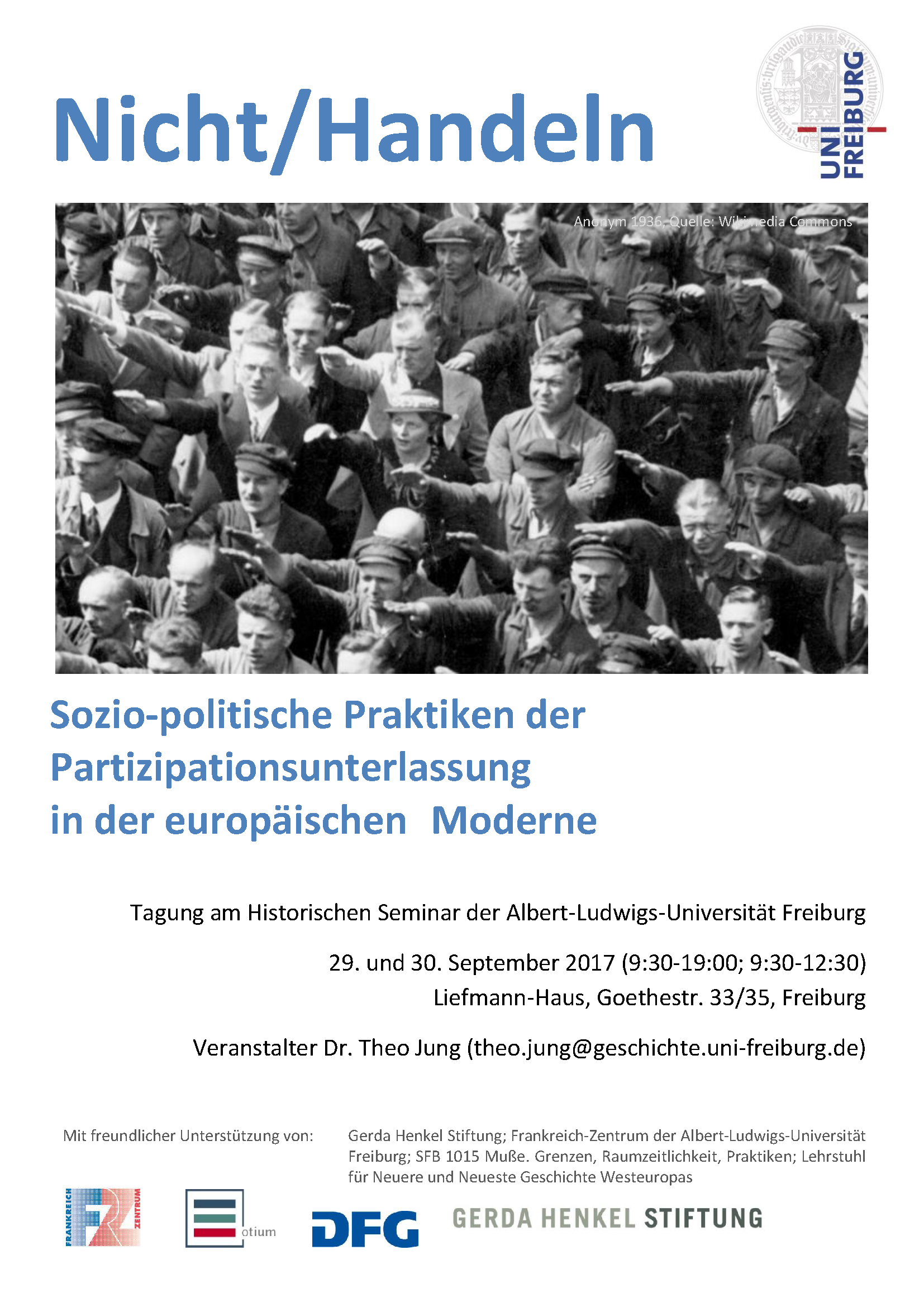
Nicht.Handeln.Poster

The preliminary program (in German) is as follows (download it here):

Freitag, 29. September 2017

9:30 – 10:00

Ankunft und Begrüßung

10:00 – 10:30

Einführung – Theo Jung (Freiburg)

10:30 – 12:30

Sektion I: Konflikt ohne Widerspruch: Politisches Handeln durch Auslassung und Unterlassung

  • Das Desinteresse an politischen Wahlen im 19. Jahrhundert – Hedwig Richter (Hamburg)
  • Conspicuous Non-Consumption. Konsumboykotts als politische Proteststrategie im 20. Jahrhundert – Benjamin Möckel (Köln)
  • Beharren und Verweigerung als Formen des politisch abweichenden Verhaltens in der DDR – Christian Halbrock (Berlin)
  • Kommentar – Michael Freeden (Oxford/London)

12:45 – 14:00

Mittagspause

14:15 – 16:15

Sektion II: Einstieg und Ausstieg: Teilhabe und die Konturen der modernen Gesellschaft

  • Aussteiger. Überlegungen zu einer Figur des 20. Jahrhunderts – Tobias Weidner (Göttingen)
  • Aufrufe und Anleitungen zum Nichtstun seit den 1950er Jahren – Yvonne Robel (Hamburg)
  • Ausstieg vom Ausstieg. Die westdeutsche ‘Jobber-Bewegung’ der 1980er Jahre als doppelte Verweigerung gegen bürgerliches Arbeitsethos und alternative Lebens- und Arbeitsideale – Jörg Neuheiser (Tübingen)
  • Kommentar – Thomas Welskopp (Bielefeld)

16:15 – 16:45

Pause

16:45 – 18:45

Paneldiskussion: Grenzen der Leistungsgesellschaft? Aktuelle Perspektiven

  • Achim Lenz (Haus Bartleby)
  • Jochen Gimmel (Freiburg)

Samstag, 30. September 2017

9:30 – 11:15

Sektion III: ‘… that no matter how one may try, one cannot not communicate.’ Kommunikation und ihr Gegenteil

  • Ausbleibender Applaus: Akklamationsverweigerung als Form öffentlichen Protests in Frankreich (c. 1780-1848) – Theo Jung (Freiburg)
  • ‘Mon affliction filiale’: Dynastie und Völkerrecht im 19. Jahrhundert – Torsten Riotte (Frankfurt a. M.)
  • ‘The End of Conversation’? Debatten über das Schweigen in politischer Face-to-Face-Kommunikation in Deutschland und den USA (1960-2010) – Armin Owzar (Paris)
  • Kommentar – Kerstin Brückweh (Potsdam)

11:30 – 12:30

Schlussdiskussion und Verabschiedung


Mit freundlicher Unterstützung von:

Gerda Henkel Stiftung
Frankreich-Zentrum der Albert-Ludwigs-Universität Freiburg
SFB 1015 Muße. Grenzen, Raumzeitlichkeit, Praktiken
Lehrstuhl für Neuere und Neueste Geschichte Westeuropas, Albert-Ludwigs-Universität Freiburg


file_logo_de

image_mini


Read Full Post »

On April 6 to 7, I will participate in a conference organized by the History of Parliament research group in cooperation with Prof. Christopher Reid of Queen Mary University London.

The conference program may be found here.

My own paper, titled

“A Rhetoric of Silence: Silent Members in the July Monarchy Chamber of Deputies (1830-1848)”,

will be concerned with the rhetorical role of the silent members in the parliamentary debates of the July Monarchy. As I will argue, these silent members were anything but passive. Rather, they developed a complex rhetoric of their own, playing a significant role in the development of debates.

timthumb


Read Full Post »

Older Posts »