Feeds:
Posts
Comments

Posts Tagged ‘Violence’

Resulting from a workshop held last year in Jena, my colleagues Christian Faludi, Marko Kreutzmann and Thomas Kroll have published an edited volume on the tensions between freedom and violence in the European revolutions of 1848/49.
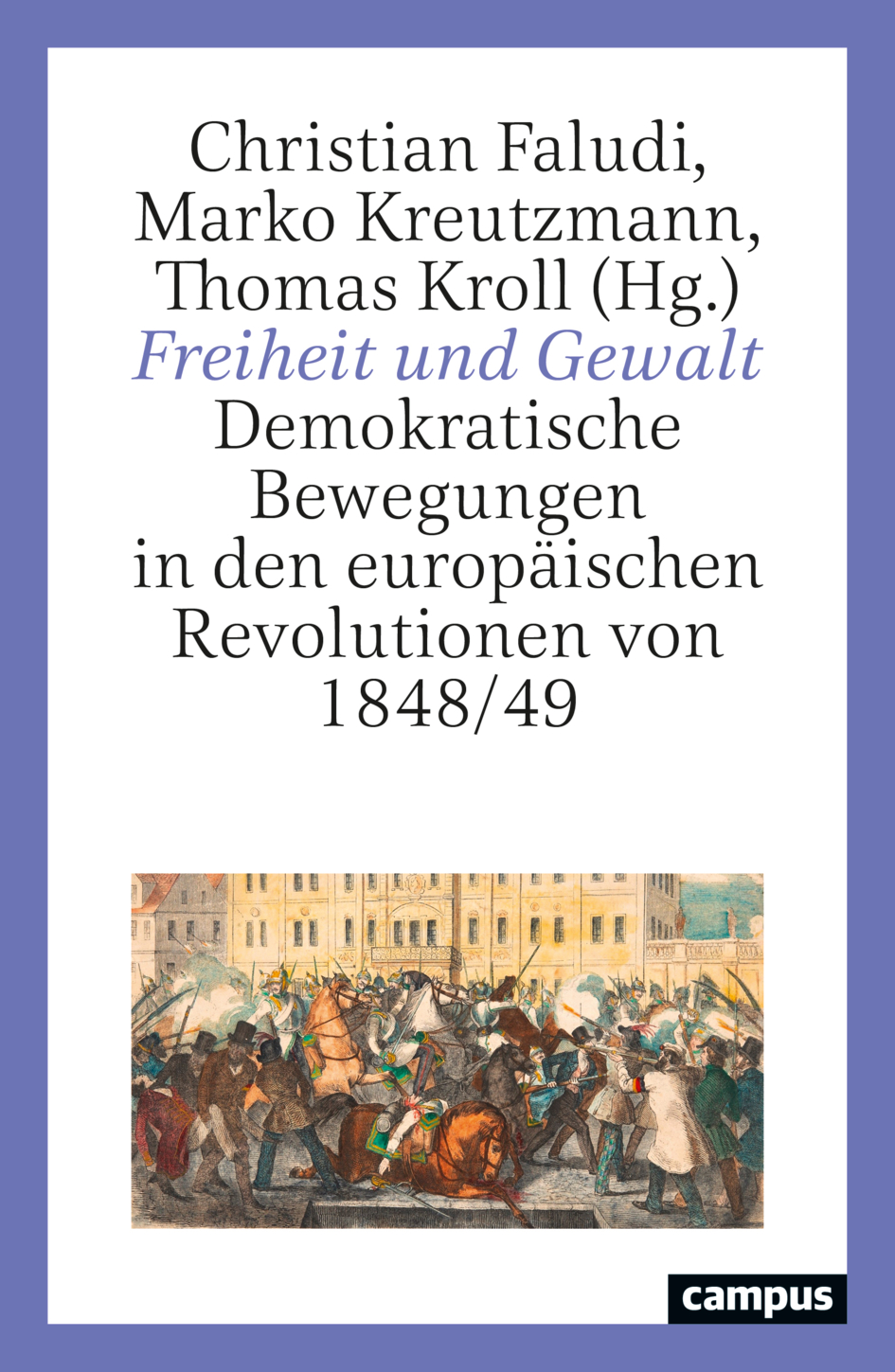
My own contribution to the volume, titled

Ambivalenzen: Neue Perspektiven auf die Geschichte revolutionärer Gewalt 1848/49

[Ambivalences: New Perspectives on the History of Revolutionary Violence 1848/49]

surveys the historical research on the role of violence in the context of the revolutions of 1848/49, identifying three perspectives that have gained new attention in recent years. Besides fruitful new perspectives on the role of structural violence and of the escalatory dynamic of “spaces of violence”, I argue that future research could benefit from a more sustained attention to the role of potential violence. What I call the history of violence “in the subjunctive” traces how contemporaries’ expectations of violence, hopes and fears, influenced how they acted in the revolutionary context.

I thank the editors for their thorough and remarkably fast work in getting this volume together. I’m looking forward to reading the other contributions.

Read Full Post »

Between 14 and 25 June, the Association for Political History organizes its postponed international conference under the title “Layers and Connections of the Political”, regrettably online instead of in Rome.

Participation is free of charge after registration with the organizers (here).

On June 21, at 9.00 – 10.30 CET, I am part of the panel “‘Political Participation’ in Democracy History: A Contested and Ever-Changing Concept and Practice?”, organized by Anne Heyer (Leiden) and Zoé Kergomard (Paris).


Chair:
Ido de Haan (Utrecht)
Discussant:
Harm Kaal (Nijmegen)

Participants:

  • Anne Heyer (Leiden): When did the Masses become Political?
  • Theo Jung (Freiburg): Battling with Words or Fists? Changing Modes of Participation in Political Meetings in Britain and Germany (1867-1914)
  • Carlos Domper Lasús (Zaragoza): The University Work Service. A politicizing experience under Francoism, 1950-1970
  • Zoé Kergomard (Paris): Is electoral abstention also a form of democratic participation? Rethinking the value of voting in the young Vth Republic (1960s-1980s)

The whole program can be downloaded here.

Read Full Post »

Next friday, I’m presenting some of my research at a workshop to be held in Berlin (and online) from 29 to 31 October under the title ‘Unity, Right, – but Freedom?’. It is organised by the Arbeitsgemeinschaft Orte der Demokratiegeschichte in cooperation with the Forschungsstelle Weimarer Republik and the Otto-von-Bismarck Foundation.

The program includes papers on various institutional, intellectual, cultural and political aspects of the German Empire’s governments, parliaments, parties, social movements, military, and citizens.

Otto-von-Bismarck-Stiftung

My own paper, titled

Cultures of Dispute in Imperial Germany

adresses the changing practices and organizational forms of political meetings. It shows how these slowly transformed from an arena of controversial debate to a more monologous form, focused mainly on the demonstration of the strength and energy of different political parties. Sketching the changing dynamics between speakers, audience, and outsiders, I argue that a more detailed analysis of the varying modes of (not just verbal) participation and interaction such venues encompassed can shed new light on the ways the society of the Kaiserreich dealt with political plurality.

The workshop’s (NB updated on Oct 26, 2020!) program can be found here:

Read Full Post »