Feeds:
Posts
Comments

Posts Tagged ‘Politics’

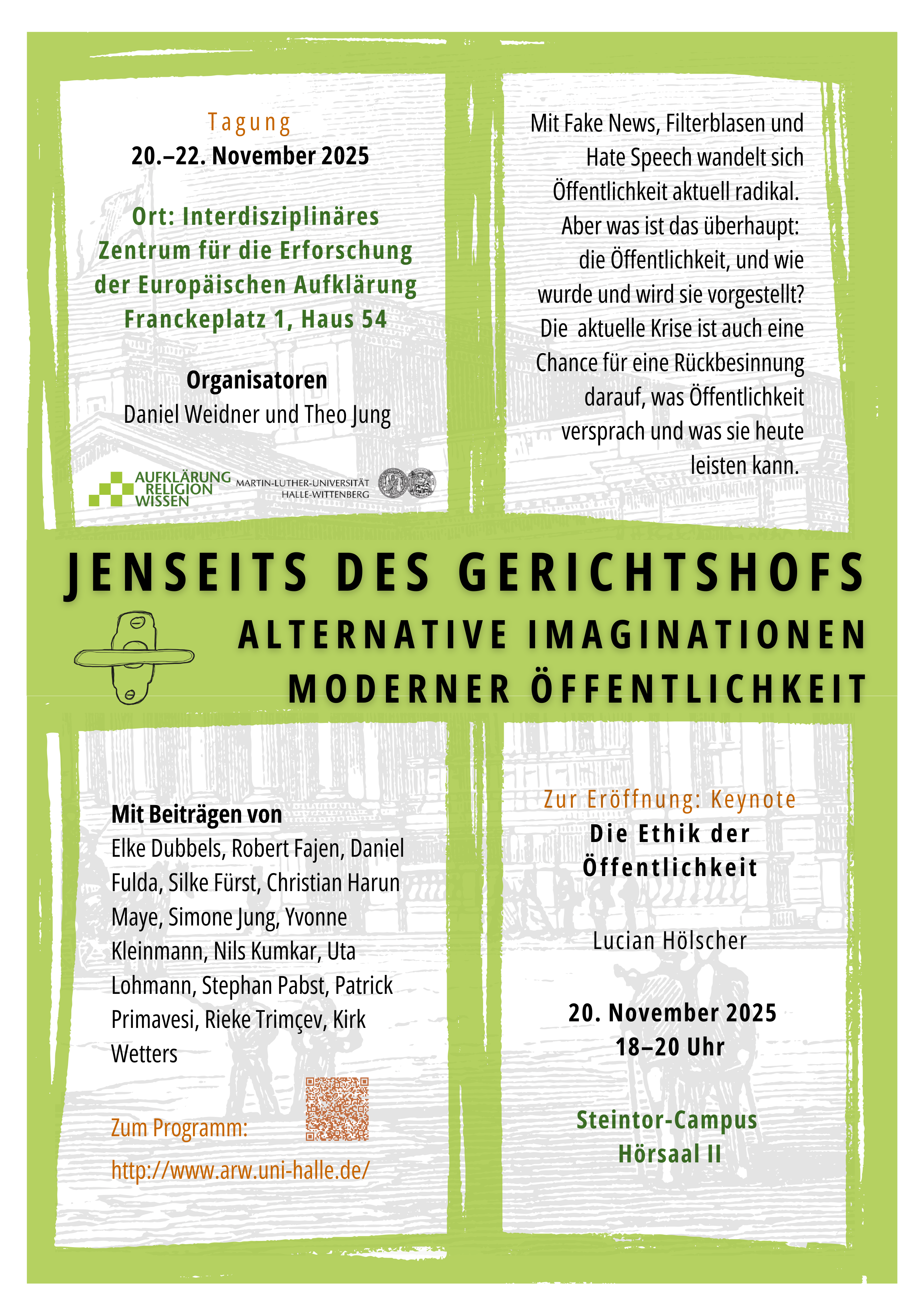
On 20 to 22 November, the yearly symposium of the Martin-Luther-University’s Research Focus “Enlightenment – Religion – Knowledge” will take place under the title

Jenseits des Gerichtshofs: Alternative Imaginationen moderner Öffentlichkeit

(Beyond the Court: Alternative Imaginations of the Modern Publich Sphere)

The symposium has been organized by my colleague Daniel Weidner and myself and will include contributions by

Lucian Hölscher (Bochum), Nils Kumkar (Bremen), Simone Jung (Lüneburg/Halle), Yvonne Kleinmann (Halle), Robert Fajen (Halle), Patrick Primavesi (Leipzig), Uta Lohmann (Hamburg), Christian Harun Maye (Basel), Elke Dubbels (Bonn), Kirk Wetters (Yale), Rieke Trimçev (Halle), Daniel Fulda (Halle), Silke Fürst (Zürich) and Stephan Pabst (Halle).

For further information on the venues and program, see here.


Abstract

In recent years, there has been renewed talk of a crisis of the public sphere. Filter bubbles and fake news, unrestrained insults and cancel culture are discussed as symptoms of decay, disintegration, or dysfunction of the publis phere – although, of course, these debates themselves take place within the public sphere itself. But what, in fact, is this “public sphere”? How de we imagine it, how do we describe it, and what conclusions do we draw from this?

The current diagnosis of crisis offers an opportunity for a critical genealogy, since the sense of crisis may itself stem, not least, from the fact that certain established imaginations of the public sphere have become fractured and questionable. Such a moment invites renewed reflection on what the public sphere was, is, and could be – and may point to traces laid down since the formative period of modern publics that have as yet not been fully pursued.

Read Full Post »
Five PhD positions for researchers from all humanities disciplines are available in the DFG-funded Research Training Group (GK) “Politics of the Enlightenment”, based at Martin-Luther-University Halle-Wittenberg.

Deadline: October 27, 2025.

More information: https://polight.uni-halle.de/en/five-positions-as-research-associates-m-f-d-for-doctoral-studies-available-2/

Read Full Post »

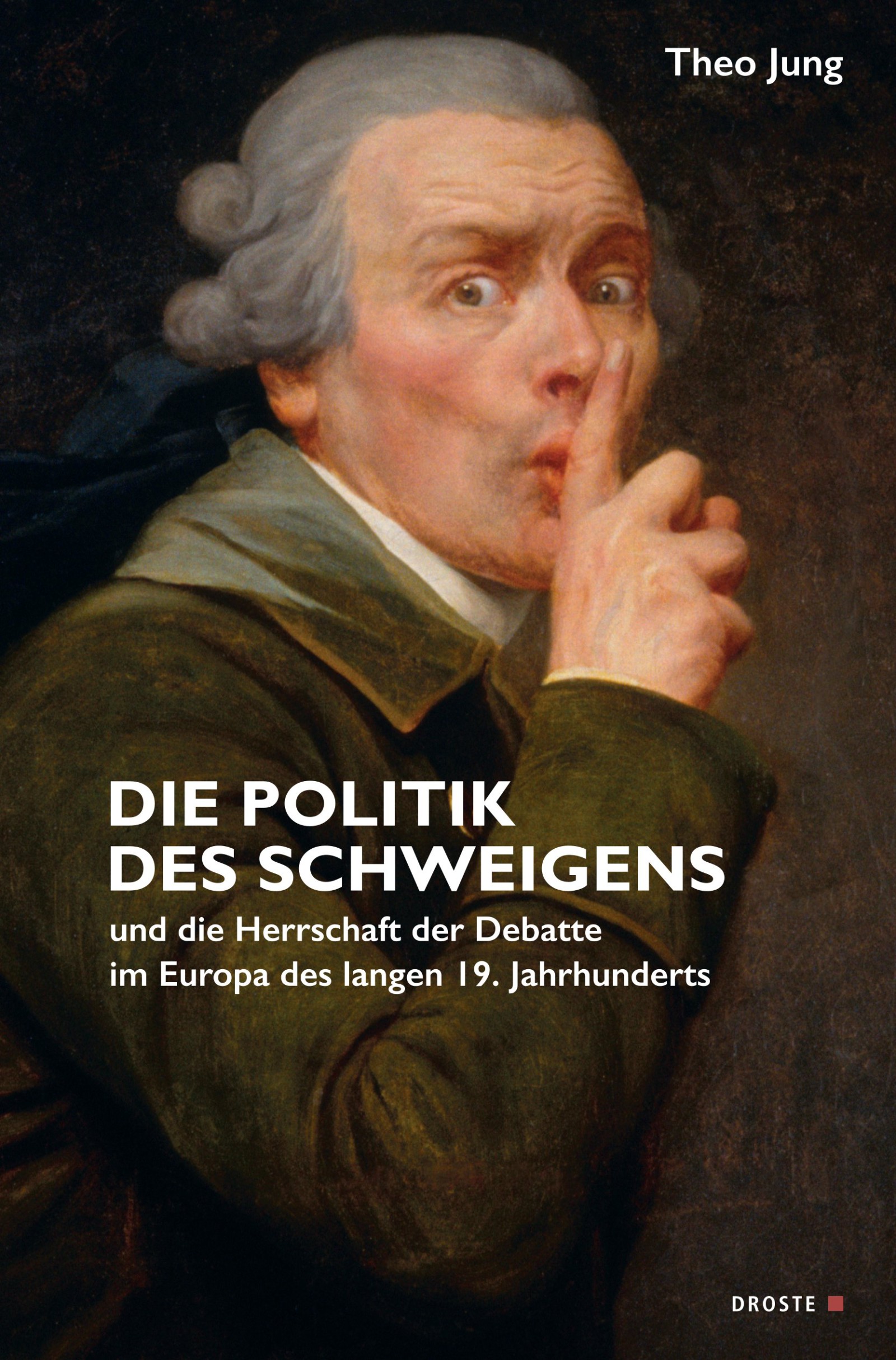
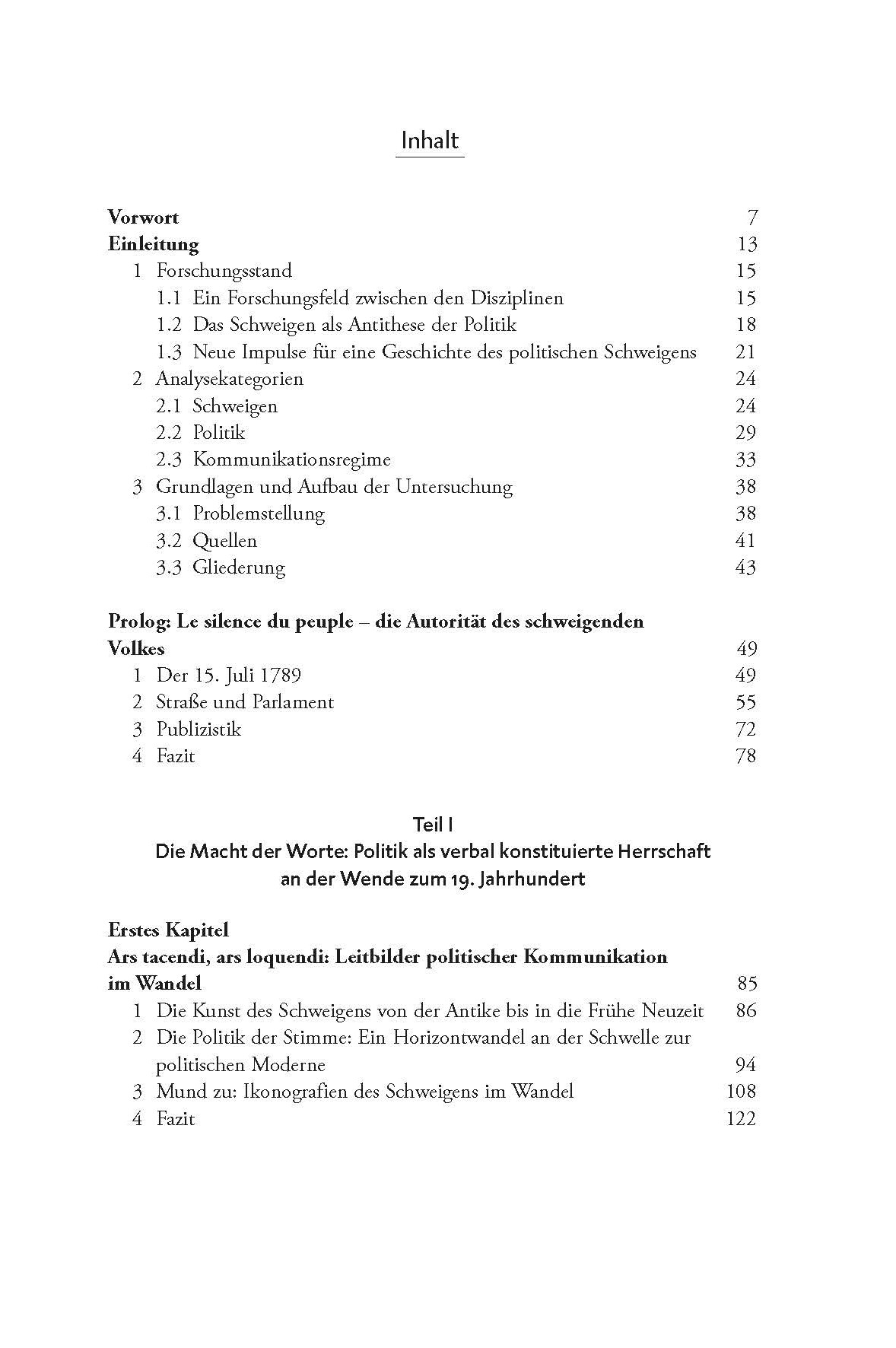
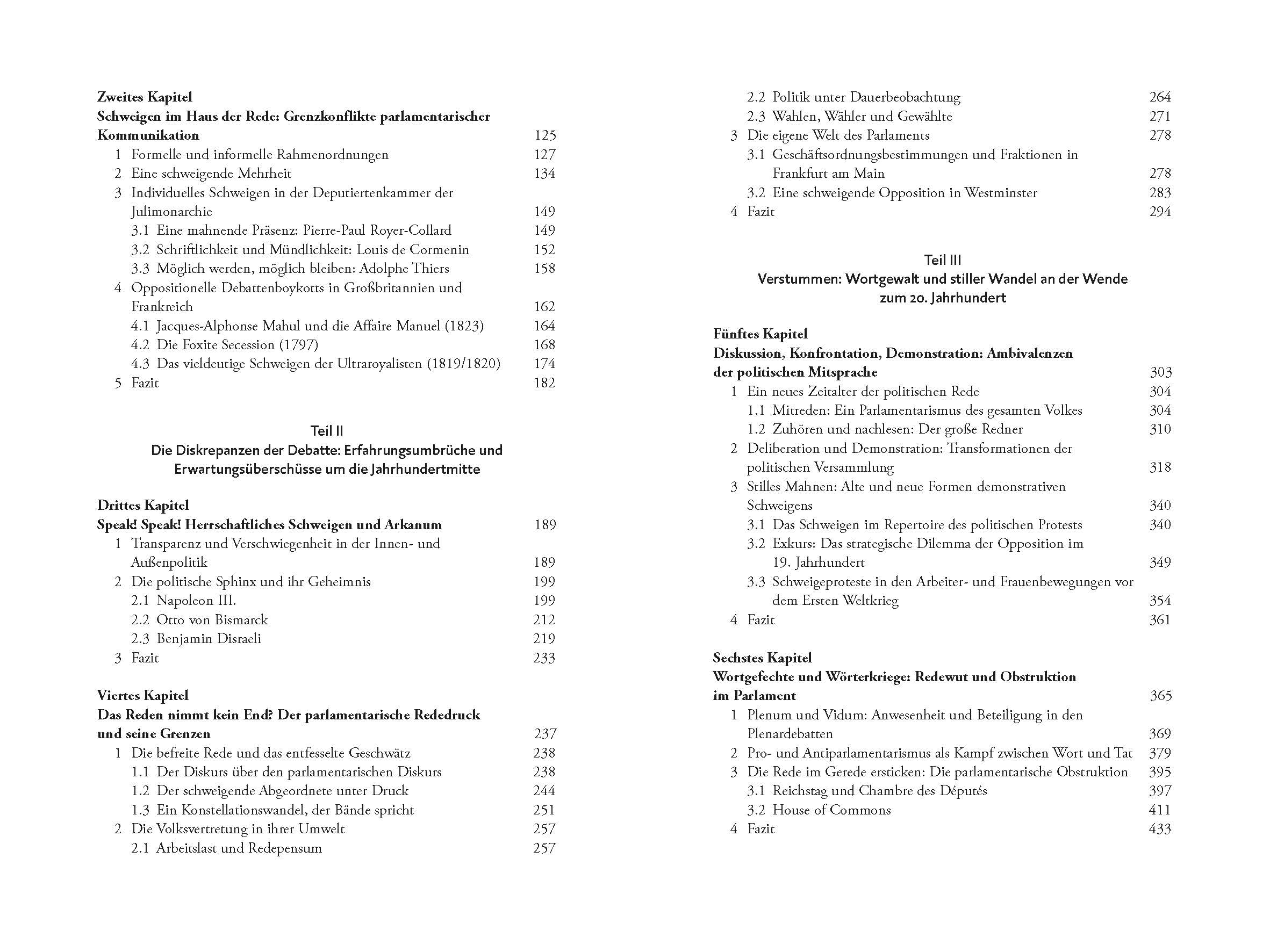
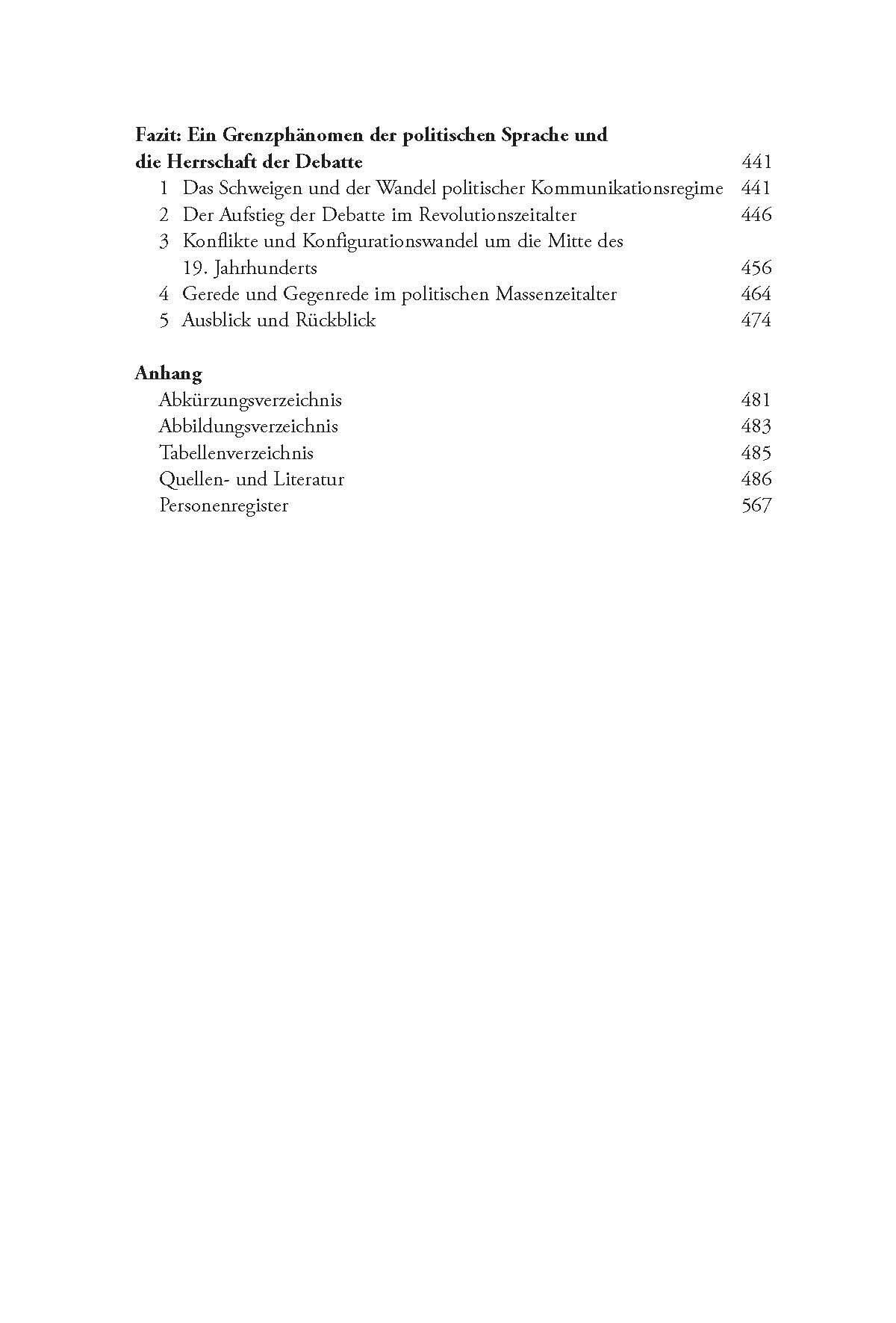
My book on the political role and meanings of silence during the long nineteenth century has now been published by Droste.

A preview of its contents my be found here.

And more information on the website of the KGParl here.

I’m very grateful to the Kommission für Geschichte des Parlamentarismus und der politischen Parteien and the editors of the Beiträge zur Geschichte des Parlamentarismus und der politischen Parteien for including my work in this prestigious series, as well as to Verena Mink for coordinating the publishing process.

Read Full Post »

In the context of a two-day workshop organized by my colleague Paulina Gulińska-Jurgiel and myself about methodological developments in the historical scholarship on parliaments, we present a public panel discussion (in German) titled

The Endangered Legislative? Historical and Contemporary Challenges in Dialogue

With our guests

Dr. Claudia Gatzka (Albert-Ludwigs-Universität Freiburg)

Prof. Dr. Thomas Lindenberger (Hannah-Arendt-Institut für Totalitarismusforschung / TU Dresden)

Dr. Danny Schindler (Institut für Parlamentarismusforschung)

we discuss the current state of parliamentary politics against the background of historical crises and developments.

Abstract

With every state and federal election, debates about the state of democracy are reignited. Ardent debates circle around justified fears of far-right parties entering parliaments and the associated risk of the institution being undermined or disempowered. While the legislature is often seen as the last fortress of democratic rule, it also increasingly appears as a fragile construct. But what is its real status today? What can parliaments and the people involved in them actually do against the onslaught of opposing forces? What instruments do they have at their disposal to protect themselves and democracy? Or should we look for alternative formats and ways of democratic representation that go beyond the concept of a legislative as the only legitimate representation of the people, enabling a different kind of social participation without falling into the trap of populism?

The discussion, which is open to all interested (free of charge), takes place in the university’s Aula (Löwengebäude), on June 25, 6 – 8 pm.

Read Full Post »

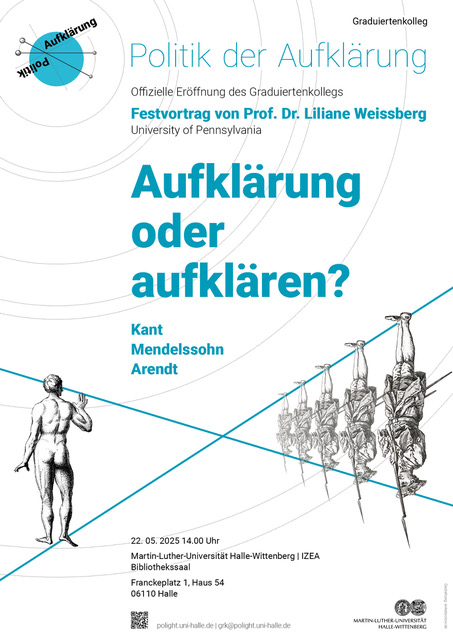
The new DFG Research Training Group “Politics of the Enlightenment”, which has started its work at the University of Halle-Wittenberg with eight doctoral and one post-doctoral researchers this month, will be officially inaugurated on May 22.

Besides various presentations by the Training Group’s members, the university’s rector, Prof. Dr. Claudia Becker, will give an official address. The ceremony is concluded with a key note speech by Prof. Dr. Liliane Weisberg, the Training Group’s first fellow and a distinguished expert in the field of Enlightenment studies.

The ceremony will be held at the library of the Interdisciplinary Centre for European Enlightenment Studies. All are welcome to join us for this festive occasion.

Read Full Post »

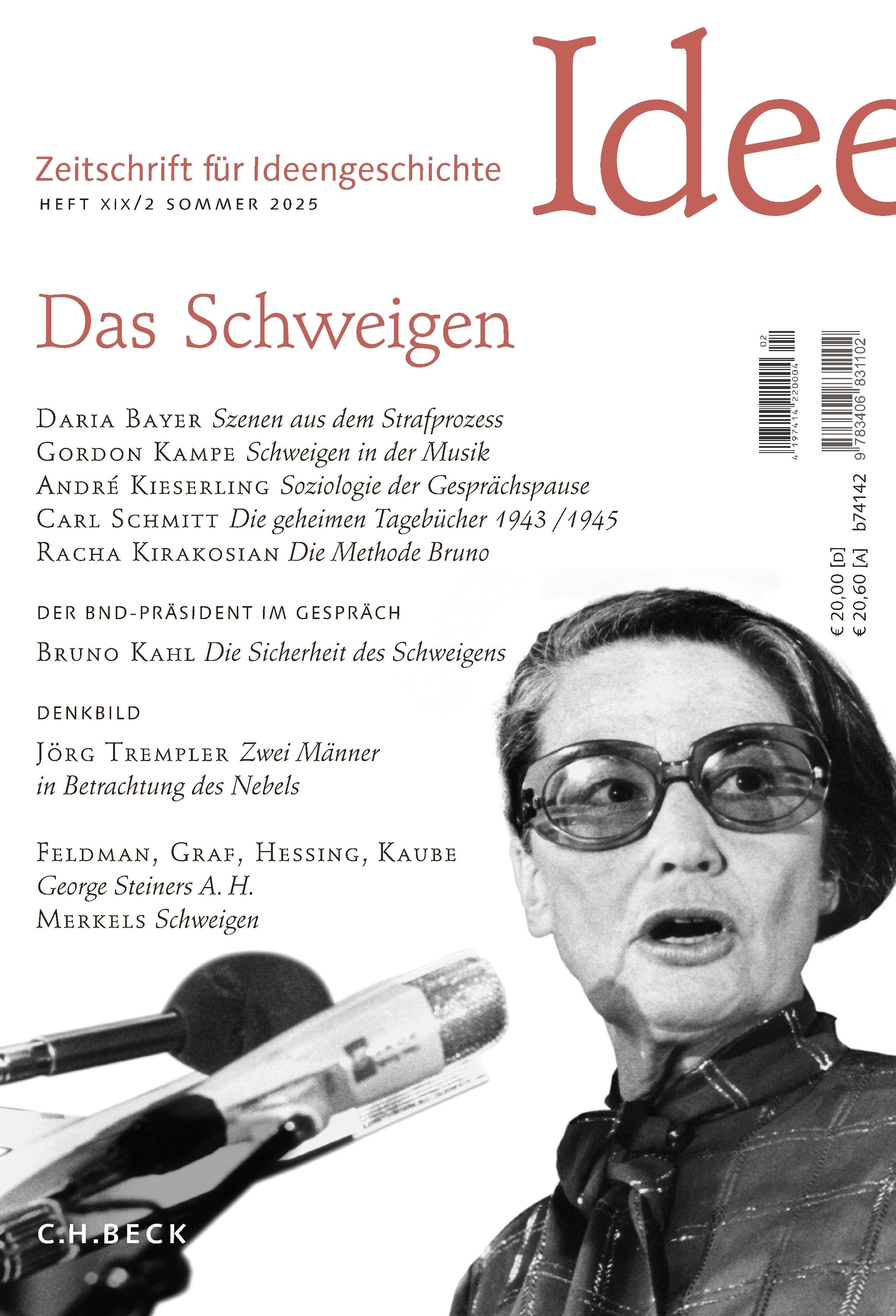
For the upcoming issue on silence to be published on May 15 by the Zeitschrift für Ideengeschichte, I’ve written a short article on the complex tensions between publicity and secrecy in the European secret societies of the late eighteenth and early nineteenth centuries.

Arkanum a. D. Geheimgesellschaften und Öffentlichkeit, in: Zeitschrift für Ideengeschichte 19, Nr. 2 (2025), 50–58. DOI: 10.17104/1863-8937-2025-2-50.

I’m looking forward to reading the other contributions and thank the editors for their thorough assistance with the writing and publication process.

Read Full Post »

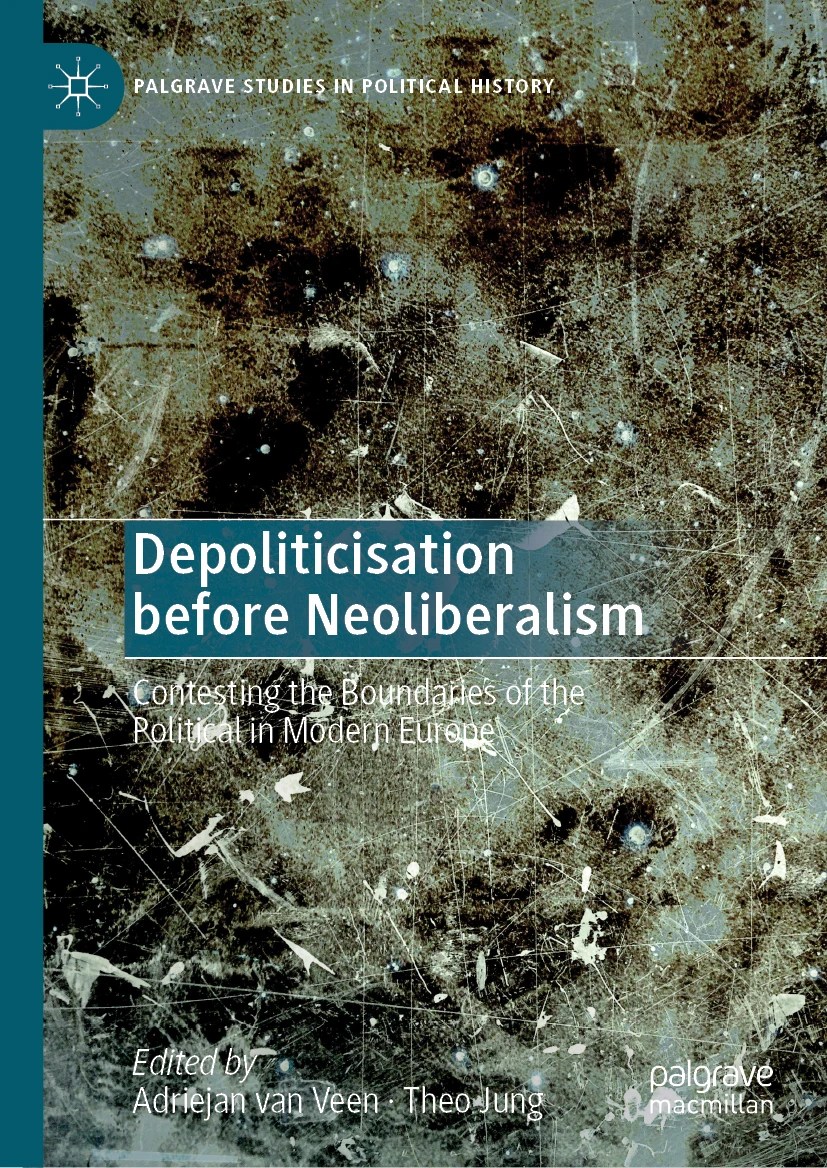
Building on a workshop organized by my colleague Adriejan van Veen and me in 2022, we have been working on an edited volume titled “Depoliticisation before Neoliberalism. Contesting the Boundaries of the Political in Modern Europe”. We were able to bring together a range of scholars from diverse national backgrounds and with different areas of expertise to study the phenomenon of depoliticisation in a long-term and european-wide perspective.

We are very happy that the volume has now been announced as part of the series Palgrave Studies in Political History.

The book’s announcement reads as follows:

This book analyses processes of depoliticisation in modern Europe from the emergence of a distinct ‘political’ sphere in the late eighteenth century until the present day. Drawing on case studies from across the continent, it demonstrates that depoliticisation has played an integral part in the contestation of modern politics since its inception. Developing a novel conceptual framework, the authors argue that depoliticisation is much more than a simple negation of politics. Rather than an anonymous and amorphous process, depoliticisation often presents an express, actor-driven effort, with modes and forms no less varied than the more familiar manifestations of politicisation. Consequently, the chapters encompass a whole range of depoliticising discursive strategies, performative practices, and institutional rearrangements, playing out across different regime types, from revolutionary orders and representative governments with limited franchises to mass democracies and totalitarian dictatorships. Illustrating how historical actors understood ‘the political’ and in which ways they intervened to renegotiate its boundaries, this book seeks to enhance our understanding of modern politics and pose questions that still resonate today. At a time when the boundaries of the political are once more heavily contested, this book offers thought-provoking insights that will appeal to scholars of history, political science, and sociology, as well as to activists and political practitioners.

Behind the scenes, my co-editor and I are still busy working out the last stages of the publishing process and it will probably still take some time until we hold the actual book in our hands, but we are very content that we are now seeing some first ‘signs of life’ and want to express our heartfelt gratitude to our contributors.

Table of contents

  • Adriejan van Veen and Theo Jung: Depoliticisation in Modern European Politics: An Introduction
  • Ido de Haan: Historicising Depoliticisation: Dimensions of the Political and Its Alternatives

    Part I: Discursive Depoliticisation: Ideas, Concepts, and Rhetoric
  • Matthijs Lok: Depoliticisation after Revolution: Moderation, Science and the State in the Nineteenth Century
  • Tamar Kojman: Between Religion and Politics: Constructing an Apolitical Sphere after the 1848–1849 German Revolutions
  • Ruben Ros: Depoliticising Democracy: Technocratic Antipolitics in Dutch Interwar Political Culture (1917–1939)
  • Stefan Scholl: Depoliticising the Economy? Semantic Struggles about ‘Politics’ and ‘the Economy’ during the Weimar Republic and National Socialism

    Part II: Doing Depoliticisation: Practices and Performances
  • Adriejan van Veen: “The Silent Citizen Became a Hero!” State, Civil Society, and the Depoliticisation of Dutch Society in the Restoration Era
  • Oriol Luján: Not Only Apathy and Disinterest: Abstention and the Blank Vote as Modes of Repoliticisation in Nineteenth-Century Europe
  • Eva Visser: Planning the Technate: The Apolitical Politics of the 1930s’ Technocratic Movement in the United States and Europe
  • Zoé Kergomard: Depoliticisation in Danger of Repoliticisation? The Ambiguities of Gaullist Get-Out-the-Vote Campaigns in the Early French Fifth Republic (1958–1969)
  • Adéla Gjuričová: Antipolitics as a Political Tool of Czech Dissent: From Earlier Roots to Its Second Life after 1989

    Part III: Institutional Depoliticisation: Delegation and Neutralisation
  • Mart Rutjes: Access Denied: The Institutional Depoliticisation of Representative Government during the Dutch Revolution, 1780–1801
  • Jan-Markus Vömel: (Un)Political Islam? Contesting the Turkish State’s Depoliticisation of Islam
  • Wim de Jong: The Police and the Political: The Problem of Depoliticisation in Dutch Municipal Policing, 1945–2002
  • Anna Catharina Hofmann: An Administered Society? Economic Planning and (De)Politicisation in the Late Franco Dictatorship
  • Koen van Zon: Eliminating Pests, Eliminating Politics? The European Community’s Regulation of Pesticides, 1958–1991

Read Full Post »

For a volume on practices of silence edited by Karolin Wetjen, Philipp Müller, Richard Hölzl and Bettina Brockmeyer, I wrote a chapter on the emergence of the silent march as a mode of protest.

Der Schweigemarsch. Entstehung und Funktionsvielfalt einer Protestpraxis in Europa und den Vereinigten Staaten (ca. 1880–1925)

[The Silent March. Emergence and Functions of a Protest Practice in Europe and the United States (c. 1880–1925)]

The chapter shows how the silent march first became established in the protest repertoire at the turn of the twentieth century, when in the context of the emerging political mass market various groups experimented with new modes of public protest. It approaches its topic in three steps. Firstly, it asks to what extent the boom of the silent march around 1900 was linked to earlier events of silent protest or to other practices established during the 19th century. Secondly, taking the French case as an example, I sketch the diversity of the contexts in which this mode of protest was used at the turn of the 20th century. The third, longest section takes a closer look at three protest movements in which the silent march played a particularly prominent role (the labor movement, the women’s movement and the African-American civil rights movement). Finally, I draw some comparative conclusions about the functions of this mode of protest and their historical development.

Read Full Post »

We have received notice that a new interdisciplinary Research Training Group, which I had applied for with a group of colleagues of the universities of Halle-Wittenberg, Leipzig and Erfurt, will be funded by the DFG (German Research Foundation). This means that from 2025 on, PhD students, visiting scholars and other researchers will be developing a wealth of new projects on the global “Politics of Enlightenment” since the eighteenth century.

Calls for application for PhD and Post-Doc positions will follow soon.

The Politics of Enlightenment

The Research Training Group (RTG) examines the politics of the Enlightenment from the 18th to the 21st century. Its approach is twofold: firstly, it analyzes the political claims and interpretations that have been fostered by the Enlightenment or in its name, and, secondly, the political discussions and measures which determines our understanding of Enlightenment that is constantly reinterpreted according to political interests and concepts. The project thus combines the study of the historical Enlightenment—here it relates in particular to recent research which has emphasized the complexity and diversity of Enlightenment movements— with the study of its impact, appropriation, and reinterpretation up to the present day.

Apparently, ‘Enlightenment’ is once again moving to the center of political debates on, for example, the crisis of the public sphere and the disappearance of truth. The historical expansion goes along with a spatial one, as the reassessment of the Enlightenment is no longer a European phenomenon but must be considered in a global context. This spatial widening is paid tribute to by the transnational conception of the RTG and by the inclusion of a postdoctoral position that focusses on issues of Enlightenment beyond Europe. Methodologically, these historically and geographically broad perspectives on the politics of the Enlightenment allow for the fruitful integration of different approaches such as the history of ideas and concepts, social and cultural history, political science and philosophy as well as literature and cultural studies, which is reflected in the team of applicants.

The joint work is oriented towards four thematic axes, which are both central to eighteenth century politics and to current references to Enlightenment: ‘civilization’; ‘public sphere’; ‘secularity’; ‘plurality’. The doctoral students will find a lively interdisciplinary working environment, that provides them with ideal conditions for completing their work. Thanks to its location at the Interdisciplinary Centre for the Study of the European Enlightenment (IZEA) at Martin-Luther-University Halle-Wittenberg (MLU), the Research Training Group will be firmly anchored in Enlightenment research. In addition, the range of applicants’ institutional affiliations link the future doctoral students with two faculties at MLU, the Research Centre Gotha at the University of Erfurt as well as the Institute of Philosophy at the University of Leipzig.

Read Full Post »

In 2022, I attended the workshop “Ruling the Assembly. Procedural Fairness, Popular Emotion, and the Access to Democracy (19th-20th Centuries)“, organized by Dr. Anne Heyer (Leiden), Dr. Anne Petterson (Nijmegen) and Prof. Dr. Henk te Velde (Leiden) in Amsterdam. It explored how politicians and citizens tried to resolve the tension between reasonableness and accessibility of political debate, both in and outside Western European parliaments. What did political newcomers have to do in order to be listened to? What meaning did parliamentary rules have for citizens participating in public political discussions? And above all, how did they develop norms and practices for the conduct of democratic politics?

Some of the workshop’s contributions, including my own, have now been published in a special issue of the journal Parliaments, Estates and Representation.

My own contribution is titled

In All Seriousness: Laughter in the German Reichstag, 1871-1914

It can be accessed (Open Access) free of charge here.

Abstract

The ideal of parliamentary debate is often construed in terms of a disimpassioned exchange of arguments. Yet in its actual practice, emotions play a key role. As recent studies of French, Belgian, British, and other parliaments have shown, a closer look at the uses and understandings of laughter in the plenary debates can provide a useful entry point for a better understanding of the difficult to grasp atmospheric dimension of debates. Focusing on a case that has hitherto received little attention – the early decades of the German Imperial Reichstag – this contribution considers the varying modes of parliamentary humour, laughter and ridicule and their significance in the context of rhetorical struggles and processes of political in- and exclusion. In comparative dialogue with research on other parliaments (contemporary and otherwise), it contributes to a more precise characterisation of the internal dynamics of an institution still very much in flux, both in terms of its inner structures and its position within the wider framework of imperial politics. While contemporaries made a sharp distinction between exclusionary laughter and inclusionary mirth (Heiterkeit), a closer look at the plenary interactions shows that while parliamentary laughter performed many different functions, on the whole it primarily constituted a mechanism of de-escalation. Even the sharpest wit and ridicule helped generate an atmosphere in which political conflict could be negotiated without further escalation. As such, parliamentary humour did not stand in opposition to (rational) debate, but rather played a key role in the management of difference and conflict that the parliament was created to facilitate.

Read Full Post »

Older Posts »