Next week, I’ll be speaking at the German History Society’s Annual Conference in Loughborough. I’m part of a panel on “Democracy in German Lands, 1780-1870”, organized by Prof. Mark Philp. My own talk is titled
Prussian Democracy? Territorial Variations in a Complex State (1815-1870)
I will address the variability of the concept of democracy in the Prussian context, focusing on some lesser-known patterns of use, especially the issues of democratic bureaucracy and local democracy.
In it, I will question the common way in which these concepts are framed in terms of a dichotomy or opposition, instead asking how historical scholarship copes with situations that are dynamic and static at the same time (but in different ways).
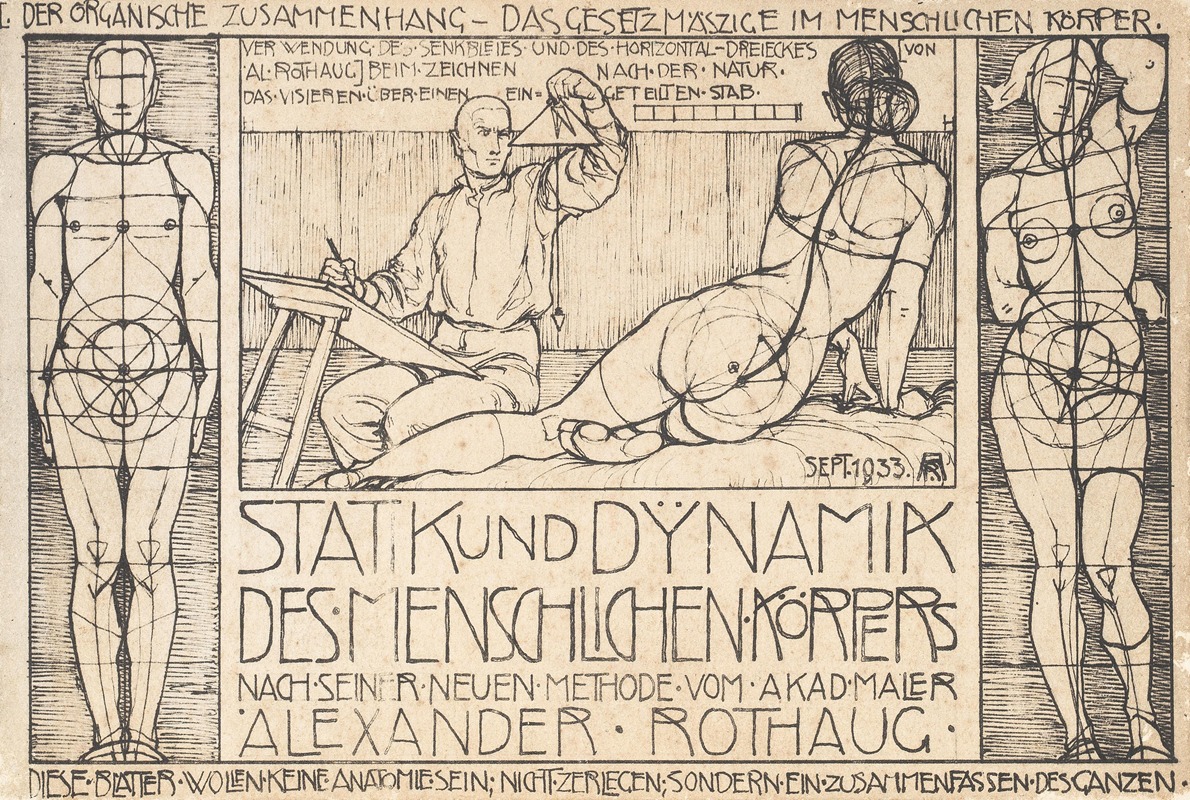
Alexander Rothaug: Statik und Dynamik des menschlichen Körpers (1933).
In the context of a two-day workshop organized by my colleague Paulina Gulińska-Jurgiel and myself about methodological developments in the historical scholarship on parliaments, we present a public panel discussion (in German) titled
The Endangered Legislative? Historical and Contemporary Challenges in Dialogue
we discuss the current state of parliamentary politics against the background of historical crises and developments.
Abstract
With every state and federal election, debates about the state of democracy are reignited. Ardent debates circle around justified fears of far-right parties entering parliaments and the associated risk of the institution being undermined or disempowered. While the legislature is often seen as the last fortress of democratic rule, it also increasingly appears as a fragile construct. But what is its real status today? What can parliaments and the people involved in them actually do against the onslaught of opposing forces? What instruments do they have at their disposal to protect themselves and democracy? Or should we look for alternative formats and ways of democratic representation that go beyond the concept of a legislative as the only legitimate representation of the people, enabling a different kind of social participation without falling into the trap of populism?
The discussion, which is open to all interested (free of charge), takes place in the university’s Aula (Löwengebäude), on June 25, 6 – 8 pm.
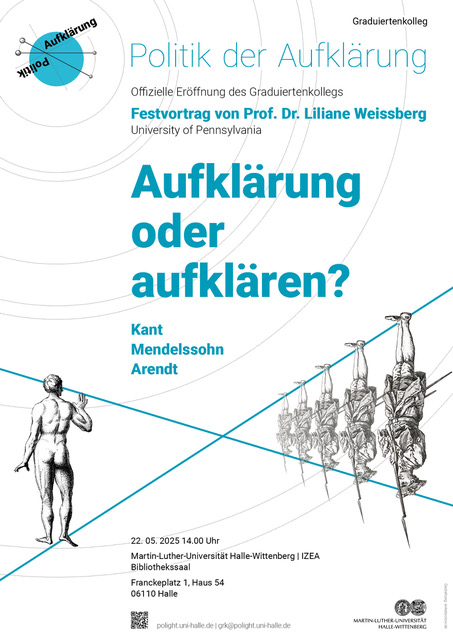
The new DFG Research Training Group “Politics of the Enlightenment”, which has started its work at the University of Halle-Wittenberg with eight doctoral and one post-doctoral researchers this month, will be officially inaugurated on May 22.
Besides various presentations by the Training Group’s members, the university’s rector, Prof. Dr. Claudia Becker, will give an official address. The ceremony is concluded with a key note speech by Prof. Dr. Liliane Weisberg, the Training Group’s first fellow and a distinguished expert in the field of Enlightenment studies.
I’m pleased to announce that together with my colleague Pia Schmüser, I’ll be presenting at the upcoming international conference “Egodocuments from Medieval Codex to Modern Media: Narratives, Presentations, Identities“, which takes place in Vilnius from May 15–17, 2025.
Our presentation is titled: “Diaries as Alter-Ego-Documents: Constructions of Diaries as a Personified Dialogical ‘Other’ in Late 19th and 20th Century Germany.”
Our talk is part of our broader collaborative work within the research project “Between Voice and Silence: Communicative Norms in Diaries, 1840-1990”, funded by The Leverhulme Trust as a collaboration between the University of Reading, UK, and the University of Halle Wittenberg, Germany, with support from The Great Diary Project in London and the German Diary Archive (Deutsches Tagebucharchiv) in Emmendingen.
The conference, organized by Nicolaus Copernicus University in Toruń, Vilnius University and the University of Lodz within the context of the International Egodocumental Research Group, brings together scholars from across Europe to explore the interpretive potential of ego-documents—letters, diaries, autobiographies, and more—as vital sources for understanding historical subjectivities and experiences. We’re very much looking forward to the exchange of ideas and the opportunity to connect with fellow researchers working on the many voices—spoken and unspoken—of the past.
More about the conference can be found here and here.
Together with my colleagues Till Kössler and Robert Buch, I’ve organized a panel discussion on the cultural, political, social and philosophical implications of recent developments in the field of Artificial Intelligence. Under the title “Künstliche Intelligenz und das Ende des Menschen?” / “Artificial Intelligence and the End of Humanity?” we have invited
to reflect on the broader significance of this technological shift, which is too often discussed only in terms of euphoric optimism or apocalyptic worries. How does our perspective on ‘humanity’ change against the background of the increasing prevalence of self-thinking machines? The discussion brings different voices from culture and science into conversation with one another to develop a sharper perspective on what the future co-existence of man and machine might entail.
In my presentation titled 1848/49 nach 175 Jahren: Kritische Perspektiven auf eine demokratiegeschichtliche Vereinnahmung, I will address the increasingly ubiquitous framing of the revolution as a “democratic departure”, reflecting on its implications and pitfalls.
All are welcome and attendance is free. The lecture will also be broadcast on Youtube and Zoom (more information on access is available here and here).
Edit: the lecture has now been made available on Youtube here.
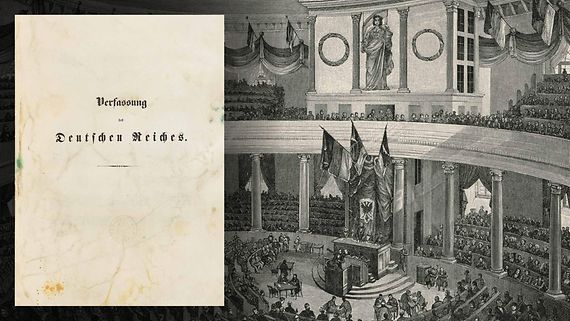
On March 27, I’m invited to speak at the opening of a new exhibition in the Reichstag-building in Berlin. The exhibition addresses one of the major achievements of the 1848/49 revolution: the Imperial Constitution adopted by the National Assembly on 27 March 1849. It’s center piece is the original constitution document itself (one of three originals, actually, but the only parchment version), signed by 405 Members of Germany’s first national parliament.
More information on the exhibition, planned by Klaus Seidl and Hilmar Sack of the parliament’s scientific service, an be found here.
A catalogue is in the making and will be available soon through this link.
[Edit, March 29, 2023]: A short video capturing the ceremony, including a snippet from an interview I gave on the historical significance of the 1848 revolution, is to be found here.
[Edit, May 12, 2023]: A video of my talk is now available online through this link.
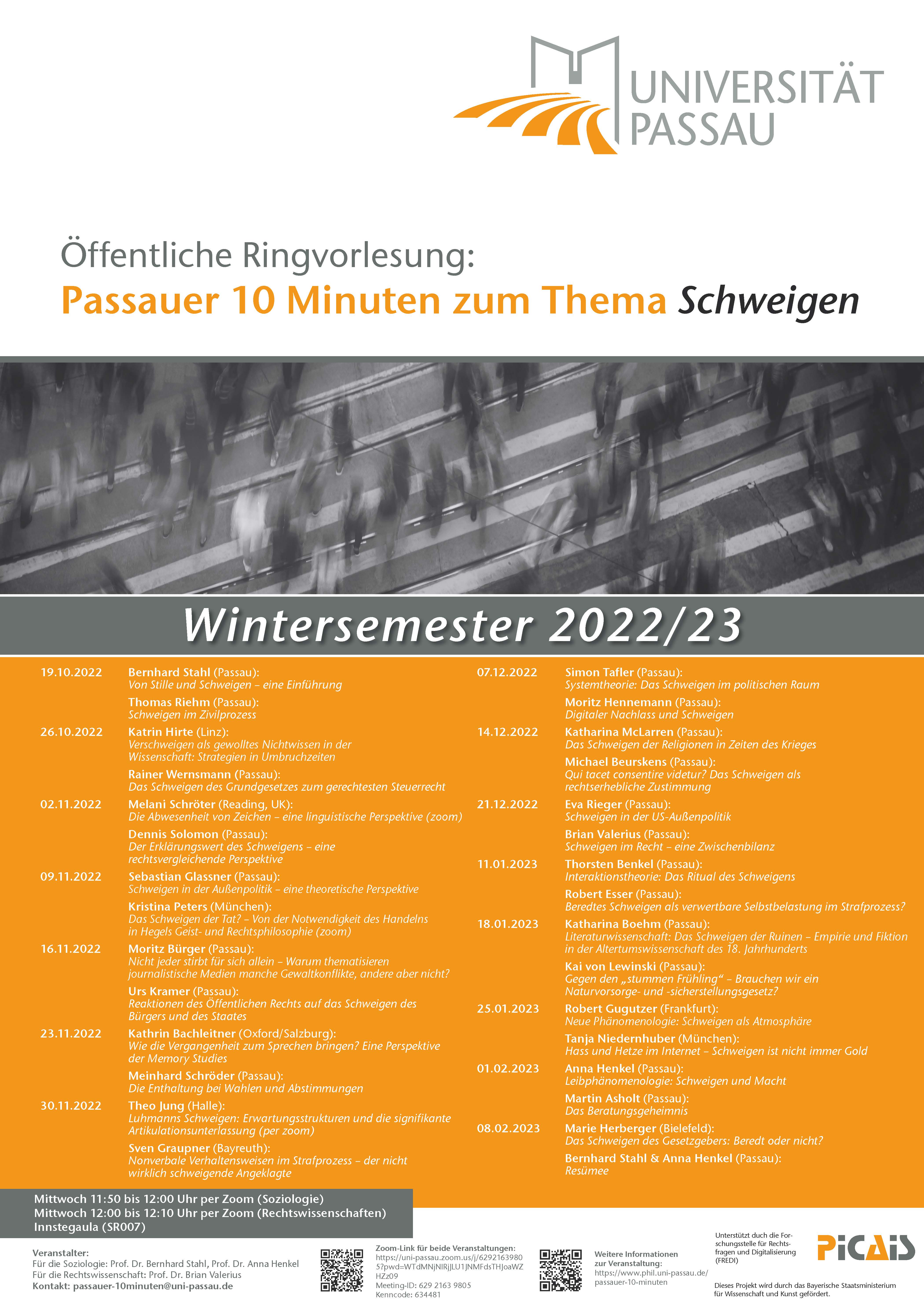
In the coming months, the University of Passau organizes a series of 10-minute lunchtime lectures on silence. Most contributions come from law and sociology, but other disciplines are also represented.
My own contribution on 30 November addresses Niklas Luhmann’s theoretical exploration of silence from the perspective of systems theory and its implications for sociological (and historical) research.
All lectures (in German) can be attended on zoom as well as offline.
[Edit (Feb. 22, 2023): the lectures are now available online on this website.]
On August 18, 6 pm, I’m presenting my research on the first German national parliament and its role in the revolution of 1848/49 at the Cemetry of the March Revolution in Berlin.
Please note that due to expected weather conditions the venue has changed. More information can be found here.
On January 13 and 14, I am attending the conference
Languages, Discourses and Practices beyond the Vote: New Perspectives on Politicization in the Nineteenth Century
which was originally planned in Madrid, but is now held online. The organizers, Oriol Luján and Diego Palacios Cerezales (Madrid), seek to build on recent debates on nineteenth-century processes of politicization, collective mobilization, citizenship-buidling, electoral practices and petitioning.
In my own contribution, titled
Plebiscites on the Streets: The Politics of Public Acclamation in Early Nineteenth-Century Europe
I will discuss the politics of applause, cheering and other modes of vocal support and disapprobation.
Theo Jung (Albert-Ludwigs-Universität Freiburg), Plebiscites on the Streets: The Politics of Public Acclamation in Early Nineteenth-Century Europe
Emmanuel Fureix (Université Paris-Est Créteil), Visual History and Popular Politicization in the 19th Century: Approaches and Proposals (France, 1814-1871)
11.00 Coffee break
11.15 Second Session– Mass Politics? Associations and campaigns
Maartje Janse (Leiden University), Voluntary associations and political participation
Diego Palacios Cerezales (Universidad Complutense de Madrid), Comparative cultures of mobilisation. Transnational Catholic campaigns in the 19th century
12.35 Lunchbreak
15.00 Third Session – Representation and citizenship
Henry Miller (Durham University), Petitioning and representation
Florencia Peyrou (Universidad Autónoma de Madrid), Women, politics and politicization in Spain (1808-1874)
Volker Köhler (TU Darmstadt), A Republican Intermezzo? Changing Perceptions of State and Citizenship in the city of Mainz, 1793-1814
17.00 End of the day
Thursday 14 January 2021
9.30 Fourth Session – Popular mobilisation
Álvaro París Martín (Université Toulouse-Jean Jaurès), Popular Royalism in the Marketplace: Women, Work and Everyday Politics in Marseille and Madrid (1814-1830)
Jordi Roca Vernet (Universitat de Barcelona), Popular mobilization through the National Militia. Cities and liberal revolution
10.50 Coffee break
11.00 Fifth Session – Participation in elections beyond vote
Malcolm Crook (Keele University), Hoarse throats and sore heads: popular participation in elections before democracy
Oriol Luján (Universidad Complutense de Madrid), Political citizens, thanks to or despite the law? The empowered voice of subjects in electoral claims