Feeds:
Posts
Comments

Archive for the ‘Conference’ Category

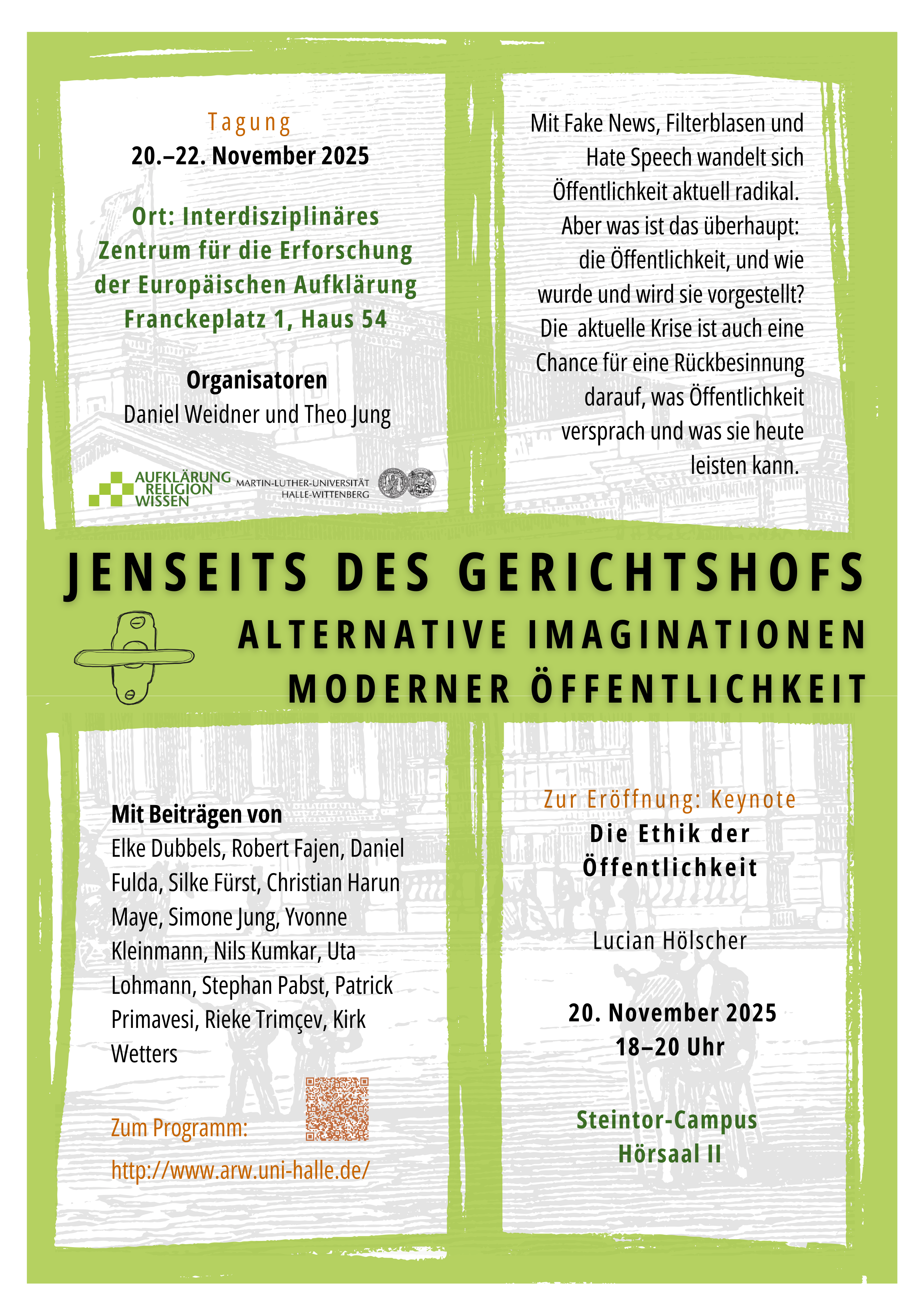
On 20 to 22 November, the yearly symposium of the Martin-Luther-University’s Research Focus “Enlightenment – Religion – Knowledge” will take place under the title

Jenseits des Gerichtshofs: Alternative Imaginationen moderner Öffentlichkeit

(Beyond the Court: Alternative Imaginations of the Modern Publich Sphere)

The symposium has been organized by my colleague Daniel Weidner and myself and will include contributions by

Lucian Hölscher (Bochum), Nils Kumkar (Bremen), Simone Jung (Lüneburg/Halle), Yvonne Kleinmann (Halle), Robert Fajen (Halle), Patrick Primavesi (Leipzig), Uta Lohmann (Hamburg), Christian Harun Maye (Basel), Elke Dubbels (Bonn), Kirk Wetters (Yale), Rieke Trimçev (Halle), Daniel Fulda (Halle), Silke Fürst (Zürich) and Stephan Pabst (Halle).

For further information on the venues and program, see here.


Abstract

In recent years, there has been renewed talk of a crisis of the public sphere. Filter bubbles and fake news, unrestrained insults and cancel culture are discussed as symptoms of decay, disintegration, or dysfunction of the publis phere – although, of course, these debates themselves take place within the public sphere itself. But what, in fact, is this “public sphere”? How de we imagine it, how do we describe it, and what conclusions do we draw from this?

The current diagnosis of crisis offers an opportunity for a critical genealogy, since the sense of crisis may itself stem, not least, from the fact that certain established imaginations of the public sphere have become fractured and questionable. Such a moment invites renewed reflection on what the public sphere was, is, and could be – and may point to traces laid down since the formative period of modern publics that have as yet not been fully pursued.

Read Full Post »

In the context of a two-day workshop organized by my colleague Paulina Gulińska-Jurgiel and myself about methodological developments in the historical scholarship on parliaments, we present a public panel discussion (in German) titled

The Endangered Legislative? Historical and Contemporary Challenges in Dialogue

With our guests

Dr. Claudia Gatzka (Albert-Ludwigs-Universität Freiburg)

Prof. Dr. Thomas Lindenberger (Hannah-Arendt-Institut für Totalitarismusforschung / TU Dresden)

Dr. Danny Schindler (Institut für Parlamentarismusforschung)

we discuss the current state of parliamentary politics against the background of historical crises and developments.

Abstract

With every state and federal election, debates about the state of democracy are reignited. Ardent debates circle around justified fears of far-right parties entering parliaments and the associated risk of the institution being undermined or disempowered. While the legislature is often seen as the last fortress of democratic rule, it also increasingly appears as a fragile construct. But what is its real status today? What can parliaments and the people involved in them actually do against the onslaught of opposing forces? What instruments do they have at their disposal to protect themselves and democracy? Or should we look for alternative formats and ways of democratic representation that go beyond the concept of a legislative as the only legitimate representation of the people, enabling a different kind of social participation without falling into the trap of populism?

The discussion, which is open to all interested (free of charge), takes place in the university’s Aula (Löwengebäude), on June 25, 6 – 8 pm.

Read Full Post »

I’m pleased to announce that together with my colleague Pia Schmüser, I’ll be presenting at the upcoming international conference “Egodocuments from Medieval Codex to Modern Media: Narratives, Presentations, Identities“, which takes place in Vilnius from May 15–17, 2025.

Our presentation is titled:
“Diaries as Alter-Ego-Documents: Constructions of Diaries as a Personified Dialogical ‘Other’ in Late 19th and 20th Century Germany.”

Our talk is part of our broader collaborative work within the research project “Between Voice and Silence: Communicative Norms in Diaries, 1840-1990”, funded by The Leverhulme Trust as a collaboration between the University of Reading, UK, and the University of Halle Wittenberg, Germany, with support from The Great Diary Project in London and the German Diary Archive (Deutsches Tagebucharchiv) in Emmendingen.

The conference, organized by Nicolaus Copernicus University in Toruń, Vilnius University and the University of Lodz within the context of the International Egodocumental Research Group, brings together scholars from across Europe to explore the interpretive potential of ego-documents—letters, diaries, autobiographies, and more—as vital sources for understanding historical subjectivities and experiences. We’re very much looking forward to the exchange of ideas and the opportunity to connect with fellow researchers working on the many voices—spoken and unspoken—of the past.

More about the conference can be found here and here.

Read Full Post »

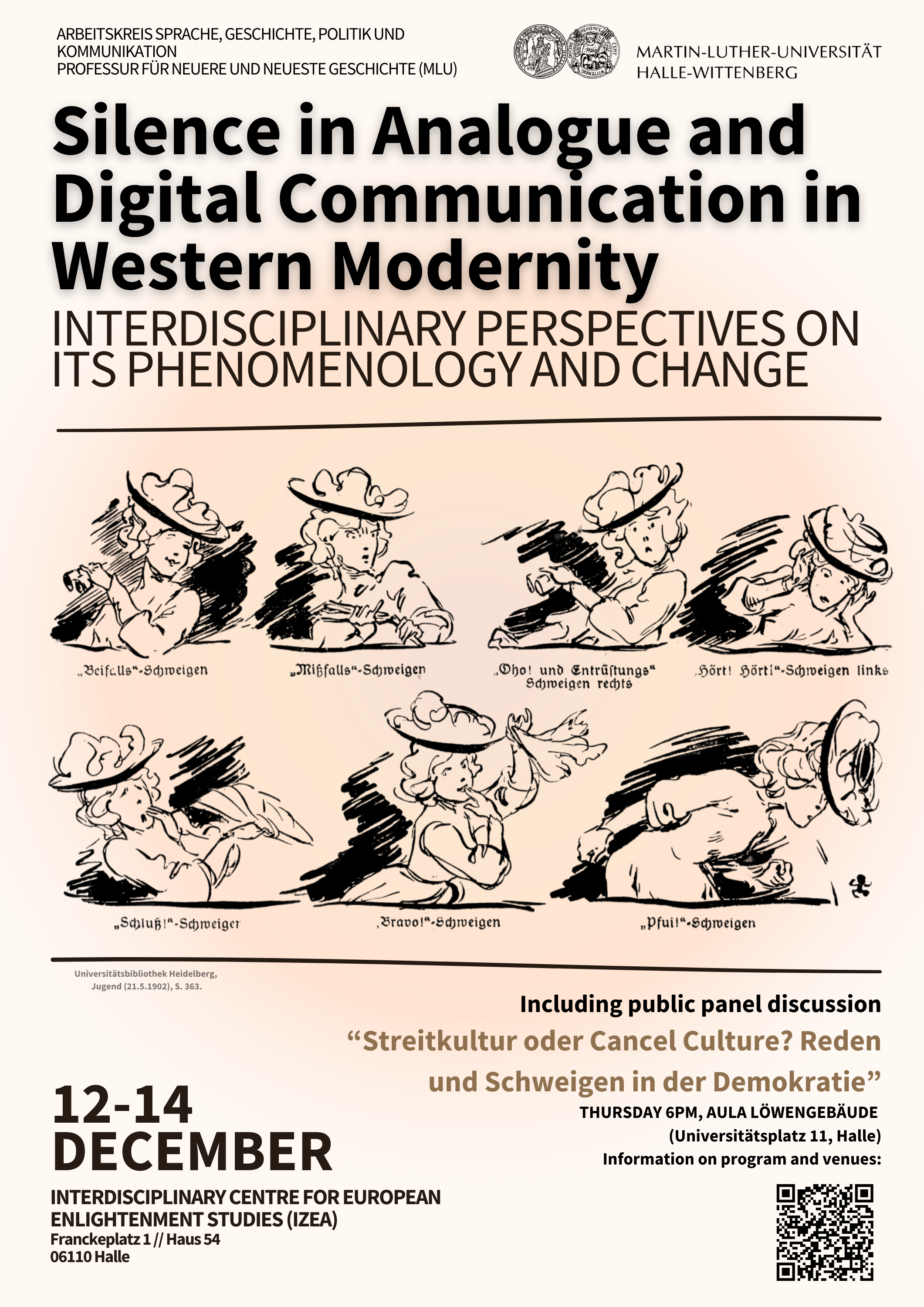
As announced earlier this year, from 12 to 14 December the University of Halle-Wittenberg will host the interdisciplinary conference Silence in Analogue and Digital Communication in Western Modernity. Interdisciplinary Perspectives on Its Variety and Change.

This event is organized by the Arbeitskreis Sprache, Geschichte, Politik und Kommunikation in cooperation with Martin-Luther-University’s Chair of Modern and Contemporary History.

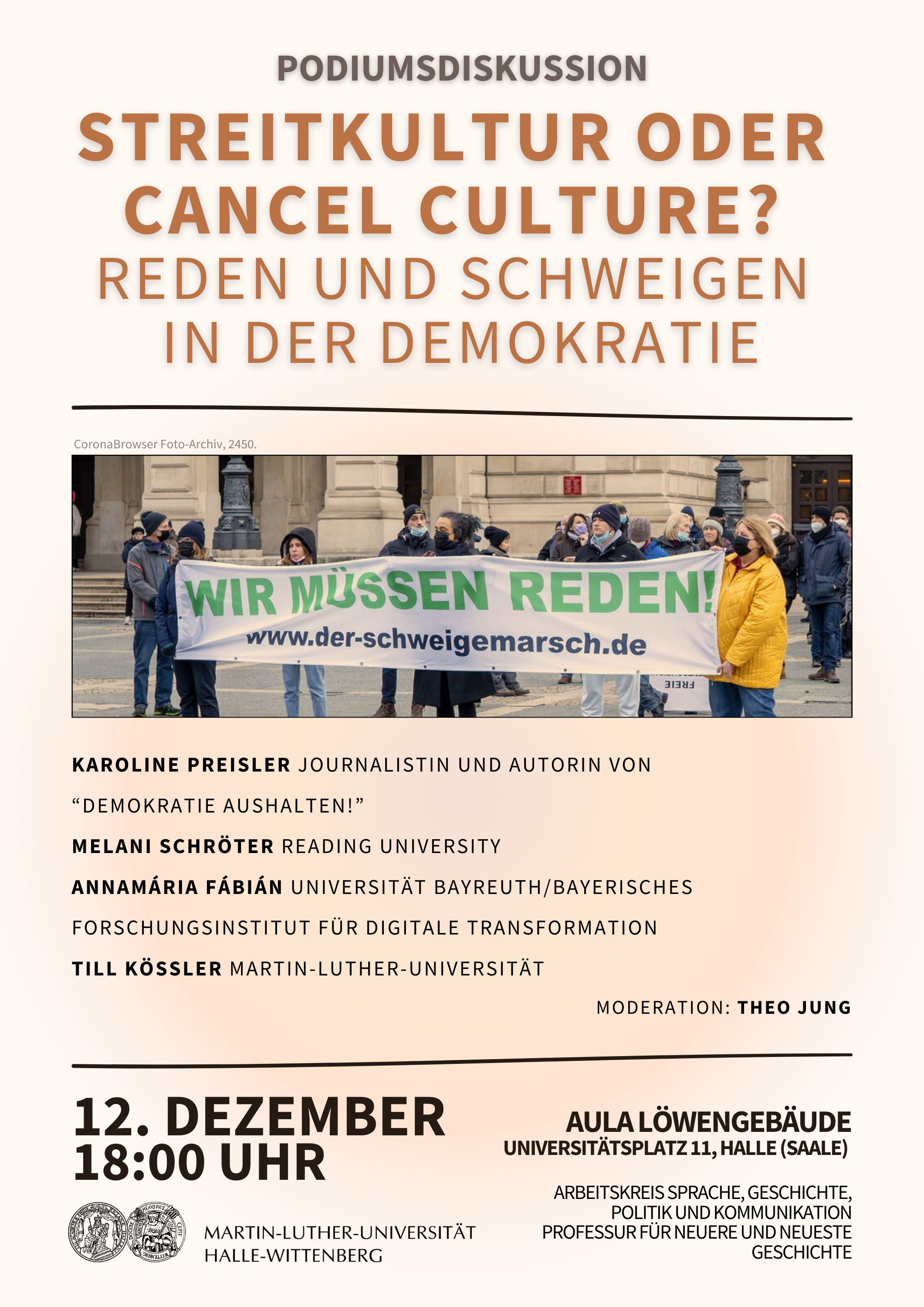
The conference begins with a panel discussion (in German) involving experts from journalism and various academic disciplines, who will tackle the many tensions between speech and silence apparent in current democratic regimes. This event is open to the public and entry is free. It takes place in the university’s main building (Löwengebäude, Universitätsplatz 11).

Many thanks in advance to Karoline Preisler, Melani Schröter, Annamária Fábián, and Till Kössler for their willingness to join in this discussion.

On Friday and Saturday, we continue with a dense program of presentations from the fields of history, literature, media studies, linguistics, memory studies and philosophy. Again, anyone is very welcome to attend one or more of the panels. Please note the different venue for Friday and Saturday: the Interdisciplinary Centre for European Enlightenment Studies, Franckeplatz 1 – Haus 54.

The organizing committee includes: Torsten Leuschner (Ghent), Judith Visser (Bochum), Annamária Fábián (Bayreuth), Armin Owzar (Paris), Melani Schroeter (Reading), Igor Trost (Passau), and myself.

Many thanks in advance to all those participating in the conference, to my co-organizers, as well as to my colleagues at the Chair of Modern History, who have made this possible.

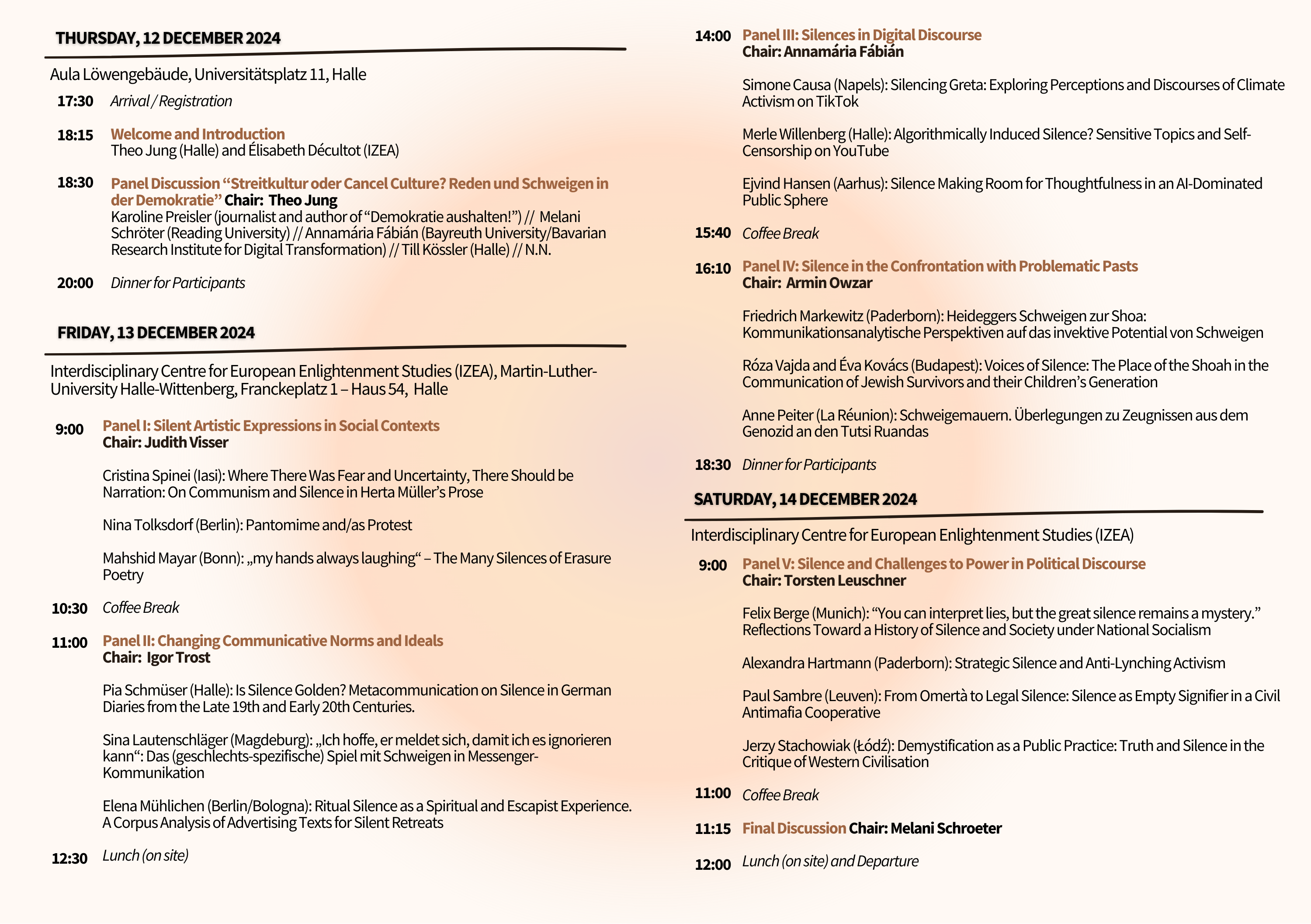
To dowload the program, click here.

Read Full Post »

Silence in Analogue and Digital Communication in Western Modernity. Interdisciplinary Perspectives on Its Variety and Change.

Interdisciplinary Conference, Martin Luther University of Halle-Wittenberg

Halle, Germany, 12-14 December 2024

This conference seeks to explore how changes in the conditions, means, and opportunities of communication in the Western world since 1800 have affected the perception and the evaluation of silence and concealment. Silence is understood broadly as the absence of communication where it could have been expected or relevant, and as encompassing forms of concealment. Our object of investigation is therefore not limited to synchronous oral communication, but includes a multitude of written, oral, and multimodal forms of analogue and digital communication in a broad spectrum of historical and societal contexts.

The relevance of silence as a phenomenon of communication and the changes affecting uses, function and evaluation become manifest in Western modernity in at least five ways:

First, silence is part of an evolving communicative landscape in the constitution of modern societies as literacy increases and mass media develop along with different modalities of mediated communication, digitisation and social media. In this context, increasing production of, and exposure to, communication has led both to rising expectations on communication and to disappointment when expected communication fails to occur.

Second, processes of democratisation have increased the demand for information and transparency and for the inclusive and active participation of citizens in political processes and discourse since the long 19th century. As the volume of public discourse grew and expectations of and demands on communication rose, silence came increasingly to be scandalised. Moreover, refusal to engage in communication and discourse can be criticised as forsaking one’s right of political participation. Even modern dictatorships have to acknowledge expectations of participation and develop processes of pseudo-consensual communication. In turn, refusal to engage can be seen as resistance.

Third, for people with diverse ethnic, ability, or gender backgrounds, the availability of forums for expression and resonance becomes crucial, as members of diverse groups work for inclusion and against silence in analogue and digital communication. However, the very same strategies are being used to increase the acceptance of anti-democratic, exclusionary agendas, alleging a left-liberal hegemony and accusing the mainstream media of stifling freedom of expression and restricting access to discourse for some segments of political opinion.

Fourth, together with increased opportunities of and demands on communication, hopes have risen that communication itself can help solve problems and alleviate conflict. Political dialogue and negotiations, conflict mediation and therapeutical talking cures are designed to avoid or overcome problems, while communicative reticence is seen as an obstacle to achieving this.

Fifth, since the second half of the 20th century especially, social and cultural liberalisation has brought the de-tabooisation of traumatic experience, mental health, bodily functions, gender and sexuality, illness and disability. It would be interesting to investigate how such changes are negotiated in debates about what can(not) be said and in attempts to (re)draw borders of possibility and acceptability.

Papers are invited addressing the themes sketched above (or potentially others) while looking into the uses, functions, perceptions, and evaluations of silence in analogue or digital communication with a view to historical change. Questions such as the following could be pursued:

  • What are the functions of silence in different situational, institutional, and media contexts? How do such functions change before the background of various broader processes of social change?
  • Which societal, political or other consequences arise from controversial debates about the meaning and legitimacy of silence?
  • Which cultural values are associated with silence (and with communication as its implicit counterpart) in analogue and digital communication, and with what implications?
  • In which contexts and at what times do expectations of and demands on communication raise and fall? What consequences does this have for the ways in which silence is evaluated?
  • How do opportunities of communication and silence relate to societal diversity and  inclusion and/or marginalization?

Conference languages will be German and English. Papers will last 20 minutes, followed by 10 minutes of discussion. Please submit an anonymised abstract of up to 500 words (excluding references) via email to silenceinhalle@mail.de by 30 June 2024. You will hear back from the organising committee by the end of July 2024. We are planning to publish selected contributions after the conference.

There will be no charge for registration. Support for travel and/or accommodation expenses may be available for early-career researchers without financial backup from an institution. If this applies to you, please contact us at silenceinhalle@mail.de.

Organising committee: Annamária Fábián (Bayreuth, Germany), Theo Jung (Halle, Germany), Torsten Leuschner (Ghent, Belgium), Armin Owzar (Paris, France), Melani Schroeter (Reading, UK), Igor Trost (Passau, Germany), Stefanie Ullmann (Cambridge, UK), Judith Visser (Bochum, Germany).

Read Full Post »
In April, I will be speaking in Dresden, at the conference “Das Königreich Sachsen 1848/49 – Dynamiken und Ambivalenzen der Revolution” (April 24-26, 2024), organized by Prof. Dr. Susanne Schötz, Prof. Dr. Andreas Rutz and Werner Rellecke.

The program can be downloaded here.

All are welcome and attendance is free.

Conference abstract in German:

Sehr geehrte Damen und Herren,
 
vom 24. bis 26. April 2024 veranstalten die Professur für Wirtschafts- und Sozialgeschichte der TU Dresden, die Sächsische Landeszentrale für politische Bildung und das Institut für Sächsische Geschichte und Volkskunde eine internationale Tagung in Dresden, die sich den revolutionären Ereignissen von 1848/49 im Königreich Sachsen widmet. Niemals zuvor haben sich hier so viele Menschen für Freiheit, Recht und Einheit begeistert wie während der Revolution von 1848/49. Männer und Frauen verliehen ihrem Wunsch nach bürgerlichen Rechten, größerer sozialer Gerechtigkeit und einem vom Volk gewählten sächsischen wie nationalen Parlament auf vielfältige Weise Ausdruck. Sachsen war in dieser Zeit der am dichtesten besiedelte und industriekapitalistisch am weitesten entwickelte deutsche Mittelstaat. Hier hatte sich eine starke Demokratiebewegung entfaltet, zahlreiche Arbeitervereine entstanden und Frauenrechte wurden zum Thema. Doch wie anderswo behielten auch in Sachsen die konservativen Kräfte die Oberhand. Die Tagung spürt den Verflechtungen, Dynamiken und Ambivalenzen des Geschehens aus unterschiedlichen Perspektiven nach. Sie interessiert sich für revolutionäre Karrieren und staatliches Handeln ebenso wie für transnationale und transatlantische Aspekte sowie Formen des Erinnerns und der Revolutionsbewältigung.
 
Die Tagung findet in Präsenz in der Sächsischen Landeszentrale für politische Bildung, Schützenhofstraße 36, 01129 Dresden statt. Das vollständige Tagungsprogramm und den Link zur Anmeldung finden Sie hier: www.isgv.de/tagung1848
Die Anmeldung ist ab jetzt freigeschaltet und noch bis zum 16. April 2024 möglich.
 
Wir freuen uns auf Ihren Besuch!
 
Im Namen des Tagungsteams
 
Prof. Dr. Susanne Schötz

Read Full Post »

As the 1848 revolutions’ anniversary slowly draws to a close, a few more academic conferences on the topic are planned for 2024. I’m participating in two of them.

In April, I will be speaking in Dresden, at the conference “Das Königreich Sachsen 1848/49 – Dynamiken und Ambivalenzen der Revolution” (April 24-26, 2024), organized by Prof. Dr. Susanne Schötz, Prof. Dr. Andreas Rutz and Werner Rellecke. The preliminary program can be downloaded here. All are welcome and attendance is free.

Then in September, I’m participating in the workshop “Freiheit und Gewalt: Politikkonzeptionen und Aktionsformen demokratischer Bewegungen in Europa in der Revolution von 1848/49” (September 26-28, 2024), organized by the Forschungsstelle für Neuere Regionalgeschichte Thüringens (PD Dr. Marko Kreutzmann), the Chair of Western European History at the Friedrich-Schiller-Universität Jena (Prof. Dr. Thomas Kroll), and the Gesellschaft zur Erforschung der Demokratie-Geschichte in Weimar (Dr. Christian Faludi).

More information to follow.

Read Full Post »

On Friday, 21 October, I will be part of the workshop “Ruling the Assembly. Procedural Fairness, Popular Emotion, and the Access to Democracy, 19th-20th Century”, held in the Royal Netherlands Academy of Arts and Sciences in Amsterdam.

The organizers, Anne Heyer (Leiden), Anne Patterson (Nijmegen), and Henk te Velde (Leiden), seek to explore how politicians and citizens in the 19th and 20th century tried to resolve the tension between reasonableness and accessibility of political debate, both in and outside Western European parliaments. Political practices are central to this analysis. What did political newcomers have to do in order to be listened to? What meaning did parliamentary rules have for citizens participating in public political discussions? And above all, how did they develop norms and practices for the conduct of democratic politics? To answer these questions, they develop a political-cultural approach in which the rules of political debate are not self-evident, but rather the subject of an ongoing political struggle about the democratisation of the political system.


Programme

9.30-10.00: Registration

10.00-10.30: Introduction: Two Traditions of Deliberation? Henk te Velde, Leiden University

10.30-11.15: Keynote | Public Politics and Public Spheres in the Making of Democracy, Jon Lawrence, University of Exeter

11.15-11.30: Coffee break

11.30-12.15: The Art of Making Oneself Heard: Political Audibility in and beyond Europe’s Second Chambers in the Late Nineteenth Century, Josephine Hoegaerts, University of Helsinki. Discussant: Maartje Janse, Leiden University

12.15-13.30: Lunch

13.30-14.15: In All Seriousness: Laughter in Bismarck’s Reichstag, Theo Jung, Freiburg University. Discussant: Ido de Haan, Utrecht University

14.15-15.00: Gatherings of Laughter: Public Meetings in the Early Stages of Democratization, Belgium, 1872-1893, Martin Schoups, Ghent University. Discussant: Adriejan van Veen, Radboud University

15:00-15.30: Coffee break

15.30-16.15:  Ruling the Rally in the Name of Democracy: Political Parties and ‘Popular’ Voices in West Germany’s Electoral Communication, 1940s to 1960s, Claudia Gatzka, Freiburg University. Discussant: Carla Hoetink, Radboud University

16.15-16.45: Learning from the Outside: Parliament’s Response to Popular Meetings in Germany and The Netherlands, 1870-1914, Anne Heyer, Leiden University & Anne Petterson, Radboud University

16.45-17.00: Conclusion

17.00-18.00: Drinks


Attendance is free. More information on registration can be found here.

Read Full Post »

Depoliticization before Neoliberalism: Contesting the Limits of the Political in Modern Europe

All too often, depoliticization is reduced to a very recent phenomenon, an effect of ‘Neoliberalism’. In a workshop to be held in Nijmegen on April 1-2, 2022, organized by Adriejan van Veen (Nijmegen) and myself, we aim to place the concept in a wider historical perspective. On the basis of a broad spectrum of European cases from the late eighteenth century until today, depoliticization no longer appears as a monolithic and autonomous process, but rather as a complex bundle of practices and discourses contesting the boundaries of the political sphere.

For further information on the themes and questions we will be addressing, please refer to our call for papers here.

[Edit April 28, 2022: Oliver Weber wrote a detailed report on our workshop for the Frankfurter Allgemeine Zeitung titled “Entpolitisierung. Hinter unserem Deich sind wir keineswegs sicher”. It is available online here.]

Guests are more than welcome to attend, either off- or online (via zoom). Please contact the organizers for registration and further details.

Venue: Vergader- en Conferentiecentrum Soeterbeeck Elleboogstraat 2 5352 LP Deursen-Dennenburg

Workshop Program

Friday April 1

Introduction (9:30 – 9:55) Theo Jung and Adriejan van Veen

Keynote (9:55 – 10:40) Ido de Haan

Panel 1: Timeless Realms: Art and Religion beyond Politics (10:45 – 12:30)
● Tamar Kojman: Constructing an Apolitical Realm after the 1848/9 German Revolutions
● Jan-Markus Vömel: Unpolitical Islam? Stategies of De-Politicization Surrounding Islam in Turkey
● Klara Kemp-Welch: Antipolitics and Art in Late-Socialist East-Central Europe

Lunch (12:30 – 14:00)

Panel 2: Perspectives on Political Abstention (14:00 – 15:45)
● Oriol Luján: Articulating Political Unease in 19th Century Europe: Abstention and Blank Vote as Forms of (De)Politicization
● Adriejan van Veen: Passive Citizenship? Civil Society and Political Abstention in the Netherlands, 1780–1840
● Zoé Kergomard: Depoliticizing “Apathy”? Institutional Reactions to Non-Voting in France under De Gaulle (1958–1969)

Coffee (15:45 – 16:15)

Panel 3: Discourses of Competence and Functionalism (16:15 – 18:00)
● Ruben Ros: Technocratic Anti-Politics in Dutch Interwar Political Culture (1917–1939)
● Koen van Zon: Depoliticisation through Participation? Consultation and Consensus Formation in European Community Policy-Making, 1960s–1980s
● Wim de Jong: Politicizing the Police? The Problem of Depoliticization in the Public History of Democratic Municipal Policing in the Netherlands, 1945–2019


Saturday April 2

Panel 4: Protecting the System from Politics (9:00 – 10:45)
● Mart Rutjes: Depoliticizing the Will of the People: Limiting the Franchise for Political Opponents in the Netherlands 1780–1800
● Stefan Scholl: Doubly Politicized? Semantical Struggles around the Relation between Economics and Politics in the Weimar Republic and National Socialism
● Anna Catharina Hofmann: An Administered Society? Planning and (De-) Politicization in the Late Franco Dictatorship, 1964–1973

Coffee (10:45 – 11:05)

Panel 5: Ruling by Ideas and Dreaming of Rational Government (11:05 – 12:50)
● Matthijs Lok: Moderation and Depoliticization after the Revolution: the Case of the Idéologues
● Eva Visser: Planning the Technate. The Apolitical Politics of the 1930s’ Technocratic Movement
● Jussi Kurunmaki and Jani Marjanen: Ideology, Politicization and Depoliticization in Parliamentary Rhetoric

Lunch (12:50 – 14:00)

Final discussion (14:00 – 15:00)

Read Full Post »


On December 8 and 9, I will attend the conference titled “Unrelating: Infrastructures, Imaginaries and Politics of Disconnection” organized by Timon Beyes, Urs Stäheli, Clara Wieghorst and Lea Zierott of the research project “Disconnectivity: Imaginaries, Media Technologies, Politics”.

Originally, the conference had been planned to take place in Hamburg, but due to current circumstances, it is now going to be held online. While this is sad for all of us who were looking forward to attending in person, it does make it a lot easier for anyone interested in the topic to join. If this includes you, please register at cdcforum@leuphana.de.

In my contribution, titled “Varieties of Negativity: Historical Perspectives on Passivity and Disengagement”, I will present a survey of current historiographical research on inaction, disconnection and related topics, hoping to enrich the theoretical discussion ongoing in other fields of scholarship.

Because of the change of venue, the program is not yet set in stone. The organizers are working on it. Roughly, we can expect the following:

December 8

  • Timon Beyes, Urs Stäheli, Clara Wieghorst, Lea Zierott: Welcome and Introduction
  • Theodora Sutton: Disconnect/Reconnect: Imaginaries and Politics of Digital Detoxing
  • Ana Jorge: Pilgrimage and Dis/Connection
  • Steffen Krämer: Unplugging Audiences: Non-Attention as a Third Mode Between Attention and Distractioon
  • Milan Stürmer: Disconnection by Decree: From Bronze Age Debt Cancellations to Digital Objects
  • Theo Jung: Varieties of Negativity: Historical Perspectives on Passivity and Disengagement
  • Alice Lagaay: DIS*CONNECTION: Responding With Paradox to the Paradoxes of a Network Society
  • Marilyn Strathern: Productive Breaks and Energising Gaps in the Worlds of Anthropology (Keynote)

December 9

  • Martina Leeker: Accept the Gap! Mediocrity for Digital Cultures
  • Nine Yamamoto-Masson: tba
  • Nicole Scheller: Being Invisible: Countersurveillance Strategies in Art and Design
  • Melissa Gregg: tba
  • Nishant Shah: tba
  • Sebastian Gießmann: A Very Short History of Credit Card Fraud

Read Full Post »

Older Posts »