Feeds:
Posts
Comments

Posts Tagged ‘Enlightenment’

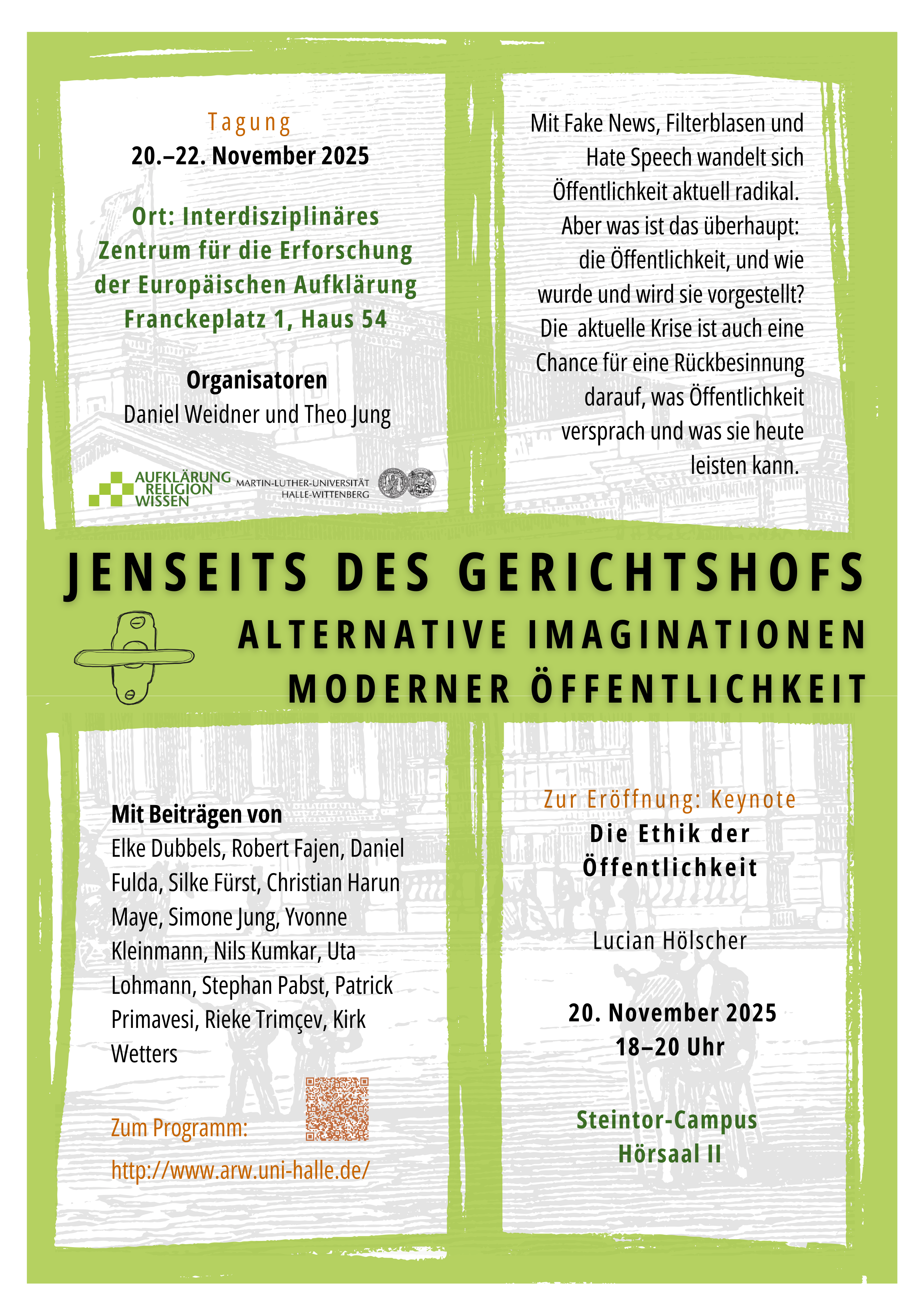
On 20 to 22 November, the yearly symposium of the Martin-Luther-University’s Research Focus “Enlightenment – Religion – Knowledge” will take place under the title

Jenseits des Gerichtshofs: Alternative Imaginationen moderner Öffentlichkeit

(Beyond the Court: Alternative Imaginations of the Modern Publich Sphere)

The symposium has been organized by my colleague Daniel Weidner and myself and will include contributions by

Lucian Hölscher (Bochum), Nils Kumkar (Bremen), Simone Jung (Lüneburg/Halle), Yvonne Kleinmann (Halle), Robert Fajen (Halle), Patrick Primavesi (Leipzig), Uta Lohmann (Hamburg), Christian Harun Maye (Basel), Elke Dubbels (Bonn), Kirk Wetters (Yale), Rieke Trimçev (Halle), Daniel Fulda (Halle), Silke Fürst (Zürich) and Stephan Pabst (Halle).

For further information on the venues and program, see here.

Abstract

In recent years, there has been renewed talk of a crisis of the public sphere. Filter bubbles and fake news, unrestrained insults and cancel culture are discussed as symptoms of decay, disintegration, or dysfunction of the publis phere – although, of course, these debates themselves take place within the public sphere itself. But what, in fact, is this “public sphere”? How de we imagine it, how do we describe it, and what conclusions do we draw from this?

The current diagnosis of crisis offers an opportunity for a critical genealogy, since the sense of crisis may itself stem, not least, from the fact that certain established imaginations of the public sphere have become fractured and questionable. Such a moment invites renewed reflection on what the public sphere was, is, and could be – and may point to traces laid down since the formative period of modern publics that have as yet not been fully pursued.
Read Full Post »

Five PhD positions for researchers from all humanities disciplines are available in the DFG-funded Research Training Group (GK) “Politics of the Enlightenment”, based at Martin-Luther-University Halle-Wittenberg.

Deadline: October 27, 2025.

More information: https://polight.uni-halle.de/en/five-positions-as-research-associates-m-f-d-for-doctoral-studies-available-2/

Read Full Post »

The Research Focus Group ‘Enlightenment – Religion – Knowledge‘ based at the Martin-Luther-University Halle-Wittenberg is offering a 1-year postdoctoral fellowship under the title “Kritik im Widerstreit” (criticism in contest), beginning on October 1, 2025.

The research focus group is dedicated to the historical Enlightenment and its continued legacy up to the present. This includes, not least, the concept of “criticism,” which was first emphatically formulated during the Enlightenment and is currently again the subject of intense debate—particularly with regard to its political implications.

Where does criticism stand today, what is it still capable of, and how must we rethink it? What forms of practice are associated with it, what does it mean in different fields—politics, art, the public sphere—how is it shifting under new media conditions, and what political significance does it have in each case?

Today, criticism itself is under criticism: it is said to be elitist, exhausted, and outdated, to defend particular interests, and to serve self-promotion more than its apparent cause. Particularly disturbing is the fact that critical arguments seem to be easily appropriated by their opponents: Today, prohibitions on thinking are proclaimed in the name of “freedom”; exclusions in the name of “equality”; and questionable dogmas in the name of “criticism”. What remains of criticism if one does not want to abandon it entirely but has given up belief in a “critique of critical criticism” (Marx)?

The scholarship is intended to serve as a means of investigating and discussing political figurations of criticism between appropriation and dismissal together with other scholars involved in research focus group. Applicants should propose an academic project (aimed at publishing an academic article) and, within this framework, organize and host an academic event; accompanying formats such as readings, panel discussions, exhibitions, guided tours, etc. are also conceivable and can be financed with ARW funds.

Deadline for applications is 27 June, 2025.

More information on the fellowship and application procedure can be found here.

Read Full Post »

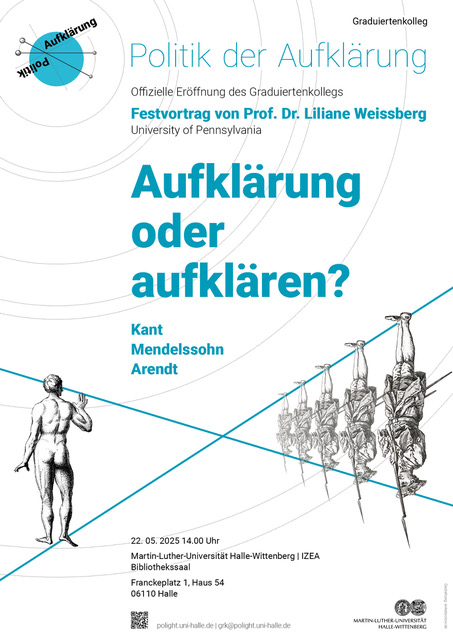
The new DFG Research Training Group “Politics of the Enlightenment”, which has started its work at the University of Halle-Wittenberg with eight doctoral and one post-doctoral researchers this month, will be officially inaugurated on May 22.

Besides various presentations by the Training Group’s members, the university’s rector, Prof. Dr. Claudia Becker, will give an official address. The ceremony is concluded with a key note speech by Prof. Dr. Liliane Weisberg, the Training Group’s first fellow and a distinguished expert in the field of Enlightenment studies.

The ceremony will be held at the library of the Interdisciplinary Centre for European Enlightenment Studies. All are welcome to join us for this festive occasion.

Read Full Post »

In the coming year, a new DFG Research Training Group “Politics of the Enlightenment” will be established at the Interdisciplinary Center for European Enlightenment Studies (IZEA) at the University of Halle-Wittenberg. We are now seeking applications for the first ‘cohort’.

  • 8 PhD positions of 4 years (48 months) each
  • 1 postdoctoral position of 5 years (60 months)

The first cohort will start on April 1, 2025. Two further cohorts of 5 doctoral students each will be recruited in 2026 and 2027. A second funding phase of the Research Training Group of 4 years is planned from 2030.

The application deadline for the first round of applications is November 4, 2024.

Read Full Post »

A call for applications for a new 1-year postdoctoral fellowship program in the context of the Research Group “Aufklärung – Religion – Wissen” of the Martin-Luther-University of Halle-Wittenberg has just been published. It’s deadline is August 18, 2024.

For more information on the project, titled “sites of futurity” (Zukunftsorte) and on the application process, see here.

Read Full Post »

We have received notice that a new interdisciplinary Research Training Group, which I had applied for with a group of colleagues of the universities of Halle-Wittenberg, Leipzig and Erfurt, will be funded by the DFG (German Research Foundation). This means that from 2025 on, PhD students, visiting scholars and other researchers will be developing a wealth of new projects on the global “Politics of Enlightenment” since the eighteenth century.

Calls for application for PhD and Post-Doc positions will follow soon.

The Politics of Enlightenment

The Research Training Group (RTG) examines the politics of the Enlightenment from the 18th to the 21st century. Its approach is twofold: firstly, it analyzes the political claims and interpretations that have been fostered by the Enlightenment or in its name, and, secondly, the political discussions and measures which determines our understanding of Enlightenment that is constantly reinterpreted according to political interests and concepts. The project thus combines the study of the historical Enlightenment—here it relates in particular to recent research which has emphasized the complexity and diversity of Enlightenment movements— with the study of its impact, appropriation, and reinterpretation up to the present day.

Apparently, ‘Enlightenment’ is once again moving to the center of political debates on, for example, the crisis of the public sphere and the disappearance of truth. The historical expansion goes along with a spatial one, as the reassessment of the Enlightenment is no longer a European phenomenon but must be considered in a global context. This spatial widening is paid tribute to by the transnational conception of the RTG and by the inclusion of a postdoctoral position that focusses on issues of Enlightenment beyond Europe. Methodologically, these historically and geographically broad perspectives on the politics of the Enlightenment allow for the fruitful integration of different approaches such as the history of ideas and concepts, social and cultural history, political science and philosophy as well as literature and cultural studies, which is reflected in the team of applicants.

The joint work is oriented towards four thematic axes, which are both central to eighteenth century politics and to current references to Enlightenment: ‘civilization’; ‘public sphere’; ‘secularity’; ‘plurality’. The doctoral students will find a lively interdisciplinary working environment, that provides them with ideal conditions for completing their work. Thanks to its location at the Interdisciplinary Centre for the Study of the European Enlightenment (IZEA) at Martin-Luther-University Halle-Wittenberg (MLU), the Research Training Group will be firmly anchored in Enlightenment research. In addition, the range of applicants’ institutional affiliations link the future doctoral students with two faculties at MLU, the Research Centre Gotha at the University of Erfurt as well as the Institute of Philosophy at the University of Leipzig.

Read Full Post »

9780367427733An article I wrote on the efforts to reform the German language during the late eighteenth and early nineteenth centuries has been published in a volume edited by Susan Richter, Thomas Maissen and Manuela Albertone. Languages of Reform in the Eighteenth Century: When Europe Lost Its Fear of Change, published by Routledge, is based on a series of conferences held in Paris (2014), at the Villa Vigoni (2015) and in Heidelberg (2016). It’s scope is defined thus by the editors:

Societies perceive “Reform” or “Reforms” as substantial changes and significant breaks which must be well-justified. The Enlightenment brought forth the idea that the future was uncertain and could be shaped by human beings. This gave the concept of reform a new character and new fields of application. Those who sought support for their plans and actions needed to reflect, develop new arguments, and offer new reasons to address an anonymous public. This book aims to compile these changes under the heuristic term of “languages of reform.” It analyzes the structures of communication regarding reforms in the 18th century through a wide variety of topics.

My own contribution, titled

Mending the Boat While Sailing:
Languages of Linguistic Reform in the German Territories, c. 1750–1815

traces the ways in which projects of language reform in the German territories were framed. It identifies two different ‘languages’ of linguistic reform dominating debates on the topic from the second half of the eighteenth century to the early decades of the nineteenth: a language of linguistic enlightenment and one of linguistic identity. Despite their common subject matter , their perspectives were fundamentally different. Thus, two competing approaches of speaking about language emerged, presenting contrasting vistas on the German language’s current state, the possibilities of its future reform, and their political and social implications.

My thanks go out to the editors as well as to the co-contributors for their efforts in getting together this wide-ranging volume.

The volume’s introduction, written by Pascal Firges, Johan Lange, Thomas Maissen, Sebastian Meurer, Susan Richter, Gregor Stiebert, Lina Weber, Urte Weeber, and Christine Zabel, can be read online here.

Read Full Post »

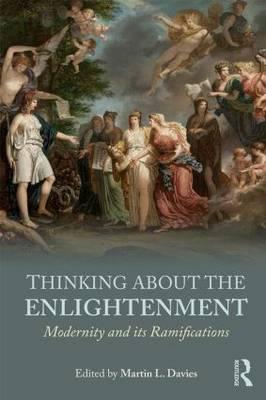
thinking-about-the-enlightenment

The volume Thinking about the Enlightenment: Modernity and its Ramifications, edited by Martin L. Davies of Leicester University has now been published by Routledge.

My chapter,

Multiple Counter-Enlightenments: The Genealogy of a Polemics from the Eighteenth Century to the Present

the penultimate in a very diverse series of perspectives on the various dimensions of the relationship between Enlightenment and the present, takes up the issue of counter-enlightenment(s). It asks how various criticisms of ‘the’ Enlightenment gradually came to be viewed as constituting a singular tradition of thought, constitutive of Western reflection upon or own place in history.

[Edit: The text is now available online here.]

Volume Introduction

Thinking about the Enlightenment looks beyond the current parameters of studying the Enlightenment, to the issues that can be understood by reflecting on the period in a broader context. Each of the thirteen original chapters, by an international and interdisciplinary team of contributors, illustrates the problematic legacy of the Enlightenment and the continued ramifications of its thinking to consider whether modernity can see its roots in the intellectual revolution of the seventeenth and eighteenth centuries.

Drawing from history, philosophy, literature and anthropology, this book enables students and academics alike to take a fresh look at the Enlightenment and its legacy.

Read Full Post »

Some of my writing has been made available online through the Freidoks server at Freiburg University.

Read Full Post »

Older Posts »