For the journal French Studies, I reviewed the volume “Éloquences révolutionnaires et traditions rhétoriques (XVIIIe et XIXe siècles)” edited by Patrick Brasart, Hélène Parent and Stéphane Pujol.

The review can be found online here.
For the journal French Studies, I reviewed the volume “Éloquences révolutionnaires et traditions rhétoriques (XVIIIe et XIXe siècles)” edited by Patrick Brasart, Hélène Parent and Stéphane Pujol.
The review can be found online here.
Posted in Publications | Tagged Book Review, Eighteenth Century, France, French Revolution, Nineteenth Century, Rhetoric | Leave a Comment »
Together with my colleagues Till Kössler and Robert Buch, I’ve organized a panel discussion on the cultural, political, social and philosophical implications of recent developments in the field of Artificial Intelligence. Under the title “Künstliche Intelligenz und das Ende des Menschen?” / “Artificial Intelligence and the End of Humanity?” we have invited
to reflect on the broader significance of this technological shift, which is too often discussed only in terms of euphoric optimism or apocalyptic worries. How does our perspective on ‘humanity’ change against the background of the increasing prevalence of self-thinking machines? The discussion brings different voices
from culture and science into conversation with one another to develop a sharper perspective on what the future co-existence of man and machine might entail.

The discussion is organized in partnership between the Landeszentrale für politische Bildung Sachsen-Anhalt and the Landesforschungsschwerpunkt Aufklärung – Religion – Wissen. Moreover, it is part of the “Transformationslabor Hochschule” which is funded by the Stifterverband der deutschen Wissenschaft e.V.
The event will take place in the neue theater Halle on January 18, 2024 from 7:30 pm. Attendance is free and all are very welcome.
Posted in Presentation | Tagged Artificial Intelligence, Aufklärung - Religion - Wissen, Halle (Saale), Martin-Luther-University Halle-Wittenberg, neues theater, Panel Discussion | Leave a Comment »
As the 1848 revolutions’ anniversary slowly draws to a close, a few more academic conferences on the topic are planned for 2024. I’m participating in two of them.
In April, I will be speaking in Dresden, at the conference “Das Königreich Sachsen 1848/49 – Dynamiken und Ambivalenzen der Revolution” (April 24-26, 2024), organized by Prof. Dr. Susanne Schötz, Prof. Dr. Andreas Rutz and Werner Rellecke. The preliminary program can be downloaded here. All are welcome and attendance is free.
Then in September, I’m participating in the workshop “Freiheit und Gewalt: Politikkonzeptionen und Aktionsformen demokratischer Bewegungen in Europa in der Revolution von 1848/49” (September 26-28, 2024), organized by the Forschungsstelle für Neuere Regionalgeschichte Thüringens (PD Dr. Marko Kreutzmann), the Chair of Western European History at the Friedrich-Schiller-Universität Jena (Prof. Dr. Thomas Kroll), and the Gesellschaft zur Erforschung der Demokratie-Geschichte in Weimar (Dr. Christian Faludi).
More information to follow.
Posted in Conference | Tagged 1848, History, Nineteenth Century | Leave a Comment »
Next Tuesday, November 7th, I am invited to the Villa Lessing in Saarbrücken to hold the Kommission für Saarländische Landesgeschichte‘s annual lecture.
In my presentation titled 1848/49 nach 175 Jahren: Kritische Perspektiven auf eine demokratiegeschichtliche Vereinnahmung, I will address the increasingly ubiquitous framing of the revolution as a “democratic departure”, reflecting on its implications and pitfalls.

All are welcome and attendance is free. The lecture will also be broadcast on Youtube and Zoom (more information on access is available here and here).
Edit: the lecture has now been made available on Youtube here.
Posted in Presentation | Tagged 1848, Democracy, History, Nineteenth Century | Leave a Comment »
For the Jahrbuch zur Liberalismus-Forschung, I wrote an article on the Boulangist Crisis during the French Third Republic.
Building on the work of Bertrand Joly and others, I use the case to develop a fresh perspective on a particular variety of antiliberalism that became prevalent across Europe during the late nineteenth and early twentieth centuries. Framing the political issues of the time against the backdrop of a fundamental opposition between ‘words’ and ‘deeds’, a whole spectrum of political groups began to define their own position in contrast to the image of a ‘politics of mere verbiage’, encompassing a whole range of phenomena, from liberalism and parliamentarism to public discussion and the political press. The Boulangist Crisis, during which a former army general briefly came to political prominence and was generally believed to be preparing a coup against the Third Republic, exemplifies the ways in which contemporaries came to perceive the political issues and conflicts of the time through the lens of the opposition between words and deeds.
The article is available in open access and can be downloaded here.
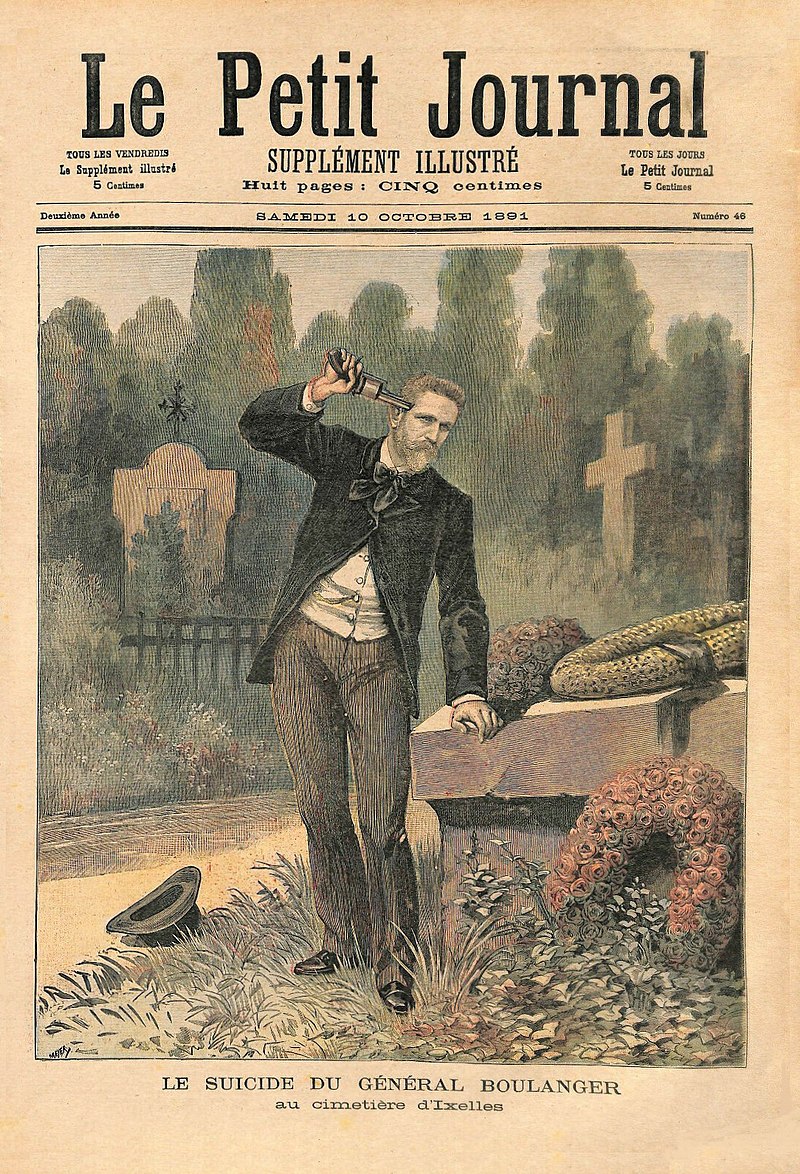
Posted in Publications | Tagged Antiliberalism, French History, French Third Republic, Georges Boulanger, History, Liberalism, Nineteenth Century, Politics, Words | Leave a Comment »
For the German historical platform H-Soz-u-Kult, I wrote a book review of “Werkstatt der Demokratie: Die Frankfurter Nationalversammlung 1848/49”. Written by Heidelberg historian Frank Engehausen, the book presents a monograph-length analysis of the first German national parliament. Besides going into the book’s many strengths, I also try to link it to wider tendencies in the historical engagement with the revolutions of 1848/49 as we are ‘celebrating’ their 175-year anniversary.
The review can be found here.
Posted in Publications | Tagged 1848, Book Review, Germany, History, Nineteenth Century, Parliament | Leave a Comment »
In October 2023, a new research project titled “Between Voice and Silence: Communicative Norms in Diaries, 1840–1990”, funded by the Leverhulme Trust, will be established as a cooperation between the Martin-Luther-University Halle-Wittenberg and the University of Reading.
In this context, we are looking for a Researcher (m-w-d) in part time (80%) for a period of 3 years (EG 13-TVL).
More information on the project can be found here.
The call for applications (in German) can be found here.
Deadline: August 11, 2023.
Posted in Jobs | Tagged Communication, Diaries, History, Job offer, Nineteenth Century, Twentieth Century | Leave a Comment »
[Edit 28 June 2023: The MLU’s department of history has published a short blog on the discussion here. The event was recorded and broadcast by MDR Kultur radio. The recording is available in full here.]
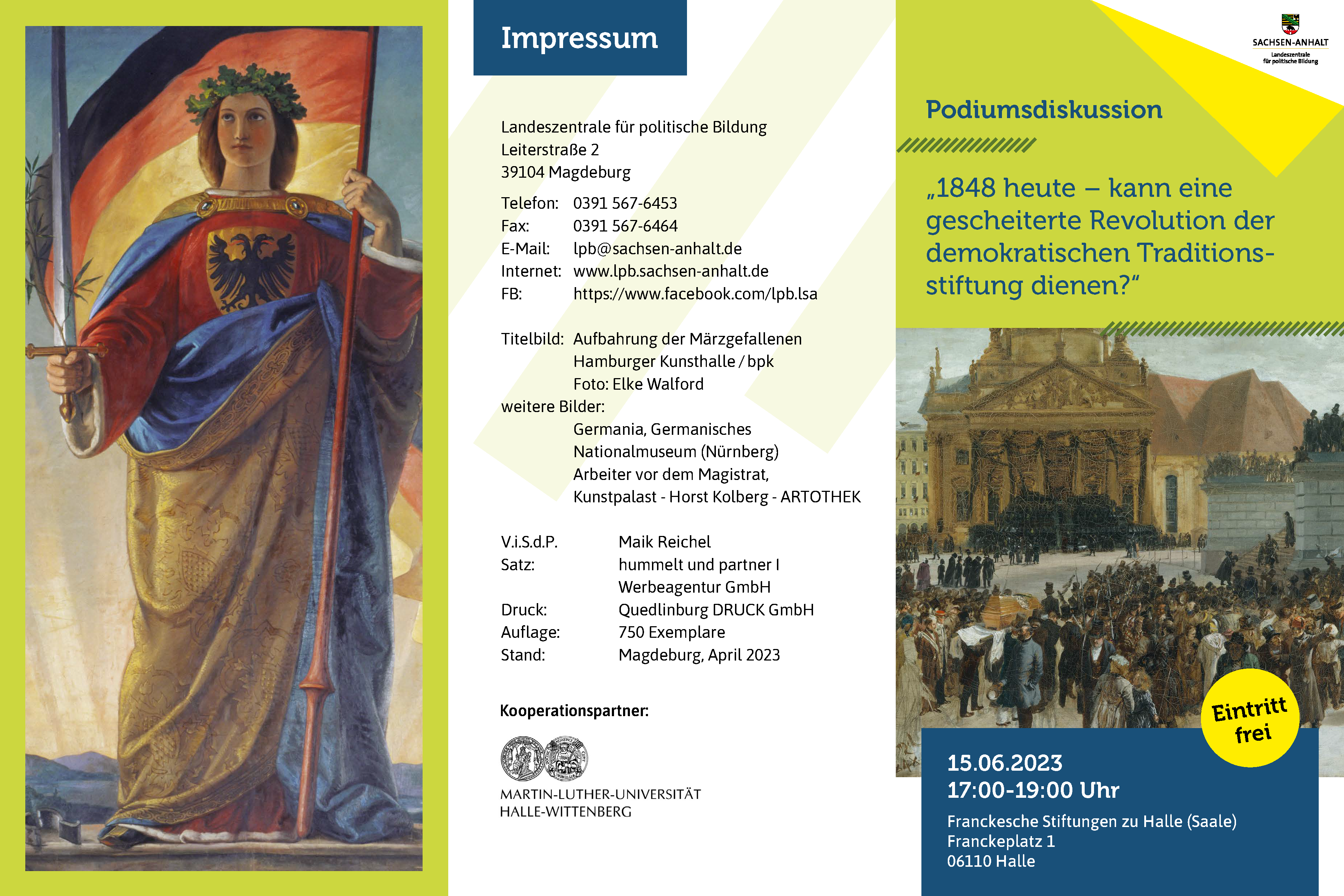
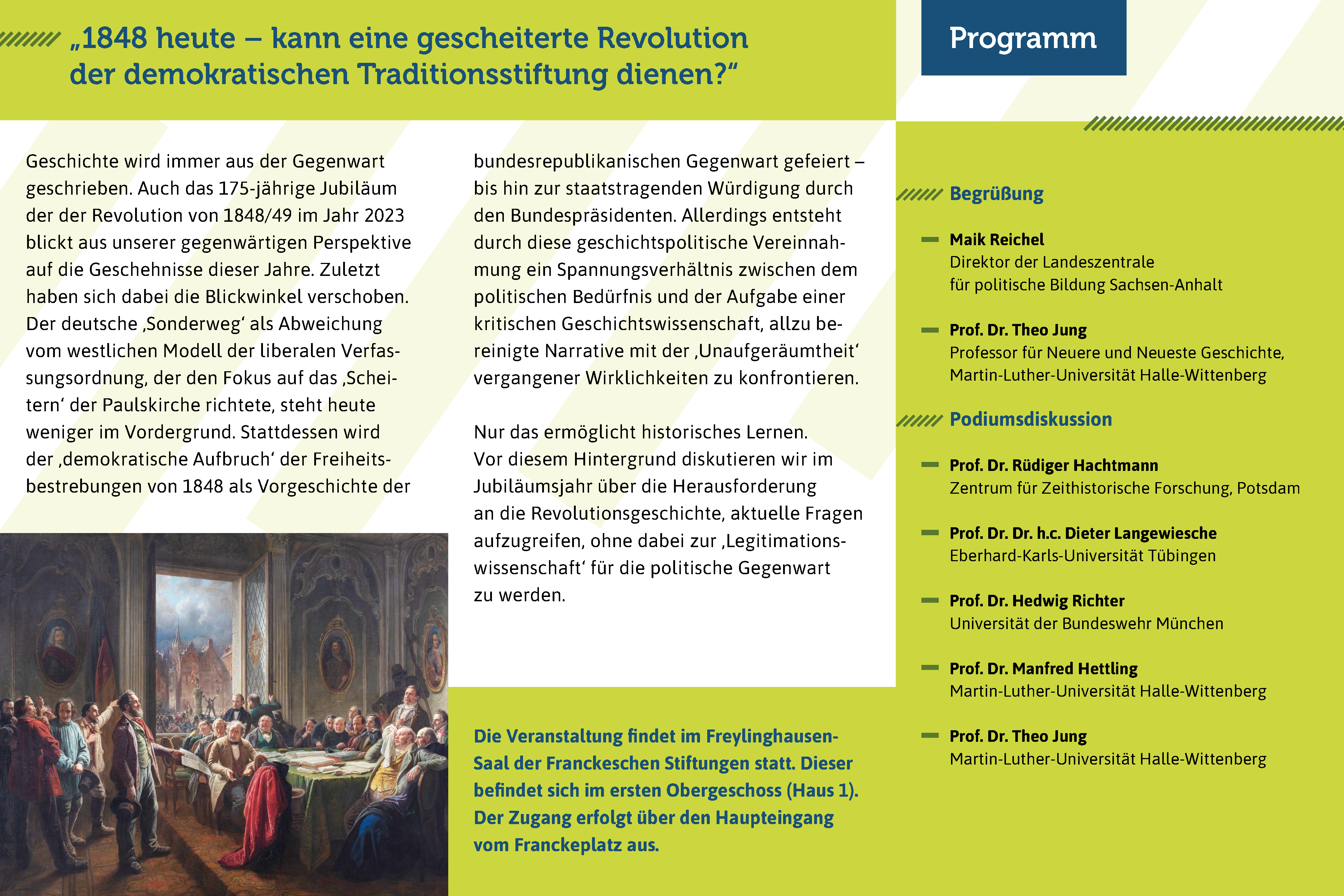
In the context of the 175-year anniversary of the revolutions of 1848/49, on June 15, the Martin-Luther-University Halle-Wittenberg and the State Centre for Political Education Saxony-Anhalt host a public panel discussion on the current significance of these historical events. How can we engage with the revolutions’ legacies without reducing the complexities and ambivalences of this so called ‘milestone’ of German democratic history to a mere opportunity for self-gratulatory contentedness?
Discussants:
All are welcome.
Date: June 15, 5 to 7 pm
Venue: Franckesche Stiftungen, Franckeplatz 1, Haus 1, Freylinghausen-Saal, 06110 Halle a.d. Saale
Funding: State Centre for Political Education Saxony-Anhalt.
Posted in Uncategorized | Leave a Comment »
I received notice that I’ve been appointed to the Advisory Board of the newly established Foundation Sites of German Democratic History (Stiftung Orte der deutschen Demokratiegeschichte).
The Foundation aims to promote consciousness of and public engagement with the eventful and complex history of German democracy in a Eurpean and global context. It was established by the German Bundestag in 2021. It is currently in development and will start its activities later this year.
Posted in Honors | Tagged Democracy, History, Politics | Leave a Comment »
 Theo Jung